Monday, June 26, 2006

Bukowski: Born Into This

“as the spirit wanes, the form appears.”
—Bukowski, “art”

So I watched the dvd of the Bukowski: Born Into This documentary the other night, and I have to say it was amazing. I’ve always liked Bukowski, and probably in the last year or so I’ve even liked him more and have been rereading a lot of his books. Some people still criticize him because of his drinking and so forth, but it really doesn’t matter how much he drank or what kind of image he projected if his writing is good, and his best work only seems to increase in greatness over time. Virtually nobody could write so simply, so spare, yet pack language with meaning, beauty, and ugliness. It looks deceptively easy, which is why most of his imitators come off as such rank amateurs.

So really there was no way I wasn’t going to like this film, unless the director John Dullaghan turned out to make some sort of major mistake – but he didn’t. He uses all kinds of great footage, from different time periods, in color and b&w. It’s moving photographs, juxtaposed with texts and readings and interviews, films within films, a solid, classic documentary style. The pacing was perfect. Even the use of “sincere” U2 frontman Bono worked out alright; it was done sparingly and tastefully, and he didn’t seem pompous at all here. Of the other famous interviewees, Sean Penn was really good. Of poets, it was especially nice to see Jack Micheline. (I wonder, though, why the “sexily” posed model photoshopped into the picture on the cover?)

I liked the ongoing segments of Bukowski driving around East Hollywood in a beat up VW Bug with a cracked windshield, filmed on what looks like early videotape, and he’s got an Iron Cross hanging from his mirror to remind himself of his German heritage. The scene of him in the bathroom of the house he grew up in, demonstrating how his father used to beat him, and the way it was framed looked like Kubrick. Bukowski crying as he reads the poem “the shower” was a sudden shock, heart-wrenching actually.

The scene from the Barbet Shroeder tapes where Bukowski semi-attacks his girlfriend (later wife) Linda Lee is unflattering, but it was good to know that there was no whitewashing going on in Born Into This. I had seen this segment before and was wondering if it was going to be in. It had to be, and it was. And the other side of all of that is here too – the Bukowski who could write “the bluebird.” But I think another thing his detractors dislike is the cult of personality involved, the autobiography. I suppose for some people it forces it to be an issue of whether you like the man you perceive Bukowski to be, and some just don’t. Fair enough. But I certainly would’ve had a drink or eight with him if I’d had the chance. This film isn’t quite like being there, but that’s not what is required. It is “like” watching a really good documentary.

Wednesday, June 21, 2006

Geoffrey Squires, Lines (Shearsman)

Shearsman has recently published Geoffrey Squires’ new poem Lines as an e-book (available for free by navigating the previous link). I personally have been pretty dubious about e-books, preferring the feel of the real printed book, as physical object, the crispness of the page, the smell of the paper and binding, and all of that. But this is one publication which is really suited to the format, so much so that I think something would be lost if it were not read onscreen in PDF form. When you set it up in the Single Page view, fitted to your screen, it almost seems like the lines (the title is apt) shoot across the page, and the effect is great.

The lines themselves are sentence fragments which seem to fall back on each other, echo themselves, sometimes becoming two, occasionally three or four. I could almost liken it to sculpture. They are sculpted, meant to be seen with the eye just as much as they are meant to be read with the brain. But the chopped-up construction makes the brain take them in differently than it would in reading “regular” poetry.

I can’t say that I understand what it all means, and probably it doesn’t mean much in the literal sense because what we are presented with is essentially detritus, what is left of sentences when they are broken into their constituent parts, with many of the less pertinent words discarded. But what seems to be going on is that Squires is somehow trying to break through to the structure of language, rather than using language to describe an idea, or descry an image, etc. At the same time it is poles apart from the more nonsense aspects of some experimental/avant-garde poetry out there, and maybe surprisingly to some it is quite pleasant to read. To give a short quote would not do the work justice, so I highly recommend checking it out for yourself.

Friday, June 16, 2006

Bloomsday, 2006

“Now have thy children entered into their habitations. And nationglad, camp meeting over, to shin it, Gov be thanked! Thou hast closed the portals of the habitations of thy children and thou hast set thy guards thereby, even Garda Didymus and Garda Domas, that thy children may read in the book of the opening of the mind to light and err not in the darkness which is the afterthought of thy nomatter by the guardiance of those guards which are thy bodemen...”
FW, 258

Sunday, June 11, 2006

Catherine Walsh, City West (Shearsman Books)

Catherine Walsh’s City West (2005) is one long poem, composed of three sections. Before turning to the book itself there’s some background which I’d briefly like to discuss. Recently I was pleasantly surprised to see that my article about “the Wild Honey poets” was hyperlinked in a post on Robert Archambeau’s blog. Archambeau has written about certain experimental Irish poets, Catherine Walsh among them, in his essay Another Ireland (1997). My piece (which I published in The Burning Bush 5, Spring 2001) dealt with many of the same writers. Archambeau’s recent blog post challenges the myth that British poets are generally conservative and eschew experimentalism, and he also here mentions “a similarly pervasive myth about Irish poetry.” I published my article over five years ago, at a time when Irish experimental poetry was really not as well-known as perhaps it may be today, and I was to an extent echoing Archambeau’s own Another Ireland article where he identified a conservative Irish “nationalist-regionalist tradition” and wrote that “Irish experimental poets...have survived in the shadows of near total obscurity, with virtually no support from the institutions of Irish literature...” Before Trevor Joyce’s with the first dream of fire they hunt the cold was published in 2001, and almost universally fêted, a majority of readers in Ireland were still largely ignorant of any such experimental movement, though it has been there for a long time, as both myself and Archambeau before me wanted to show.

Catherine Walsh is one of the loosely associated group referred to above. Her earlier work, Idir Eatortha & Making Tents (1996), is much heralded in certain circles but probably less well-known to a wider audience. The new book, City West, is a powerful confirmation of her talents, yet the current blurb on the hardPressed poetry site (a quote from Tim Allen of Terrible Work) still kicks against the pricks, the pricks in this case being the “institutionalised avant websites etc.” more than the mainstream institutions that Archambeau was concerned with. Perhaps, as with Trevor Joyce and Randolph Healy, it will take a “Collected Poems” before Walsh becomes more widely read even by “avant” audiences. But to be honest, her poetry is probably not for everybody – it can be difficult and obscure. Too many people are afraid of obscurity, apparently don’t have confidence in their own powers of cognition, and shrink from the work involved in trying to read someone like Walsh. So I wonder if maybe the attempts to popularize “experimental” poetry in this day and age, be they Archambeau’s, mine, or anyone else’s, are ultimately limited by this fact. Should anyone be worried about it at this point?

In any event, you certainly can’t approach Walsh the same way you would a lot of familiar, (let’s say) lyrical poetry. She works in long, open forms instead of self-contained poems. Rather than declaiming, she constructs her work as if with building blocks. Except these blocks are not physical objects, but words which represent ideas or syntactical units of language. Not unlike Healy in this sense, Walsh’s poetry is scientific, a poetry of inquiry. This is most evident in the second section of City West, “Tangency,” in which for example she writes,

      problem thinking
      knowledge

      due process leading circulatory
      thought deemed consequential

      knowledge
      grinding halt

      should one place be better to stop
      than another [...]

      why should stopping
      not involve another part
          of due process...


Other times her writing is a dense wordscape, approaching the way that an abstract filmmaker like Stan Brakhage might employ quick cuts and flowing successions of images:

      arresting thought forensic
      pile         glitter far out
      on ocean                   migrating
      dissolution       removal       resolution
      placement       sensational fare
      on             ah here get off of that
      arrested       thought       frantic
      pine       bitter forgotten
        what


Sometimes Walsh strips it down to a series of single words whose relations to each other are not immediately apparent, and where the real purpose might be in the patterning on the page, the effect gleaned in the act.

“City,” the first section of the book, I found to be somewhat more immediately accessible, you might even say playful. On p. 10 she juxtaposes two columns of similar but slightly different poems, versions implying other versions, also implying that other sections could equally have their own alternate (but here unwritten) versions. Finitude is undermined. Elsewhere (pp. 17-19, for ex.) rhythm is to the fore (it would be interesting to hear this section read out loud), and the reader will also discern scenes of teenage revelry and the stark underside of the city. But more so than the actual scene or remembrance, it is the process of perception and memory that concerns Walsh: “static unreal knowing / another memory linking / experiencing dreaming no / knowing knowing knowing...”

Section three is “Plane,” where this process of perception is further scrutinized, an overt awareness on Walsh’s part of the book medium:

      the time I really thought I was writing
      ‘a book’ that got to me more than any of the
      knowing full well who knows I thought
                  cant
            recant

I really liked pages 66-69, about the city and the night – the phrase “anarchy of the flesh” is great – and then the overheard fragments of speech and the unmistakable Dublin accent: “hey you how woz?...” A passage in Irish which comes toward the end, apparently co-opted from elsewhere, seems to be an ironic statement of intent: “léiriú atá I [sic] gcuid de na scealta seo ar / an teannas idir an seandearcadh / dúchasach agus an meon nua-aoiseach...” (“many of these stories focus on the / tension between traditional native ideas / of the world and more modern ways...”). As City West closes, the tension between the writer and a putative audience surfaces with Walsh jokingly imagining the compliments – “(we liked your story so / much” – and then proceeds to sign off: “had a lot of fun / but it’s time / to go...” The little interplay of voices here is a nice touch. What a great book. I look forward to her next release, and hopefully someday that “Collected.”

Wednesday, June 07, 2006

Longhouse review

Bob Arnold has written a very nice review of Mercury, the Dime, on the Longhouse site. It appeared in March, but I only discovered it just now. Since it’s so short, I hope they won’t mind if I copy and paste/post it below:

WOODBURNERS WE RECOMMEND:
Michael S. Bengal [sic], Mercury, the Dime (Six Gallery www.sixgallerypress.com) : a highly attractive, pocket-size glossy marvel of a book, with poems to sweep you up from a San Francisco early 90s feeling in an era more Sandburg than anything Beat. A sure footed Americana celebration, “Past the Western frontier / lay the Great Plains, / multitudes of Americans—” I always love a poet who loves his country in Whitmanesque multitudes.
~ © Bob Arnold
March 5, 2006

Thursday, June 01, 2006

“Is fada liom oíche fhír-fhliuch”

Following on from my previous post, here is my own translation of Aodhagán Ó Rathaille’s “Is fada liom oíche fhír-fhliuch” (c. 1710), which was published in the Summer 2002 issue of Translation Ireland. The poem has been translated many times before, including by Thomas Kinsella, and Michael Hartnett, and I don’t claim to top them. I will say that translation is in many respects arbitrary, the subjective way that one person might render another’s poem into a different language, at a given time. Kinsella’s version of the first line and title as “The drenching night drags on” (in An Duanaire/1600-1900: Poems of the Dispossessed) is probably the best – but I like “sopping night” too. As with Kinsella, I have not attempted to replicate the metre of the original poem, which would most likely come off seeming artificial in English. Every strategic decision implies a trade-off, however. The above photo is Muckross Abbey, Killarney, where Ó Rathaille (†1729) is buried.


Aodhagán Ó Rathaille

This Sopping Night
(translated from the Irish by Michael S. Begnal)

This sopping night seems endless—sleepless, snoreless,
without cattle, means, sheep stock or horned cows;
a storm on the wave nearby has unsettled my head,
and I was not raised to eat dogfish or cockles.

If he still lived, the patron king from the banks of the Laune,
with his following by his side—they would understand—
and if he still held sway in that gentle, sheltered, harboured haven,
my poor people would not stay in the bleak district of Duibhne.

MacCarthy, strong and ferocious (who despised fraud),
MacCarthy of the Lee (imprisoned without parole, enfeebled),
MacCarthy, king of Kanturk (in the grave with his family)—
there’s desolation in my heart: no sign of them at all.

My heart withers in my chest, my body weakens,
those heroes were never stingy whose right it was to rule
from Cashel to Clíodhna’s Wave and over to Thomond,
their towns and their lands have been plundered by foreigners.

O high wave down there roaring loud,
my mind is overwhelmed with your screeching—
if help were ever to return to bright Ireland
I’d shove those bitter howls right down your throat!

Thursday, May 25, 2006

The Hidden Ireland: a reading

I have recently been reading Daniel Corkery’s The Hidden Ireland (1924), his account of Gaelic civilization and poetry in 18th c. Munster. In all my reading of Irish material, I had never got around to this book before, though I am well familiar with some of the poets Corkery deals with – Aodhagán Ó Rathaille, Eoghan Rua Ó Súilleabháin, et al. With all the knocks Corkery has taken from revisionist historians (e.g. L.M. Cullen) for supposedly being narrow or backward-looking, I suppose I had almost believed that The Hidden Ireland would indeed be everything its critics have said. Or not said. To use one example, in Mere Irish and Fíor-Ghael: Studies in the Idea of Irish Nationality, its Development and Literary Expression prior to the Nineteenth Century (1996), Joep Leersen barely gives Corkery a mention (except to dismiss him for being a Gaelic League nationalist), when The Hidden Ireland is such an obvious precedent to Leersen’s own work. In fact the two books deal with largely the same time period, the same themes, and much of the same material. Does Leersen really feel that Corkery can be so safely ignored? Without taking too much away from the impressive qualities of Mere Irish and Fíor-Ghael – apparently he does.

To be fair, Leersen draws more from contemporary source materials for the bulk of it than he does from more recent criticism, relatively speaking, but one big influence he does acknowledge is Foucault. “Foucault,” Leeresen says, “has questioned the traditional generic divisions between literary, historical and scientific texts,” and this multi-genre approach is central to Mere Irish and Fíor-Ghael, as well as to imagology as a wider discipline (“the imagologist,” Leersen explains, “studies the textual expression of an image, and the historical context of its textual expression, rather than its pretended reference to empirical reality”). Yet, in part, this is exactly what Corkery was doing 80 years ago. Primarily a study of Gaelic poetry and poets, it also draws on the history of Lecky and others, the memoirs of Clanricarde and others, the essays of Romain Rolland among others; and the list could go on. It is an attempt to place the poetry in its historical context, but also to focus on aspects of Irish cultural history which had theretofore been ignored. Corkery was of his time, as we all are. Patrick Walsh offers an eminently sensible corrective to the revisionism of Cullen (a “revision” of revisionism?) in his article “Daniel Corkery’s The Hidden Ireland and Revisionism” (2001), in which he points out, “The Gaelic League was not wished into existence by romantic nationalist ideologues, but resulted from the unique conjuncture of the political, social, historical, economic, and linguistic conditions of Ireland at the turn of the century.”

I am not trying to offer a defense of nationalism as such here. I think nationalism can be progressive, and a useful strategy in a liberation struggle – as it was for Ireland – but it can also become a conservative straight-jacket – as it was for Ireland later, when the aims of Pearse and Connolly were subverted to the strictures of the Catholic Church and isolationism. But can’t the nationalism of a small, oppressed country still be a bulwark against the homogenizing imperialism of oppressor nations? For these do still exist in a very real sense. (Perhaps nationalism is not even the correct word anymore, because it can also imply exclusion, which is not my intent at all.) In asking this question, I am also familiar with Manuel De Landa’s spectacular book A Thousand Years of Non-Linear History (1997), where he writes:
First, although it is true that nation-states swallowed their minorities and digested them by imposing national standards for language, currency, education, and health, the solution is not simply to break up these large sociopolitical entities into smaller ones....To simply increase heterogeneity without articulating this diversity into a meshwork not only results in further conflict and friction, it rapidly creates a set of smaller, internally homogeneous nations. (Hence the balkanization of the world would increase heterogeneity only in appearance.)
At the same time, I can only agree with Corkery in his introduction to The Hidden Ireland: “After all, all that aptness in mechanism means control of force; it is natural. What is not natural is that ‘progress’ should spell ‘uniformity.’ If those whose very dreams have become mechanical still see any use for the arts, it can only be that they pay lip-service to old saws. How anyone who cares for literature can bear to see a language, any language, die is a thought beyond us.”


James McCloskey’s study of the Irish language’s current situation, Voices Silenced: Has Irish a Future? (2001), is also framed in anti-nationalist terms (do I sense a trend?). Nonetheless, McCloskey’s thesis is indisputable to anyone but the most banal of fascists. “The effort to support Irish,” he asserts, “is in fact one strand, or ought to be one strand, in an international effort to open cracks, however small, in the dreary homogeneity of culture and ideology created by global capitalism.” My impression is that the point of Corkery’s nationalism was not to make English-speaking Irish people feel belittled, embarrassed, or threatened, but to arrive at a place where the Gaelic language and culture would no longer be threatened either. That is, a state of mutual respect. Or perhaps, in De Landa’s terminology, a “meshwork.”


Today, with European integration becoming ever more drawn, and the effects of globalization more and more tangible, many of Corkery’s arguments are oddly relevant. While his attack on Renaissance modes of art might seem in a sense anti-modern at first glance, what he was really trying to do was make a case for multi-culturalism and idiosyncrasy: “Caught up at second-hand into the art-mind of Europe – thus becoming international, their effect was naturally to whiten the youthfully tender national cultures of Europe. That is, the standards of a dead nation [Greece, or the Renaissance image of Greece] killed in other nations those aptitudes through which they themselves had become memorable.” Just look at the current euro currency notes, with their bland representations of “European” architecture, but which actually depict no real individual buildings. Corkery shows how the poetry of an Ó Rathaille still carries an intensity and power lacking in the Renaissance-influenced art of his (Corkery’s) day.


Now, James Joyce (for example) would probably have a different outlook on contemporary European art, an outlook that Corkery did not engage with. Nonetheless, aspects of Corkery’s view of the Gaelic poets have at least something in common with 20th c. modernism. Of Ó Rathaille, he writes, “His themes are scanty: one might, indeed, say he had but two; the first, Ireland and it broken...the second, himself, broken too; and sometimes these two themes become one....But in a lyric, the question of theme must ever be of small moment, the method of treatment being so nearly everything.”


To my mind, The Hidden Ireland is far from being a parochial or inward-looking work – in fact Corkery highlights Irish Gaelic links with the Continent (even while Ireland was suffering under the worst of English oppression), draws comparisons between Ó Rathaille and Whitman, Ó Súilleabháin and Villon, and highlights the teaching in the bardic schools not only of Irish, but also Latin, Greek, and English. Instead, this book is a defense of literature, of education, of multi-culturalism, and of multi-lingualism. It is not only a means of access to some of the greatest poets which any language or culture has ever produced, it is a dynamic reproof of the “whitening” forces that still surround us at least as much if not more than they did in Corkery’s time.

Tuesday, May 16, 2006

Encyclopedia Destructica


Thought I would let everybody know that the new issue of Encyclopedia Destructica is now out. It’s the first number of its second volume (“Bumba”), guest-edited by John Thomas Menesini, and comes out of the city of Pittsburgh. I am interviewed in it, and have two poems included as well. This is a really good magazine – it’s hand-assembled and bound, with the title sewn right onto the cover – which makes for an interesting little objet d’art in itself, aside from the contributors it comprises. (The others are Che Elias, Spat Cannon, Tait Johnson, Nikki Allen, Selena Orkwis, and Joseph L. Flatley with an essay on Superman as cultural trope. Menesini’s introduction is in the form of a confessional poem. The visual artwork is by Ben Hernstrom and Joana Ricou. All great stuff.)

Encyclopedia Destructica is well worth acquiring, and I don’t say that just because I am in it. I’ve been digging it ever since my contributor copy arrived this past week. Although I don’t think their website has yet been updated to reflect the new issue, at least as of this writing, check it out anyway here (it’s actually a cool site regardless, and will probably be updated any day now, and gives contact/ordering info). Part of the mission is “to raise awareness of the Pittsburgh contemporary art culture,” and this publication is a glimpse of what’s going on in Warhol’s home town, the Iron City. Encyclopedia Destructica is also one of the coolest titles ever. (Click on the photo for larger than life detail!)

Thursday, May 11, 2006

Long May Federman Rot

Long May Federman Rot: A Review of Raymond Federman’s More Loose Shoes and Smelly Socks (Replenishment)

This review cannot but be extremely subjective. Before reading this book I was unfamiliar with Raymond Federman as anything other than a name, often associated with Samuel Beckett – the two were apparently good friends, and Federman has published Beckett criticism and so forth. But I had previously read nothing of Federman’s work. Therefore I am not in the position to review this volume in relation to his wider oeuvre and am in a sense reading it in a void, taking it strictly on its own terms without the context of his other work. I should also point out that Replenishment is an imprint of Six Gallery Press, which has published two small volumes of my own. Disclaimers thus set on the table, we turn to the book itself.

More Loose Shoes and Smelly Socks is a collection of odds and ends: short prose pieces, poems, manifestoes, which apparently did not fit in to any of Federman’s other publications. It is a chaotic mix, but this fact is not especially off-putting. What does add to the chaos, unnecessarily perhaps, is the lack of pagination and a table of contents, and the deliberate use of a hodge-podge of different font styles and sizes. I am told that the author intended the book to look as if it had just rolled out of his computer printer, unedited, and in this he has succeeded. Federman puts himself across as something of an avatar of postmodernism, and he wants the reader to be overtly aware of the medium as such – these are printed words, formatted on the computer screen, and don’t forget it! So in the poem “The Central Place,” the author, hyper-conscious of language even down to punctuation, writes,

this is a curious place free new and safe
a place that Federman both occupies and creates
and destroys at the same moment.

[skip the . makes me nervous when I see a final
point]

As a postmodernist, Federman is obsessed with the meaning of postmodernism and constantly looks over his own shoulder, the self-reflexivity of the writing being a primary feature of the genre. If indeed it ought to be termed a “genre,” which I realize is sort of a reductive way to look at it. But occasionally it seems to me that this is in fact a genre which Federman has consciously chosen – though he would presumably counter that postmodernism is simply the post-World War II zeitgeist, the only form possible after the horror of the Holocaust. Being a Holocaust survivor (a topic dealt with in “Debris & Design of the Holocaust” and “The Key to the Universe,” among others), it is natural that he would tend to see the world through this lens. However, as far back as the nineteenth century there were already writers grappling with the indeterminacy of truth in a modern way, and, to go back much further than that, there was Heraclitus a couple of millennia or so before. I guess I’ve never totally understood all the hoopla about 20th c. postmodernism – something like it has been there all along.

Postmodernism, though, is Federman’s signature style, the style through which he is best able to put forth his point of view (post-structuralist “death of the author” notwithstanding – the author is quite present here!), and to discuss his favorite subjects, which include his writing and himself. He reminds me very much of Bukowski in this respect. He’s surprisingly autobiographical, and although Federman and Bukowski are generally on opposite ends of the spectrum as regards literary technique, both are somehow able to foster a cult of personality. Consider, for example, this passage from “Gaston – The Rejected Editor”:
Still, the lady Chief Editor could have informed me herself that she couldn’t see me, instead of leaving me in Monsieur Gaston’s hands. Besides, she was rather attractive, and who knows, maybe the sexy passages in my novel got her excited. Things like that happen.

This is quite Bukowskian in tone. I happen to like Bukowski, so by no means do I intend this as a negative criticism.

One other thing I do intend as a (minor) negative criticism, though, is the constant name-dropping of Beckett, or as Federman often refers to him, “Sam.” As these references began to pile up I wanted to respond, “Okay, we get the point; we know you were friends with the great man!” But he continues to do this every chance he gets. I wondered why he felt he needed to ride Beckett’s coattails, when he himself has been internationally celebrated and is clearly established as an important figure in his own right, particularly in Europe. And his talents are certainly on display here. His experiments in bilingualism, as in “Automatic Translation of Les Boudoirs de l’Internet” and “The Bilinguist,” are especially interesting and convey the subjective nature of language in a manner that straightforward discourse cannot. In short stories like “New Clothes” he further demonstrates his ability as a prose stylist with a comedic bent: “Yesterday my wife dragged me to the mall to retool me sartorially. Or, I should say, to re-dress my body.”

But the highlight of More Loose Shoes is the manifesto “Twenty Reasons for the Death of Postmodernism,” which fittingly appears in both French and English, and is the finale of the whole book. It shows that Federman, for all his conscious identification with postmodernism, is actually more farsighted. He knows that any such literary category is eventually going to become outdated when something else begins to resonate, or arises out of the circumstances of a new era. He recognizes that postmodernism is finally just a temporary label for one particular manifestation of a current of thought that will always run in opposition to mainstream literature and art, under whatever guise. He also admits that postmodernism per se was ultimately a hollow and nihilistic enterprise, and so could not be sustained forever. What will eventually take its place is uncertain, but: “...after a fixed period of bubbling at the surface, it sinks and recombines with other like elements to form again a part of the generative stew of art and culture, and that moment of rot is called the death of a movement.” Long may Federman continue to rot.

Saturday, May 06, 2006

James Liddy

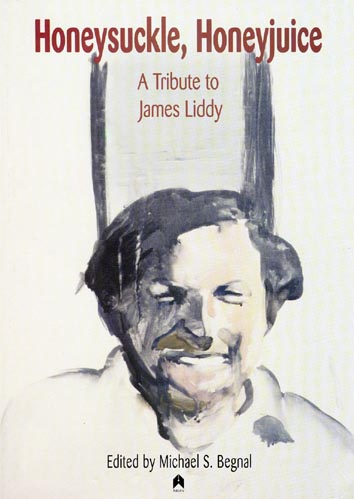
Honeysuckle, Honeyjuice: A Tribute to James Liddy (Arlen House, 2006, 144 pp., ISBN 1-903631-71-8) is now finally out. Edited by myself, it includes poems, prose articles, criticism, memoirs, etc. on the Irish poet James Liddy. Among those appearing are Thomas Kinsella, John Montague, Michael Hartnett, Cathal Ó Searcaigh, Dermot Bolger, Eamonn Wall, Mary O’Donoghue, Nuala Ní Chonchúir, George Stanley, Dan Tobin, Jim Chapson, Zack Pieper, Bob Watt, John Menesini, and a spectacular letter to Liddy from Charles Bukowski, among numerous other writers both famous and obscure. Having worked on this project for over two years now, I want to thank Arlen House publisher Alan Hayes for having the will to put the book out, as well as every individual contributor (the list is really too long to give here in full). The cover is by Irish painter Paul Funge, and the whole thing is a great production. Of course, I’m biased. That said, anyone with an interest in Liddy, Irish studies, or Irish poetry in general – or, for that matter, in poetry in general – ought to get it! There are very few books of this kind, with this range, on such a great writer. In Ireland, booksellers Books Upstairs (Dublin), Charlie Byrne’s (Galway) or Kenny’s will have copies. I imagine it will be available on Amazon sometime soon. The publisher unfortunately does not currently have a website, but can be contacted by email (arlenhouse@gmail.com) or regular post: Arlen House, P.O. Box 222, Galway, Ireland.

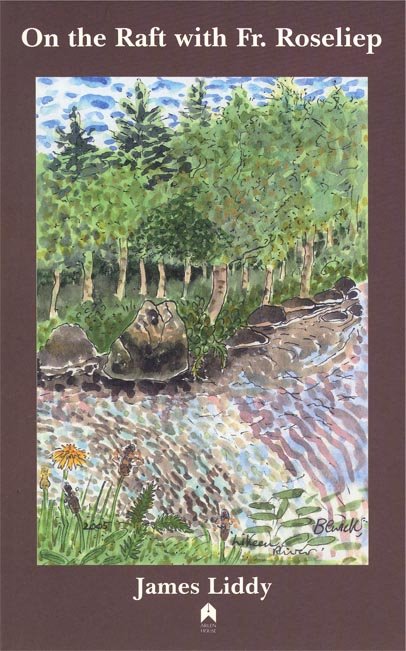
Coinciding with the release of this Tribute, Arlen House has also published Liddy’s new collection On the Raft with Fr. Roseliep (ISBN 1-903631-83-1). The 62-page volume is vintage Liddy. Lines like “You must go on this raft/ the way down the river/ your mother and priests/ drinking and talking on it,/ changing their clothes/ like you will from good to/ bad, the river decides” (“Enrafted in Wexford”), which in a way gets to the heart of it. Referencing such bizarrely diversiform writers as Dáibhí Ó Bruadair, Djuna Barnes, and Jack Spicer (not to mention Jack White of the White Stripes), Liddy graphs a liberated consciousness and also gives a political statement of his own: “Mars, have mercy, direct wars within” (“Let’s Invade Ourselves Not Iraq”). To all of this, a great big YES! Anything by Liddy is essential. And the cover art is by Pauline Bewick. (See above for suggestions on how to acquire On the Raft.)

(Clicking on either of the two cover images will give a bigger version, for your viewing pleasure...)

As an aside, my review of Liddy’s autobiography, The Doctor’s House (Salmon, 2004), can be found on the site of the Galway-based online literary journal, west47.

Monday, May 01, 2006

David Stone

David Stone sends his latest book, The Lighthouse Poems, 1997-2001 (Publish America, 2004, ISBN 1-4137-2447-7). This volume collects some of his recent work that has previously appeared in chapbook form from CC. Marimbo, New Hope International, Experimental Forest, and other small presses; as well as including individual poems that have been published in various literary magazines (The Burning Bush among others). I have been a fan of Stone’s for a while now, and have reviewed him in depth in TBB (this unfortunately not available online). So without going into too much detail here, the book really drives home his major themes: the blackbird personage (“The crows approved the medicinal flavor/of the morphine...” “The Scarecrow”), the sea-port (“The water is a grey plastic sheet,/Tugging backwards,/Some said apocalyptically...” “The Harbor”), and the horror of modern life (“The freight train tripped/in undercity tunnel,/splashing acid, wrecking towers...” “The Sea Wall”). Stone is definitely not easy to read, yet he should be read! His poetry draws on such disparate influences as Baudelaire, Guillaume Apollinaire, Surrealism, the Egyptian Book of the Dead, the pre-Socratics, Nietzsche, Jewish tradition, the Holocaust, postmodernism, and the list could go on. This is 21st c. eschatology in the form of experimental poetry. The Lighthouse Poems can be obtained from Amazon or the publisher website.

Stone also produces the Blackbird anthology of poetry and collage/xerox/mail art, and issue 7 is great. Crazy, bizarre, challenging poems from all over the world, and interesting original artworks in one of the more under-rated mediums, the photocopy machine – most of it with a blackbird/crow theme. No price or ordering information supplied, but maybe you’ll stumble on a copy somehow.

Thursday, April 27, 2006

Book reviews, and other news

Another review of Mercury, the Dime came out recently, and it is also a positive one, perhaps more descriptive than opinionated (a good description at that, if you want to get an idea of what the poem is like). It’s on the New Hope International website and can be found here (scroll down to the second review on the page).

When you’re on that page, you’ll notice that the top half of it comprises a review of my first collection, The Lakes of Coma, which is still available from Six Gallery Press, or probably more quickly from Amazon. Another quite good (I think) review of this book can be found on the Shearsman site, while a somewhat more lukewarm appraisal appears here from The Absinthe Literary Review. (The Lakes of Coma, ISBN 0-9726301-4-7, 68 pp., perfect-bound, 5.25" x 8", publication date February 2003)

In other news, the new collection (entitled Ancestor Worship) is scheduled to appear from Salmon Poetry in September. I will also have some poems in the forthcoming Salmon Anthology, due out October. And I hope shortly to be able to relay some more information about the festschrift for the poet James Liddy which I edited. It is called Honeysuckle, Honeyjuice: A Tribute to James Liddy, and is published by the Irish press Arlen House. It was just recently launched at the University of Wisconsin-Milwaukee, and at the American Conference for Irish Studies at the University of Missouri-St. Louis.

Saturday, April 22, 2006

The Burning Bush

TBB 6
I thought I would give a sketch of The Burning Bush literary magazine, of which I was editor – a brief rundown in lieu of a comprehensive history (perhaps someone will write one in the future). TBB was begun in 1999 in Galway, initially co-edited by myself and Kevin Higgins. It was A5 in size, stapled, photocopied, with full-color covers (usually), ISSN 1393-8312. Issue 1 of the magazine (Spring ’99) featured Louis de Paor, Fred Johnston, John Thomas Menesini, and Steve Earle (the famous musician, contributing two poems) among others, as well as then-unknowns like Alan Jude Moore (who went on to appear in every issue). TBB1 was quite favorably received, getting good reviews and a positive mention in the Irish Times’ anonymous “Loose Leaves” column (which quoted my Editorial Note: “Where is the experimentalism? Is there an Irish underground?”). Higgins’ article on 20th c. Irish poetry (spread over the first two issues) also set the tone: “There is a far more progressive, more alive poetry to which Irish poets could be looking.” The journal continued to progress for the next few issues, including work by the likes of James Liddy, Pat Jourdan, Deirdre Carr, Mary O’Donoghue. Other poets associated with TBB at this time included Manny Blacksher, Alex Leonard, and Daniel Ball.

At issue 4 (Autumn 2000), Kevin Higgins resigned as co-editor. This development caused a minor stir in the Irish literary scene, and it was assumed that there had been some kind of falling out between us. Fred Johnston penned articles about it in the Cork Examiner and the Galway Advertiser. Kevin has given his own version of his motivations for leaving in an article in The Red Lamp titled “Here I am, back where I started.” While Kevin’s piece is undoubtedly sincere from his subjective point of view, I personally was never aware of any of these conflicts, political or otherwise, which he mentions. Nothing was ever said about a difference of opinion at the time that he split from the magazine. Nor, for that matter, was there was ever any instance of my attempting to vaunt the merits of “Nietzsche” contra “Trotsky.” And though we did have some sparring matches in print later on, Kevin and I remain friends. In retrospect, I think that he probably felt the need to forge a separate identity, and that he knew I wasn’t enthusiastic about the cause of socialism the way he was, and so I was a useful foil for a time. Funnily enough, TBB continued to publish political poetry to the end, even while I was being criticized by some people for not doing so!

My editorial piece in issue 5 (Spring 2001) was, however, certainly an attempt to focus the magazine on poetics (though not to particularly exclude any possible political subject matter). A review and description of that issue (followed by reviews of issues 8-11) can be found here. My article on “the Wild Honey Poets” (specifically Randolph Healy, Trevor Joyce, Maurice Scully and Billy Mills) can be read on the Wild Honey Press site, and it gives you a pretty good idea of what I was getting interested in at that point. Most of these poets contributed to subsequent issues of The Burning Bush. It is no accident that the two major poets I interviewed for the magazine were Trevor Joyce (issue 7) and James Liddy (issue 8). By this time (2002), TBB was consciously attempting in its own shambolic way (possibly naïvely) to be a catalyst for a “Revolution of the Word” in contemporary Irish and international poetry. I was partially influenced by issues of the earlier journal, The Lace Curtain, a 70’s Irish late-modernist literary magazine edited by Michael Smith and Trevor Joyce. David Butler also appeared in TBB’s pages then, as did Gearóid Mac Lochlainn, and American poet David Stone. But by issue 8 I was getting a little disillusioned at the prospect of single-handedly effecting major change. There is a certain insularity in Irish poetry, and there probably always will be. Reaction to my editorial in that issue can again be found here, and perhaps still elsewhere on the internet. I was also later criticized by Marxist poet Maureen Gallagher in the pages of the Cork Literary Review 10, once again for supposedly promulgating “Art for Art’s sake.” (A later take on the poetry/politics argument can be found in an opinion piece I wrote for Poetry Ireland News entitled “Art and Revolution”.)


TBB 9
Despite all this, the following issue (9, Spring 2003) (reviewed here) was one of the best in my opinion, including some really good poetry contributions, an amazing (I think) poetic-prose story by Liam Mac Sheóinín entitled “George Bush Buys Coke in the Irish Riviera,” criticism, and a great cover. I was attempting to draw back from some of my grandiose notions of the historical avant-garde, and simply produce what I considered to be a solid literary magazine. But it was always crucial, to my mind, to have a particular critical viewpoint. The Burning Bush continued on to issue 11 (Spring 2004), at which point I decided it was better to go out on top than to linger on fulfilling the audience’s expectations. An interesting and pretty apt obituary of the magazine was given by Andrew Jordan in his journal 10th Muse:


The paradigm at the heart of this publication stretched from realism to good old fashioned romanticism. Temporally, the paradigm ranged from the now of today to the now of the past, casting a backwards glance at Modernism. Spatially, The Burning Bush came out of Ireland and - as far as I can recall - every issue included some poetry in Irish. Thus there was also a national/international paradigm at work. They did the sublime to the ridiculous as well: "'Roy Orbison calls from a Burning Bush' / Portions of sense occur, but soon get lost…" Pat Jourdan (from "At the reading", BB 8). All this meant the magazine had a lively instability which was, in effect, its style.

Though I sometimes felt that the magazine fell short of the ambitions I had as editor, looking back it certainly did play a role in the general broadening of Irish poetry’s collective mind. Copies are probably getting harder to find now, but perhaps Kenny’s or Charlie Byrne’s in Galway are worth a try. Amazon claims to have at least one issue available. It would be worthwhile to do a Burning Bush anthology, I have thought, but that of course depends on finding a willing publisher. Preferably an Irish publisher, since TBB was always primarily, as a starting point, an Irish magazine.

Thursday, April 20, 2006

Mercury, the Dime

Mercury, the Dime, which was officially published November 2005, but really only out since January 2006, got a review last week by CB Smith on the Barfing Frog website. It's a very good review I have to say, idiosyncratic (in a positive sense). He does nail the aspect of lyric youthfulness quite well, and I especially liked the lines, “Onward plods the march of change, turning soil upon soil, stamping in and leaving behind that which is no longer germane. Different is not always better, but better is always different. A handy axiom that breaks things down to component level thought.” To read the whole piece you have to go to their main page (click on the above link), then click on Book Reviews, then New Reviews, then the Mercury the Dime link.

Mercury, the Dime is a chapbook sized book (4.75" x 6"), perfect bound, 46 pp., one long poem, written 1992-93, cover by Kim Decker (a very good graphic designer), published by Six Gallery Press (Pittsburgh), ISBN 0-9746033-7-6. More information can be found by navigating the Six Gallery site (the previous link), or it can be ordered directly from Amazon. (Apologies for the self-promotion.)

Incidentally, I am not necessarily much of blogger; so perhaps the “blog” is the next best thing to having a website.

Wednesday, April 19, 2006

Post a haon

Anois teacht an earraigh is an lá dul chun síneadh,
is tar éis na Féile Bríde ardóidh mé mo sheol...