|
| Cover art: Cheryl Penn |
I have two poems in Blackbird 16, a print journal of poetry, mail-art, collage, and painting, edited by David Stone.
|
| Cover art: Cheryl Penn |
I have two poems in Blackbird 16, a print journal of poetry, mail-art, collage, and painting, edited by David Stone.

https://www.arteidolia.com/swifts-slows-michael-begnal/

we sometimes heard a furtive, creeping sound,
and hairless things that gave strange human cries
stared at us with blind, vestigial eyes.
 The anger caused by the trauma of losing her home to the builders of the bomb clearly permeates the collection. Even before the advent of the nuclear age, however, Church’s poetry wrestled with Western, Cartesian conceptions of the natural world and the alienation she felt from it even as she desired connection with it (the subject of my forthcoming article) — and this was only heightened by the events of World War Two and increasing technological “advancement.” Armitage writes that Church “attempted to penetrate the Western skein of consciousness about place as the ‘other,’ which she believed was dramatized dangerously in the atomic, scientific, and modern projects connected also to constructs of the feminine” (“Shared and Shifting Land[scapes]” 113).
We saw the crystalline flowering of the stone,
the many-faceted complexity,
the light turned back with orchestrated beat
into our listening eyes, the blood-stained reds,
the flush of yellow and the dove-dark greens.
Light became leaf,
and leaf, with who knows what of agony,
contrived its seed to float upon the wind.
The colored lichens take the world apart…


1. Direct treatment of the “thing” whether subjective or objective.
2. To use absolutely no word that does not contribute to the presentation.
3. As regarding rhythm: to compose in the sequence of the musical phrase, not in sequence of a metronome.
Don’t use such an expression as “dim lands of peace.” It dulls the image. It mixes an abstraction with the concrete. It comes from the writer’s not realizing that the natural object is always the adequate symbol.
Go in fear of abstractions.
The apparition of these faces in the crowd :
Petals on a wet, black bough .
[with Pound’s original spacing and punctuation]
London, my beautiful,
it is not the sunset
nor the pale green sky
shimmering through the curtain
of the silver birch. . .
Like a gondola of green scented fruits
Drifting along the dank canals of Venice,
You, O exquisite one,
Have entered into my desolate city.
The red deer are high on the mountain,
They are beyond the last pine trees.
And my desires have run with them.
A touch of cold in the Autumn night—
I walked abroad,
And saw the ruddy moon lean over a hedge
Like a red-faced farmer.
I did not stop to speak, but nodded,
And round about were the wistful stars
With white faces like town children.

Full press release here: https://www.arsc-audio.org/pdf/ARSC_awards_finalists_press_release_2022.pdf
Book info here: https://www.routledge.com/The-Music-and-Noise-of-the-Stooges-1967-71-Lost-in-the-Future/Begnal/p/book/9780367648435

Paul Vogel is a Milwaukee-based poet who was once a student of James Liddy at UWM and has published with the illustrious presses Adjunct Press and Tepichfresser Press. (Disclosure, not that I think it matters either way: I’ve also published with Adjunct Press and possibly Tepichfresser [via Burdock].) Milwaukee seems to have a much more flourishing poetry scene than most other American cities, and it was through Liddy that I met (and still keep in touch with) the Milwaukee poets.
These latest offerings from Vogel are two self-contained long-ish poems (5-6 pp. each) in chapbook form (from an adjunct of Adjunct Press, Associate Adjunct Press), both in a way of a piece with each other in regard to style and intent. The first, Ecology Center, opens with lush imagery and the imperatives to “hear” and “smell,” suggesting for a brief moment that this will be a rather standard celebration of oneness with nature, “Let it permeate the skin.” Vogel’s poetry, most saliently in the earlier stanzas, makes deft use of internal rhyme (“surface inversion,” “observe”), assonance (“quackgrass / inaccessible”), and alliteration.
Very quickly, however, after being lured in by the seemingly straight if gorgeous description of the natural world, we are given to know that not everything is what it seems. It is an Ecology Center, after all; there are “viewin’ windows,” and the turtles have silly names. By p. 3, we learn that the point is “to inspire STEM curiosity,” and from there the nightmarish situation of late capitalism becomes inescapable. Even the “ecoacoustics” are “harmonized,” while the Visitor Center museum features bizarre things like “fossilized labia” and an axe-throwing bar.
Vogel renders the exaggerated artificiality of the place effectively, with curated activities and an ironic reference to UWM faculty poet John Koethe. The reader is caught in a horrific celebration of “Armed Forces Day” (which is actually a real, official holiday, which makes it all the more conspicuous, i.e. didn’t we already have Memorial Day and Veteran’s Day to commemorate the military?) near an “RV Dump Station.” Finally, the nature images iterated at the beginning of the poem return to engulf all: “A solitary wave over the spine of the peninsula / brings an annulus of spray.” What peninsula? Does Lake Michigan have such giant waves? Yes it does, and, in any case, it is a commentary; the poet wishes all of this could be washed away. What is “this”? A situation where even nature is cynically invoked in the project of cognitive, psychological, and political regulation. It is a cuttingly satirical form of ecopoetics, which Vogel handles strikingly.
He does something similar in Art Museum, where once again the setting is a self-contained institution that purports to give us something beyond capitalist use-value but, as it turns out, is nothing but further exploitation. In this poem, things are noticeably strange from the start, surreal in the sense that it seems to be rendering a dream world and imagery, with a dream-like narrative unfolding of events. The museum is the real Milwaukee Art Museum (it has wings!), but exaggerated with a foreboding sci-fi vibe: a crowd enters “in an orderly fashion / watched over by muscular docents / armed with thermal handguns.”
There are variously described strange exhibits and a museum café limned in an almost pedestrian manner. Here the real is just as awful in its blunt pedestrianism as any heightened surrealism could make it: “an ever-changing menu / of contemporary cuisine / inspired by the feature exhibition / ‘Nature and the American Vision’”—which connects us back to Ecology Center. The “American Vision” indeed.
As with the former piece, Art Museum is a critique of neoliberal capitalism, where everything is acceleratingly coopted and exploited, even that which at one time may have to some degree resisted such (art and nature, though of course art has always often in some way been embroiled with the market — but here it’s worse). Not only that, but the museum has “Visiting artists [who] promote / updated cultural hierarchies”; that is, even the artists themselves have now bought in/sold out and embrace the hierarchy the art museum represents as a means of advancing in their careers. Poets do it too, of course. But I think what Vogel and his association with Adjunct Press are registering is that there is also an underclass of poets (perhaps an “undercommons,” to use Fred Moten and Stefano Harney’s term, though I deploy it tentatively), who often sell our labor to academia on a contingent and low-wage basis (adjunct) and who publish in the small press (Adjunct) on the extreme margins of the culture industry.
As Art Museum moves to its conclusion, the earlier surrealist style is no longer necessary, as once again, we are in a consumerist, accelerationist, neoliberal nightmare that would be surreal unto itself if it were not all too real. The gift shop (a motif in both poems) here sells artist-themed wallets and money-clips, as Vogel urges the reader, wryly, to “Make sure to ask about / the membership discount.” Sadly, we are all already members whether we wish to be or not, and these poems offer no easy answers to that situation. Instead, Vogel attempts a response in art that stands, if not completely separately from the capitalism it critiques (how could it really), as at least the desire to escape from it, registering the concomitant revulsion and alienation through images of almost humorous disgust, with a poetic voice that functions like the aforementioned annulus of spray.
Here’s the capitalist part. Order from: https://www.paypal.com/instantcommerce/checkout/X5WTLVXNGGVJ8

This is my attempt at an imaginary Beatles album released on Apple Records in 1971. In reality, the Beatles broke up in September 1969, when Lennon announced privately to the others that he was leaving the group (though this did not really become official until April 1970). However, earlier in Sept. 1969, they had discussed doing a further Beatles record, with Lennon and McCartney being credited separately and Harrison receiving more space than before. So, what would it have been like if they’d all for one reason or another decided to make that album and recorded it in 1970?
Though my song selections are subjective, there is some rationale for each (see below). I’ve tried to avoid making this simply a “greatest hits of the solo Beatles” and instead organized the pieces that I think best make sense together as an album (though, yes, a few are “signature” recordings). There are four Paul songs, three John, three George, one Ringo. Almost all have some kind of Beatles link, or in one or two cases at least fall within the correct time period and can be imaginatively associated with what would’ve been recorded for such a project.
Obviously, not all band members play on all tracks. The Paul songs in particular don’t feature other Beatles, but to my mind most of these recordings have similar production values. George plays on a John track, while Ringo overlaps a bit with George and John, etc. There is precedent to this; for example, John didn’t play on Let It Be’s “I Me Mine,” Ringo is absent from a couple songs on the White Album, and John’s Beatles single “The Ballad of John & Yoko” was recorded by John and Paul only. Eric Clapton, who appears on a few of these, famously played on “While My Guitar Gently Weeps,” while Billy Preston (the “fifth Beatle” on Let It Be) appears on some too.
For an album title, perhaps Let It Down would be a clever follow-up to Let It Be, but to avoid one guy’s song being the title track, I’m using The Beatles II (like the White Album is simply The Beatles). The idea here is to listen to the whole, letting the songs combine in your mind as a fictional Beatles LP, rather than hearing them as familiar individual solo exercises.
Side 1:
“Cold Turkey” was written by Lennon during the Abbey Road sessions, offered to the Beatles but passed over, prompting him to release it himself as a single. But let’s say that instead of rejecting it, Paul had said something like, “Hold off on releasing this now, and let’s think about it as an album track next time around.” The 45 that John recorded features Ringo on drums and Clapton on guitar.
“Another Day” is a McCartney tune dating back to the Let It Be sessions and thus could’ve easily been a Beatles tune. Since it was his first solo single, let’s say he would’ve insisted it be included on the hypothetical new Beatles album. Though John later dissed it in “How Do You Sleep,” we’ll imagine the group embracing it in the spirit of compromise.
Harrison’s “Art of Dying” dates to 1966, and it serves to bring up the energy level and tempo, aside from just being a strong piece in itself.
Ringo began writing “It Don’t Come Easy” in late 1968, finishing it with the help of George, who plays on the 1970 recording, giving it a particularly Beatles sheen.
“Teddy Boy” is a Paul tune c. 1968, first recorded during the Let It Be sessions in 1969, almost ending up on that LP. Some have criticized it as another boring “observational” Paul song, but there’s something interesting happening with the chord changes and bassline here.
It’s well known that “All Things Must Pass” was inexplicably nixed for Let It Be, but in this imaginative exercise George now insists, and the other Beatles finally recognize the song’s greatness. Ringo’s here, and Billy Preston, so that’s three-fifths of the Beatles already.
Side 2:
“Maybe I’m Amazed” is one of Paul’s best, recorded 1970 and sounding a lot like his Beatles work (it was written while the Beatles were still officially together). Its connection to the actual Beatles is that the opening piano riff evolved from “Song of Love,” a draft piece played during the Let It Be sessions.
“Gimme Some Truth” was recorded at the Let It Be sessions in basically the same form. The Lennon recording includes George’s guitar work, giving it that Beatles feel.
“Oh Woman Oh Why,” the B-side of Paul’s first single, doesn’t seem to have Beatles ties but was composed at the right time and still stands as one of his greatest solo songs, though now mostly forgotten. It’s a heavy groove with Paul using his wild R&B voice, and would’ve made a good contrast to his softer compositions, showing that he could still rock.
John’s “Remember” sprang from the Abbey Road sessions, with him experimenting on piano during the 1969 recording of Harrison’s “Something.”
George wrote “Let It Down” in 1968 and again offered to the Beatles for Let It Be. There’s an interesting McCartney vibe to this piece, in my opinion, which makes it sound very Beatlesesque, with a sort of “Hey Jude”-like crescendo that ends the album with a bang.

Here is the link to the interview.
Ralph wrote an extensive article on the Stooges back in 1995 (published in Goldmine), and it was great to have the opportunity to bounce ideas off of him and his expertise. In fact, he had also let me use extracts from his interview with Ron Asheton for my book.
We get into some of the things I write about there, and the tone is informal and conversational. I didn’t even realize Ralph was recording till about midway through.
Many thanks to Ralph.

An ambient/electronic group by the name of these_nails has incorporated my poem “The Ewes at Imbolc” as lyrics/vocals to a music track, streaming on Soundcloud:
 |
| Things That Happen (with some of its parts) |
Maurice Scully’s Things That Happen, written 1981-2006 and finally published in complete form, one volume from Shearsman (2020). I’ve been reading this gargantuan work in smaller pieces throughout the decades now, since approximately 2000 when I was living in Galway and editing The Burning Bush literary magazine. I got in touch with Scully around that time, and I’d received a couple of his chapbooks from Randolph Healy, poet and publisher of Wild Honey Press. I was immediately drawn to Scully’s work, along with that of other innovative Irish poets whose writing was finally beginning to come to prominence. Scully and I exchanged a few letters (before email became the primary mode of communication), and he sent me some more of his books as well, and I’ve written about these and others in various essays and reviews — for example, online: of Prelude, Tig, A Tour of the Lattice; and about further of these book-excerpts in various print outlets. Initially I approached them as self-contained chapbooks or what have you, but especially when larger pieces of Things That Happen began coming out from Shearsman and other presses in the early 2000-10s, the bigger picture began to emerge. Now there is this single volume of approximately 600 pp., finally bringing it all together and allowing us to encounter it as one. There’s something about the book itself, a big blue object, minimalist design, an object of apparent import even before being read. “The book / is fat.”
It is a great accomplishment, and for me this has become one of the most important books not only in Irish poetry, but worldwide English-language poetry more broadly. That said (about the English language), the glossary to this volume is primarily composed of translations of Irish (Gaeilge) phrases, and the mixing of languages is something that is especially interesting to me. Sometimes Scully signifies on other Irish poets, as in the “Interlude” to “Livelihood,” in “Sear Search” (237-38), which is almost a (very) loose translation of the modernist poet Seán Ó Riordáin’s “Saoirse.” In “Sonata” (at pp. 433-34), he reaches back to the late-Bardic poet Séamas Dall Mac Cuarta, while also perhaps alluding to Gerard Manley Hopkins in the same section (“the deity was / inventing conspicuous beauty. / praise him. & his mother.” — the Mac Cuarta line that occurs somewhat later in the piece is “le seinm na gcuach ar bhruach / na gcoille go sámh,” which is Hopkinsesque before Hopkins), as interruptions of a contemporary industrial-capitalist milieu. Other times, the Irish phrases are just random phrases, but serve to widen the frame of reference (snippets of talk or thought) as do the bits of Sesotho (resulting from Scully’s time in Lesotho). Cuireann sé seo uilig i gcuimhne dúinn go bhfuil snáithí éagsúla i gcúlra den obair seo.
There’s a poem called “Fire” (in “Livelihood”/“Steps,” actually one of many with the “Fire” title, this one pp. 319-20) that begins with the cosmic breath, being emerging and dissipating into nonbeing, and then some specifics of being in the world (forsythia in spring, “the bird in flight,” “hedges & trees,” “water in a river”), then moving into poetry itself, the act of poetry I should say, with gestures toward the ancient Irish mode. The question “what’s in the news, then?” is probably an allusion to the anonymous 9th-c. Gaelic poem “Scél lém dúib,” while other lines of Scully’s reference the practice of composing in the dark (as elaborated in Daniel Corkery’s The Hidden Ireland): “dark cell / . . .flat on your back / stone on your belly.” Possibly something as abstruse as “that vast / central column of / ( ) (being) / . . .connecting verticals” (occurring in the in the middle of the poem) can be linked to this, as a rendering of a similar kind of apophatic meditation where energy is seen to move or transform within the body (and is thus an immanent process rather than transcendent or metaphysical). While the closing lines, a “predawn whimper of a pump / in the dust.” may seem at first glance counterintuitive, a move away from that “cool” Gaelic stuff, they of course make total sense upon further reflection — what is this if not the perfect metaphor of all existence (which the poet must seek to be in tune with), with its suggestions of also a certain kind of Chinese worldview (“dust,” and the pump like the bellows of the DDJ). Things That Happen is made of interconnections but also, in instances like “Fire,” poems that can be read as self-contained (though with its themes being picked up elsewhere).
I know that in past essays (here and here) I’ve written about the immediately following poem “Four Corners,” a supposed “pastoral” that limns environmental degradation before moving to its powerful last stanza in which Scully announces,
The bookThere are many ways to read this, but this time around I see it as a crucial observation on the nature of our reality, rather the way in which we perceive the world, and specifically how language (poetry) shapes our consciousness of our being/world/environment. We might think that we are autonomous individuals who observe things then decide to write about them. But it is really only in the writing (poetry) — the code in the book! — that we create (“change”) the world and ourselves. Thus, subject-creating, a becoming-subject, rather than subject-existing-and-asserting-itself. What is the nature of or experience of being in the world, etc. Flipping through the recent Ken Keating-edited volume, A Line of Tiny Zeros in the Fabric: Essays on the Poetry of Maurice Scully (Shearsman, 2020), again, I note references to phenomenologist philosophers like Michel de Certeau and Jean-Luc Nancy, which helps to construct an apt body of criticism around Scully’s work. Scully’s poetry is of the quotidian, often, but is never itself merely quotidian. David Lloyd’s invocation of Theodor Adorno (with reference to a somewhat obscure [but eminently relevant] essay on Berg) — “Adorno’s remarks throw into relief the tension throughout Livelihood between its peculiar stasis and its constant, restless forward movement. . .” (Lloyd 63) — prompted me to go to Adorno’s Aesthetic Theory as I was writing this essay, and his observations about the transformation of quotidian material in W. C. Williams’s Paterson and elsewhere. Adorno: “When . . . William Carlos Williams sabotages the poetic and approximates an empirical report, the actual result is by no means such a report: By the polemical rejection of the exalted lyrical tone, the empirical sentences translated into the aesthetic monad acquire an altogether different quality” (123). Paterson is one of Things That Happen’s obvious predecessors, and though the aforementioned poem (“Four Corners”) does not engage in the kind of “grocery list” strategies that Paterson sometimes does, and Scully does elsewhere in the book in his own way, it is indeed partly a “polemical rejection of the exalted lyrical tone” (rejecting, for example, the Heaneyan “pastoral” lyric; though, this observation is old news by now?), and it is via the translation into the aesthetic monad that both the code and the world acquire their meaning or no-meaning (the news that stays news).
is fat, contains code. The world,
the water planet. The code contained in
this thing in the world, the book, changes
the things, the world. (322)
An old house absence of sound treesIt is the gap in the concrete, imagistic details that Scully is really emphasizing here, in both the gaps (“spaces”) between words and the more overt attempt to describe the “feeling.” As Aodán McCardle writes of this beginning (with specific reference to its accompanying photo, Yves Klein’s “Leap into the Void,” but which I think equally applies to these lines), Scully’s “idea [is] that we never really inhabit a singular moment in time” (in Keating, ed., 24). Even when we try to capture the “things,” we are really getting layers of surfaces interspersed with spaces. That is real understanding. The book ends,
moss wildlife that feeling of surface
over surface with smooth spaces between
(“5 Freedoms of Movement” 17)
Dandelion & daisy begin.There is so much to interpret there. The sensory images of the moment, the “ash” of Ashtown like the earlier-mentioned “dust,” maybe even the inevitability of death (“Box Factory,” as in the metaphoric coffin), to the pouring canal where we flow out once again into the stream of nonbeing (shades of Joyce’s “riverrun / a long the”). But as a poet, what I also am really struck by is the heavy alliteration of this final passage, d-d, s-s, w-w-w, and the assonance of “ish”-“whiff,” “wall”-“walks,” “past”-“Ash”-“Fac”-“[ca]nal.” As with the opening passage, it is the surface sheen, the poetry, that is the lens. So I return to Adorno’s assertion about the translation into the aesthetic, which is not aesthetics for aesthetics’ sake, but rather for the sake of the world.
Soon a sweetish whiff
of wallflower & walks
past the Ashtown Tin Box Factory
down to the pouring canal. (“Tig” 603)

Today would have been Kerouac’s 100th birthday, if he did not die at age 47 in the year 1969. Despite how the beginning of this essay (following) may be perceived by Kerouac followers, I love Kerouac. I love what he did as a writer, and the seriousness with which he approached being an artist through the 1940s into the mid-50s. I love the way in which he embraced life through art, his breakthroughs in merging a literary style with a study of the human consciousness (and subconsciousness) — this, I think, is his real legacy: his literary work. Not the stereotype of the angry, reactionary drunk that he became in his later life, which is ultimately a terrible image to project but one that sadly persists in America at least partly due to Kerouac’s legend (though of course there are many others who promulgated the mode of masculinist drinker-artist). All of this obscures Kerouac’s important insights and importance as a writer.
To love Kerouac is to live with all kinds of contradictions. Through my 20s, 30s, and even 40s, I was unaware of or perhaps suppressed that sense of contradiction, for a variety of reasons. From where I am at now, I would sum up the reason for this as, to put it bluntly, whiteness. I wanted to have the myth of America. I wanted to believe there was some truth to the idea that America had let Kerouac down, that his sadness was of utmost importance, that he had no choice therefore but to drink himself to death, and that his big “fuck you” to the world had shown everybody. I specifically remember thinking, for a while, that the bitterness expressed in this photo (below) was cool. That was really stupid on my part.
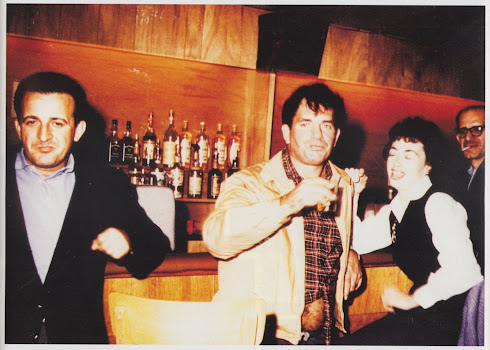
The contradictions lie in trying to separate the art from the person, and from his avowed late-life conservatism (though how late in life this develops is open to question; the Barry Miles biography dates Kerouac’s support of Sen. Joseph McCarthy to 1954 [p. 202]). There are conservative Kerouac fans out there who celebrate his sharp right turn and see no contradiction in this at all, so if I’ve lost you here, okay goodbye. It seems to me, however, that to laud Kerouac’s conservatism is also to laud his crankiness and his increasingly alcoholism — all of which is inextricably bound up together, the negativity of his drinking and the negativity of his politics. Both of these to one degree or another have their roots in the flawed sense on Kerouac’s part that his sentimentalism about America had been betrayed by “Communists.” But all of it is just that, sentimentalism rather than reality. Kerouac’s political stance never had any real credibility, and I myself never inclined toward his kind of politics, even at the height of my own “fandom.” I thought it was funny that he responded to Lawrence Ferlinghetti’s interest in the Cuban revolution in 1960 with the retort, “I’ve got my own revolution right here in Northport — the American Revolution!” (Nicosia, p. 621) — but I never believed that it composed a serious politics. (It doesn’t.)
America, though. At one time I was deeply seduced by the myth of America, as expressed in Kerouac’s road novels. I believed in the idea of “discovering” America and went “on the road” myself, driving cross-country many times. I believed in the idea of freedom this represented, and the idea that you could live outside of restrictive or normative society by being in movement, or the distance that this provided from “home.” I really had this feeling at the time, but I would also say that it is in part an illusion that is fostered by individualism and a lack of awareness of the wider contexts that facilitate the myths of individual freedom. As Scott Obernesser writes in a 2020 essay titled “What It Means to Be On The Road: Mobility and Petrocultures during the Mid-Twentieth Century,” “Sal perceives the road as imbued with transformative power; yet, at the same time, the surface is a mixture of oil and repurposed earth. The play between material surface and transcendental pursuit is emblematic of the novel’s fundamental, yet largely overlooked conflict: submission to industry in the hope of increased personal freedom” (p. 494), further clarifying, “Though Sal is acting out his countercultural impulse . . . his mobility is always already incorporated into systems of capital and consumption” (p. 496).
Basically, I used to think it was all about me, and of course this is what Americans (especially white Americans) are trained to believe. They are not usually asked to consider the ways in which their perceptions of their personal freedom bolster an often-exploitative system of consumer capitalism, the ways in which their own illusions about supposedly having rebelled against the system instead reify it.
Equally as complicated (and problematic) is Kerouac’s framing of race, with the obvious example of On the Road once again, the famous passage where he expresses that, as a white man, “I walked . . . in the Denver colored section, wishing I were a Negro. . . .” (there are other examples that could be used here too). Kerouac’s view of Black life was that all was well before Civil Rights, and that Black people embodied ecstasy and joy, and so on. I don’t doubt that Kerouac meant his comments about wishing he were Black as laudatory and affirmative, and this is the cry that always comes from Kerouac’s uber-fans even today: He meant this as a compliment. But of course the authorial intent of these passages is not the end of the story. We as readers have a duty to analyze, as well as to question the cult of personality within Kerouac fandom, and to allow for a more critical perspective.
The charge from those who would blithely defend all of Kerouac’s literary and personal stances is that we are imposing a contemporary, so-called “woke” view on something that was supposedly perfectly acceptable in its own historical context. However, this is simply incorrect. James Baldwin, in his 1961 essay “The Black Boy Looks at the White Boy,” rightly critiqued Kerouac/Sal’s Denver statement at that time, responding that “this is absolute nonsense. . . and offensive nonsense at that...” Baldwin’s essay appeared only four years after On the Road was published and still had great cultural currency, and thus puts the lie to the notion that criticizing Kerouac’s attitudes on race is merely judging him by today’s standards.
Then there is John Clellon Holmes’s 1963 interview with Kerouac, where Holmes asks him about all this. Kerouac at least admits that it (the “wishing I were a Negro” line) was a “romantic” statement, but goes on to dismiss Baldwin: “James Baldwin wants to stir up as much interest in his Civil Rights fight as he can, get everybody involved, all the writers probably, but I have no time for politics, just Art” (The Unknown Kerouac, p. 320). Fair enough, on one level perhaps. But I don’t think you actually can separate art and politics in that way, at least not completely. And the scornful attitude toward Civil Rights is telling, the idea that it is “stirring up,” rather than simply the insistence on justice. Kerouac ended up on the wrong side of history there, and Baldwin was right. Saying so triggers a lot of people’s white fragility, however. I know this from personal experience trying to discuss these questions in Kerouac social-media forums, where the response is often a frantic defense by hero-worshipers of Kerouac against the perception that he is being accused of being a racist.
Obviously many have written about Kerouac on race long before me; it is not a new idea. I don’t know if I could say whether “Kerouac was racist” or not, as the answer to the question depends on definitions, intention versus effect, individual versus structural, etc. But this is the kind of complication that, speaking for myself, I can no longer ignore if I’m going to continue to engage with Kerouac’s work. In reality, given the society that he lived in (and to a great extent we still live in today), it would almost be a miracle if he weren’t in some way racist. These are facts about American society that people have been wrestling with since its inception.
The question then is whether it is worthwhile to engage with Kerouac at all. Is it worthwhile to engage with myself? Because of course as a product of American or “Western” society I undeniably embody many of the same dynamics, which in the scheme of things I’ve only recently started to seriously confront, trying to undo the assumptions created by one’s own whiteness and so on. Maybe these concerns are not those of most Kerouac readers, and I know all of the resistance to what I’m saying, encountered it already. But to me it is a valid question, the complication of how someone like Kerouac can on the one hand harbor some in my estimation problematic social and political views inculcated by the society around him/us, leaving those uninterrogated while at the same time making deeply meaningful and insightful observations about the nature of human existence, the relation of human beings to the natural world, to animals, to other people, about new cultural and social developments in society, in literature and art (including some very strong writing about bop jazz), being in tune with all of these in often affirmative ways, to observe the mind observing, and to render it all in a truly innovative poetic and prose style (often a poetic-prose style). But not to pretend that one exists without the other, or in one’s own insecurity about oneself to feel the need to defend the negative aspects of the personality — the inability to accept complication and ambiguity as itself part of the reality of human existence.
There could also be some who do say, “Why would I want to engage with this stuff at all then?” i.e. that given all the confused or outright fucked-up parts of him, the work is just not worth it, and no you can’t separate it, so why would I want to deal with a right-wing crypto- or not-so-crypto-racist? To that, I can only say of course fair enough. I’m not trying to convince anyone, and I can’t separate it either. It’s the same argument about Pound, Eliot, Stein, and other modernists who expressed fascist sympathies to some extent or other; maybe the time has come to stop being so obsessed with them altogether, and write about other modernist poets who didn’t have fascist leanings, and whose work never got its proper due. That totally makes sense. So I’m only speaking personally here, and obviously much of what I’ve written above is connected to my own process of self-interrogation, and thus my own previous self-identification with Kerouac comes in for criticism (he is like it or not, a subject for me). Yet, when I go back to Kerouac’s writing, there’s still something (what I wrote in the last half of my last paragraph) that seems to penetrate through the shitty personalities that a (frequently) shitty society creates for us.
We think we create our own personalities, that we have the freedom to create our selves, but this is another lie of capitalism and (often anyway) of white supremacy. On some level Kerouac himself understood that, though he would never have framed it in those terms. I’ve been rereading his Book of Dreams (1960), an often-overlooked novel(?) in his oeuvre, and it’s a compelling text, not least for its insight about the functioning of the mind. Kerouac attacks Freud for his mere interpretation of hidden motivations (“Freudianism is a big stupid mistaken dealing with causes and conditions instead of the mysterious, essential permanent reality of Mind Essence” [Book of Dreams, 2001 edition, p. 282]), and instead (influenced by Buddhism) sees dreams as part of the same mind-matter that constructs the waking world as well as the sleeping world. I think there’s an obvious component to subconscious dreams that do lend themselves to interpretation of/connection to daily quotidian conscious life, and clearly I subscribe to a certain degree to materialist “causes and conditions,” and I’d suggest that Kerouac’s unfiltered confessions in this book are in fact open to a variety of interpretations.
But again, these dynamics are perhaps merely the surface overlay of personality. Though most of Book of Dreams is just that (the actual dreams, without attempt to explain or interpret), Kerouac at times does make comment about the nature of existence, consciousness, and art. He writes,
words, images & dream are fingers of false imagination pointing at the reality of Holy Emptiness---but my words are still many & my images stretch to the holy void like a road that has an end---It’s the ROAD OF THE HOLY VOID this writing this life, this image of regrets------ (pp. 280-81)
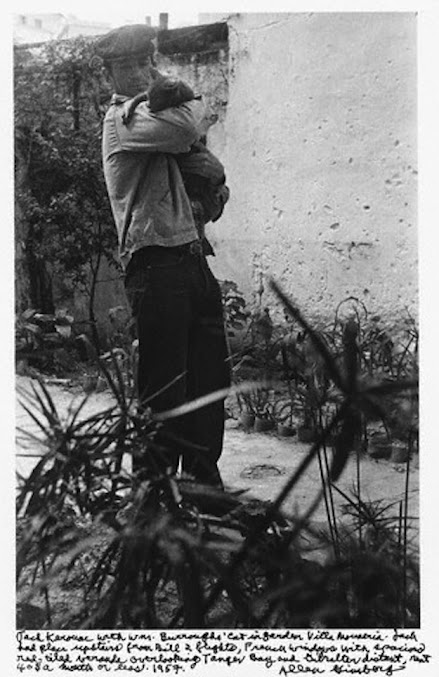
The little cat I had in my hands that had such a sweet sad little funnyface with gray eyes and finally spoke to me in a pitiful voice, like Gerard’s, “J’aime pas demain” and I said “Moi too mon ange!” and felt like crying . . . that piteous note Gerard had . . . which is in my own voice when I address little names to my cats---this kitty was an angel, and spoke the truth--- (pp. 140-41)
All day, this photo:
My Stooges book, The Music and Noise of the Stooges, 1967-71: Lost in the Future (Routledge, 2022), is reviewed in the latest issue of MOJO (#341, April 2022):

 | |
| Brigantia in Romanized form, Dumfries, Scotland, 2nd c. CE |
Brigit i.e. a poetess, daughter of the Dagda. This is Brigit the female sage, or woman of wisdom, i.e. Brigit the goddess whom poets adored, because very great and very famous was her protecting care. It is therefore they call her goddess of poets by this name. Whose sisters were Brigit the female physician, Brigit the female smith; from whose names with all Irishmen a goddess was called Brigit. Brigit, then, breo-aigit, breo-shaigit, ‘a fiery arrow’. [The latter etymology is likely speculative on the ancient glossator’s part.]
i mbolc (Modern Irish: i mbolg), meaning ‘in the belly’, and refers to the pregnancy of ewes at this time of year. . . . the Old Irish verb folcaim, ‘to wash/cleanse oneself’, [referring] to a ritual cleansing, similar to the ancient Roman festival Februa or Lupercalia, which took place at the same time of year. . . . [Or] a Proto-Indo-European root meaning both ‘milk’ and ‘cleansing’. . . . [Or] from the Proto-Celtic *embibolgon, ‘budding’.


 Posts
All Comments
Posts
All Comments