My poem entitled “Bettie Page” is included in the latest edition (issue 12, Spring 2007) of the online journal Free Verse. Please take a look....
The journal is edited by Jon Thompson, and is a really great production.

 One appears in the latest issue of Poetry Ireland Review (90), and is on Catherine Walsh’s book City West. My review is not available online, but it does incorporate (and improve upon) a piece I previously posted here. The whole issue (edited by Peter Sirr) looks good, though, so keep an eye out for (and if you can, buy) it.
 Also keep an eye out for/buy the new issue of the Belfast political and cultural journal Fortnight (453, June/July 2007). It includes my review of Maurice Scully’s most recent volumes, Sonata and Tig. Again, it’s not online, but it is also partially based on an earlier piece that is (to give you a taste)....
 My long-promised collection Ancestor Worship is now officially out. It is available from several outlets, but it would really be great if anyone who wanted to have it ordered from the publisher, Salmon Poetry. Please use the above link to order.
 I have some translations in the brand new issue (number 2) of Calque, a journal of translation. My translations are from the Irish of Aodhagán Ó Rathaille, Proinsias Nuinseann, and Mícheál Óg Ó Longáin, all 18th/early 19th century Gaelic poets.
 Copies can be ordered at this link.
Alternatively, they can also be ordered from: Calque, c/o Steve Dolph,
The editors can be contacted at editors@calquejournal.com

 David Stone’s new collection Bridge Poems has been published by Six Gallery Press, and is very much worth getting. I can’t really review it, because I’ve already written the preface for it. So instead I’ll give you that (and an excerpt from Stone himself, below).
David Stone is unique among poets. Parallels could be drawn, influences named — Baudelaire springs to mind, and perhaps I could say something tricky like, “Stone is an American Baudelaire, transposed from 19th century
Given the title of this book, Crane will loom large. Crane, who, as Stone writes here, “attained water,” and of whom Waldo Frank wrote in the 1933 edition of The Collected Poems, “His vision was the timeless One of all the seers, and it binds him to the great tradition; but because of the time that fleshed him and that he needed, to substance his vision, he could not employ traditional concretions.” And so it is for Stone. His seeming obscurity is not an affectation or a conscious wish to appear “avant-garde.” His highly-pitched language is the struggle to articulate the incomprehensible and the unacceptable. Stone’s work often reads crazily because the world certainly is crazy, and
Michael S. Begnal
Here is a poem from the collection which is perhaps representative:
Jazz Biers
The Dead
wail
in Flanders Field
& grope
mandolins
& conehats.
The Jackal
heckles
groves
of treasure
chests
hidden
in deep
sea vents.
—David Stone
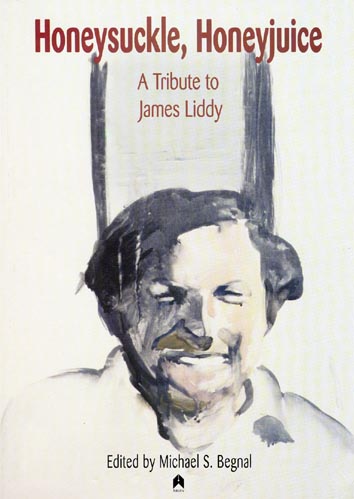
 Another review of Honeysuckle, Honeyjuice: A Tribute to James Liddy has appeared, in An Sionnach 3.1 (Spring 2007). An Sionnach is the journal of Irish Studies published by Creighton University Press. The piece, by Eric Adams, is not only a good overview of the collection, but provides an interesting description of the book launch which took place at the University of Wisconsin-Milwaukee campus last year: “There was an energetic silence in the hall—an anticipation of performance. Liddy’s reputation in Milwaukee as a center of gravity which draws in characters from all directions is not dissimilar to the spirit of his poetry.” I think this is also the only review so far to note that the book contains not only the numerous overwhelming praises of Liddy, but also a couple of “attacks” (Thomas McGonigle, Myles na Gopaleen) – both of which are included, as Adams points out, in “celebration of mischief.” A lively piece from a great journal.
 (A poem of mine was published in the Irish and Scottish Gaelic poetry journal, An Guth issue 4, edited by Rody Gorman and published by the Irish press Coiscéim.)
 We commonly run through the mythology of the 1916 Easter Rising in our minds: the proclamation of the Republic and the siege of the GPO, the “sanctifying” of the cause of Irish independence in blood, the executions of the leaders, who had been imprisoned in Kilmainham Gaol, Connolly shot while sitting on a chair due to the grievous injuries he had incurred in the fighting. It has been turned into poems, songs, etc. It has become a shorthand of sorts, for whatever you want it to mean. In the last couple decades that has often been something along the lines of: Pearse was a fanatic with a death-wish and a misguided Romantic notion about self-sacrifice, or was really just a “terrorist” who has provided cover to a whole new generation of terrorists. Now that the war in the North is over, it has suddenly become okay again to celebrate Pearse and the other men and women of 1916. Last year’s gargantuan government commemoration in Dublin, the biggest since the 50th anniversary in 1966, seems to have made it acceptable. Certainly this is a good thing. But think of the smaller marches and gatherings which have always taken place, year after year, which didn’t always have “official” sanction. And of those who wore an Easter lily when to do so immediately identified you as sympathetic to the cause of a united Ireland, when it wasn’t always the PC thing to do. And how much easier it is this year, now that Ian Paisley has sat smiling next to a lily-clad Gerry Adams.
 I think of those Sundays in Eyre Square, Galway, at the foot of the statue of Liam Mellowes. (For it was in Co. Galway that Mellowes led the only action of the Rising that occurred outside of Dublin.) A lone piper and someone reading the Proclamation. Somewhere around a hundred people or so – not bad for Galway – to show their regard and to hear a B-list Sinn Féin speaker. Then the march to Bohermore Cemetery, where the obligatory plain-clothes Branchman sat in a compact car, trying to observe who was in attendance. The action of memory has him absentmindedly reading a newspaper, but I’m sure that wasn’t really the case.
 As Roland Barthes, the post-structuralist cultural critic, has pointed out in his Myth Today, “Myth is speech stolen and restored. Only, speech which is restored is no longer quite that which was stolen: when it was brought back it was not put exactly in its place.” It wouldn’t be too difficult to identify distortions in the 1916 myth, at the agency of both reactionaries and revolutionaries. But on Easter 1916, a real Pádraig Pearse led a real uprising against a real colonial government, which sailed a real gunboat up the River Liffey, and fired real shells at the centre of Dublin. Real men and women took to the streets and battled real British soldiers. Real bullets fired by those same real British soldiers executed Pearse, Thomas J. Clarke, Thomas MacDonagh, Joseph Mary Plunkett, Ned Daly, Willie Pearse, Michael O’Hanrahan, John MacBride, Éamonn Ceannt, Michael Mallin, Cornelius Colbert, Seán Heuston, Seán Mac Diarmada, James Connolly, Thomas Kent, and there was a real rope for Roger Casement. Some were real poets.
 After a long postal odyssey, the new issue of the Milwaukee-based literary magazine Burdock finally arrived. Edited by Keith Gaustad, Burdock 2 is a good mix of poets, and also includes one prose piece by Jim Hazard. Lots of great poems here. James Liddy with a couple of shortish pieces – “Which was the real President / James Brown or Gerald Ford…?” Jim Chapson’s “The Joke” argues, tongue in cheek we think, for demons as the cause of mental illness. On a slightly related note, one of Burdock’s “burrs” (some of the poems are printed on sticker paper) is from Tim Miller, entitled “Do You Know Autism.” As Miller himself has suggested, you can use these stickers to cover up crap poems in existing anthologies. Not a bad idea at all. Good poems from Susan Firer and Sarah Fox (the latter has a piece about Salvia divinorum! – “Her blood is minty and erotic…”). (Editor Gaustad writes, “There’re women in this issue so one could say things are progressing.”) My vote for best poem title: Fr. Ronald Crewe’s “Chew Any Good Carpets Lately?” Eric Adams’ “Coolgreany Hangover” reminds me of July 2002. Cool cover (not shown) by Kyle Fitzpatrick.
 The Irish Literary Supplement has reviewed Honeysuckle, Honeyjuice: A Tribute to James Liddy in its Spring 2007 issue (Vol. 26, No. 2). The piece, by Tyler Farrell, is entitled “The Poet Who Caps Our Being,” and is quite a glowing assessment of both the Tribute and Liddy’s newest collection, On the Raft with Fr. Roseliep. Farrell writes, “The festschrift shows the desire to hail this poet, to give something back to a man who influenced poetry, shaped a new and unique outlook, and struck a blow for the spiritual and the sexual, the Irish and American, the freedoms and the footsteps.” Later he adds, “Many of the works jump off the page and relay much of Liddy’s devotion to writing, life, friends, love and art. It is gossip for the gossip poet and love for the love poet.” My appreciation to Farrell and the ILS.
 St. Patrick escapes from servitude as a pig herder in Ireland back to his native Britain (from where he had been kidnapped) with the help of sailors who agree to take him aboard. Patrick, or Patricius, says in his Confessio that “on that day, I refused to suck the breasts of these men from fear of God, but nevertheless I had hopes that they would come to faith in Jesus Christ, because they were barbarians.” The breast-sucking appears to have been a custom of ancient Irish society.
Why then should King Leary as the Archdruid’s chosen example of his way of ‘seeing’ the world appear all green? Because the fundamental point about Leary is his Irishness, a true native Irish king, the embodiment of Ireland free and unoppressed, who must therefore be seen as green, Ireland’s national colour, through and through to the Archdruids ‘throughsighty’ (FW611.32). Joyce is also saying that the Wake is a thoroughly Irish work.
 Being Irish-American has never really been particularly “cool”. Bob Dylan admits to learning a few things from Liam Clancy about protest songs, and there’s nothing particularly uncool about catching a Flogging Molly or Dropkick Murphys show. But between Bill O’Reilly and Pat Buchanan, the rebirth of cool does not seem to be around the corner.
We travel through Dublin’s wide streets bearing
white flowers to throw in bunches to our young friends
and sunrise halos from forgiveness to our unknowing lovers
where roof-high breezes out of a green still
on the fields pour along our hands which clumsily confess
the faithfulness too deep for anything but walking.
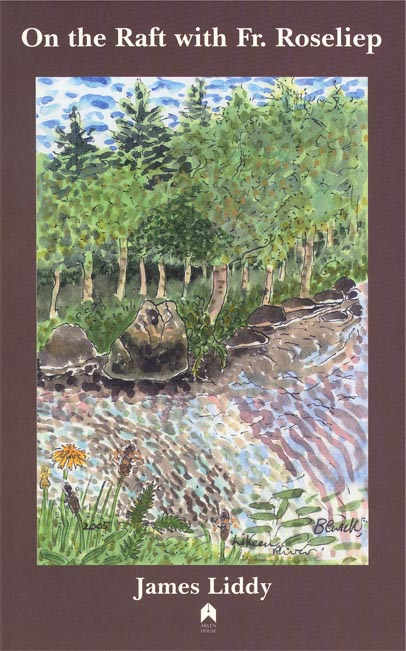 THIS CONTINUING PRESENCE is most evident in the new collection, also published by Arlen House, and, rather fittingly, featuring a painting by the early Dolmen artist Pauline Bewick. On the Raft with Fr Roseliep invokes the memory of Raymond Roseliep, another American-Irish writer transplanted to the Midwest – particularly Loras College in Dubuque, Iowa, which Liddy refers to brilliantly in his note as the “Little Rome of the Midwest”. As a frequent contributor to Threshold and The Dubliner as well as an extensive correspondent with Christy Brown, Fr Roseliep joins James Liddy’s sizable menagerie of poet-saints, for both his work and what he represents. As with many of Liddy’s recent collections in both prose and poetry, On the Raft is both a poetics and a lives of the poets at a time when, as Liddy writes in one poem, “The Writing Programs/ have won, to write is only to teach to get paid, Muses kick/ America in the ass”.
‘This album is dedicated to, and is for and about the death of the sweetheart. In a social plane, impossible to exist, and in memories, past defeating present. We mourn the sweetheart’s loss . . . ’
The note of melancholy began for Liddy with his very first work, found its first brilliant articulation in one of his most important works, Baudelaire’s Bar Flowers (White Rabbit, 1975), and continues here. This persistent melancholy, though, is that of a true and puckish lover and is discovered only by – in good readerly Beat fashion – taking the poet at his word and entering into his world, searching out this Jack White, or (if you’re one of his many students, or the current generation of writers), you may already know that Jack White is not one of Liddy’s universe of writers but the lead guitarist and writer of the band The White Stripes, whose liner notes from the album Elephant (2003) continue:
We mourn the sweetheart’s loss in a disgusting world of opportunistic lottery-ticket holders caring about nothing that is long term, only the cheap thrill, the kick, the for-the-moment pleasure, the easy way out, the bragging rights and trophy holding.
 Vice magazine, first time I’ve seen an issue in a good six months or something, maybe more. Since I don’t currently live in New York, L.A., or London, I only get them when a friend gives or sends me one. (Guess I should check the website more often, since you can actually download them for free.) But one thing I immediately noticed was a letter in this issue’s Mail section – a gushing, over-serious ass-kiss (“This is not an ass-kiss,” it begins) from a 37-yr-old man who actually deems it necessary to stipulate, “I am not a part of Vice’s demographic.” The letter-writer is, “however, always drawn to your magazine because it shows a side to society that us comfortably numb old farts can peer into and then ponder the world around us.” It then goes on to laud Vice for its “bold and important” articles, “courage,” the “issues” it “highlights,” etc. The title the editors have given this short missive is “Averting Midlife Crisis.” Inexplicably (for anyone who has ever read the magazine around, say, the early 2000’s), they don’t make fun of this guy in the slightest and actually go so far as to answer, with no real trace of irony, “Thanks, old-timer.” Perhaps Vice has in a sense entered its own mid-life crisis. But then one could hardly expect it to maintain the same relentless style of attack after ten-plus years. But to see them openly accepting a comment about a “demographic” at all, much less tacitly admitting that a 37-yr-old guy might not be part of it, was a bit weird.
 Got Maurice Scully’s latest book, Tig (Shearsman Books, 2006, 102 pp., ISBN 978-0-907562-96-2), which is the conclusion to his massive meisterwerk entitled Things That Happen. Tig follows Five Freedoms of Movement (1987, 2001), Livelihood (2004), and Sonata (2006). At present I have not gotten my hands on the penultimate volume Sonata, so I’m looking at Tig as its own thing, and am not at the moment all that worried about how it ties in with the rest (although I have read the others, Livelihood being the bulkier volume).
different (or) touching a windowpane where
drops gather ( ) difference ( ) &
or different
I’ve had quite enough
CreativityFree Expression, Genius & all that.
Quits.
Let’s communicate.
All that these able writers have said on language has been
challenging, provocative, & generally very helpful.
Thank you.
 Eric Basso is a poet, novelist, playwright, and critic, born in Baltimore in 1947. His output is prodigious, though I had not read him until I received these two well-made books. Decompositions: Essays on Art & Literature, 1973-1989 (Leaping Dog Press / Asylum Arts Press, 2006, ISBN 1-878580-58-2) is exactly what its subtitle says it is, a collection of critical essays. Although “critical” is perhaps not the right word, because these are more along the lines of explorations of the subjects Basso chooses to discuss, his responses to them, rather than the sort of critical writing one would find in a review, for example. His prose is clean and readable, while exceedingly erudite.
 However, Basso is quite interested in dreams, and thus Revagations: A Book of Dreams, Volume I, 1966-1974 (Leaping Dog Press / Asylum Arts Press, 2006, 386 pp., ISBN 1-878580-57-4). It is hard to “review” a book of this nature. You are either interested in it, or you’re not. For some, the material of the subconscious will be worthy in and of itself; for others, the dreams of a stranger with whom one has no personal connection will seem boring. I myself am in the former camp, for the most part. Oddly, Basso’s dreams even reminded me of my own in places. His introduction draws heavily from the French – no surprise there, knowing his preoccupations now – with much discussion of Valéry’s, Victor Hugo’s, and de Nerval’s work, as well as that of the English Romantics like Shelley.
 Susanna Roxman, a Scottish-Swedish poet, recently sent her book Imagining Seals (Dionysia Press, ISBN 1-903171-19-9). I guess in a nutshell I would say that it’s written in a straightforward, lyric style, with a partiality to Classical mythology (some of the poems deal with themes like Eurydice and Orpheus, Circe, etc.). But Roxman has an interesting voice and brings a certain originality to her work on the whole. For example, in “A Roman Officer in Winter Quarters,” a poem with historical subject matter, she gets psychological, using expressions such as “It’s like lying awake in darkness between two dreams about rage” and “An overwhelming winter moon / floods me with sleep-inducing water.” But for me, the more interesting pieces were the ones that presumably come from the author’s real life experience, say snapshots of Edinburgh on a rainy evening, cigarette butts, and empty beer bottles slowly filling with water (“Rain in Edinburgh”). Or “The Haunted Hut,” rendered in rather stark terms:
It looks like a TV set,
the deserted Lappic hut,
screen facing west
but walls covered with torn turf...
 Further to my previous post on the possibilities of a united Ireland, I recently read this Irish Times article about Ireland’s fast-growing census figures. If the predictions that the island will reach 8 million people in twenty years’ time (up from the present 5.5 million) is anywhere near correct, it makes planning for housing on an all-Ireland basis utterly necessary. There is apparently talk of creating a new metropolitan area out of Dundalk and Newry (which, for those who don’t know, are towns that are presently on opposite sides of the Border). Some kind of a united Ireland will really become a necessity as the population of the island of Ireland continues to grow. Economic and structural necessity means planning for housing (for one thing) on an all-Ireland basis.
 Just received what is likely the final issue of the Black Mountain Review (that is, the Irish one, not the famous American one of the 1950s and 60s). It’s a shame that it’s folding, because it was a steady, well-produced journal focusing firstly on the North of Ireland, but then also the whole of Ireland and the world as well. I myself have appeared in its pages many times. I guess, however, many a good literary magazine’s days are numbered (and sometimes that is even what ought to be). BMR had a seven-year run, and began roughly at the same time as The Burning Bush. The associated Black Mountain Press has also published some very important books of poetry and prose, not least of which was the forward-looking anthology Breaking the Skin: Twenty-First Century Irish Writing. It is to be hoped that the Press can still continue in some way.


 Posts
All Comments
Posts
All Comments