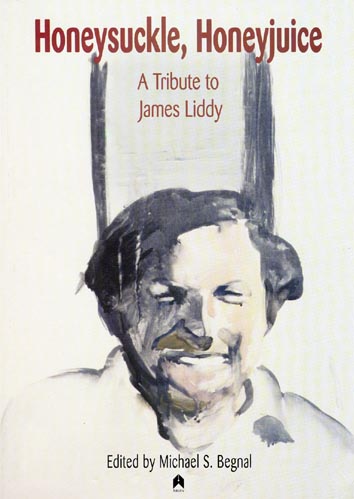
The Irish Literary Supplement has reviewed Honeysuckle, Honeyjuice: A Tribute to James Liddy in its Spring 2007 issue (Vol. 26, No. 2). The piece, by Tyler Farrell, is entitled “The Poet Who Caps Our Being,” and is quite a glowing assessment of both the Tribute and Liddy’s newest collection, On the Raft with Fr. Roseliep. Farrell writes, “The festschrift shows the desire to hail this poet, to give something back to a man who influenced poetry, shaped a new and unique outlook, and struck a blow for the spiritual and the sexual, the Irish and American, the freedoms and the footsteps.” Later he adds, “Many of the works jump off the page and relay much of Liddy’s devotion to writing, life, friends, love and art. It is gossip for the gossip poet and love for the love poet.” My appreciation to Farrell and the ILS.
Friday, March 23, 2007
Liddy Tribute reviewed in The Irish Literary Supplement
The Irish Literary Supplement has reviewed Honeysuckle, Honeyjuice: A Tribute to James Liddy in its Spring 2007 issue (Vol. 26, No. 2). The piece, by Tyler Farrell, is entitled “The Poet Who Caps Our Being,” and is quite a glowing assessment of both the Tribute and Liddy’s newest collection, On the Raft with Fr. Roseliep. Farrell writes, “The festschrift shows the desire to hail this poet, to give something back to a man who influenced poetry, shaped a new and unique outlook, and struck a blow for the spiritual and the sexual, the Irish and American, the freedoms and the footsteps.” Later he adds, “Many of the works jump off the page and relay much of Liddy’s devotion to writing, life, friends, love and art. It is gossip for the gossip poet and love for the love poet.” My appreciation to Farrell and the ILS.


Saturday, March 17, 2007
Lá Fhéile Pádraig
 St. Patrick escapes from servitude as a pig herder in Ireland back to his native Britain (from where he had been kidnapped) with the help of sailors who agree to take him aboard. Patrick, or Patricius, says in his Confessio that “on that day, I refused to suck the breasts of these men from fear of God, but nevertheless I had hopes that they would come to faith in Jesus Christ, because they were barbarians.” The breast-sucking appears to have been a custom of ancient Irish society.
Later Patrick comes back, competes with the druids in contests of magic, and lights his fire on the Hill of Slane to trump the traditional druidic fire on the Hill of Tara. (It seems the Irish government is planning to build a highway near/over Tara soon. There’s presently a campaign to stop it, which any right-thinking person should support.)
James Joyce writes about the Archdruid Berkeley’s religious disputations with Patrick in Finnegans Wake. Peter D. Fitz-Hugh examines this section in an interesting article:
Why then should King Leary as the Archdruid’s chosen example of his way of ‘seeing’ the world appear all green? Because the fundamental point about Leary is his Irishness, a true native Irish king, the embodiment of Ireland free and unoppressed, who must therefore be seen as green, Ireland’s national colour, through and through to the Archdruids ‘throughsighty’ (FW611.32). Joyce is also saying that the Wake is a thoroughly Irish work.
St. Patrick represents a major cultural shift in Irish society. Although, of course Ireland didn’t become Christian in one fell swoop, as if in 432 the country was suddenly converted en masse. The original religion existed for probably many centuries more, and numerous pagan sites and practices were preserved almost wholesale in an ostensibly Christian guise.
It has been suggested that poems on the 7th-century figure Mongán in ancient texts such the Imram Brain maic Febaill represent a native pagan resistance to the imported religion, and that “Mongán was a chief [flaith] sympathetic to pagan beliefs…and poets viewed him as their champion and a source of hope as they attempted to hold the line against Christianity” (my translation, from J.E. Caerwyn Williams & Máirín Ní Mhuiríosa, Traidisiún Liteartha na nGael, BÁC: An Clóchomhar, 1979, p. 30).
Many also point out that on another level Christianity was eventually accepted into Ireland with a striking lack of violence or force, with a lot of tolerance for the earlier belief, even subsuming some of it and molding itself to pre-existing customs (though rejecting many others). St. Patrick therefore has a strange double meaning for Ireland.
Many also point out that on another level Christianity was eventually accepted into Ireland with a striking lack of violence or force, with a lot of tolerance for the earlier belief, even subsuming some of it and molding itself to pre-existing customs (though rejecting many others). St. Patrick therefore has a strange double meaning for Ireland.
Sunday, February 04, 2007
Irish Times reviews James Liddy Tribute
The tribute/festschrift for James Liddy, which I edited, was just reviewed by David Gardiner in The Irish Times (Saturday, 3 February 2007). Here is the piece:
A poet permeated by the Beat
David Gardiner
Michael S Begnal, Ed., Honeysuckle, Honeyjuice: A Tribute to James Liddy (Arlen House, 2006)
James Liddy, On the Raft with Fr Roseliep (Arlen House, 2006)
 Being Irish-American has never really been particularly “cool”. Bob Dylan admits to learning a few things from Liam Clancy about protest songs, and there’s nothing particularly uncool about catching a Flogging Molly or Dropkick Murphys show. But between Bill O’Reilly and Pat Buchanan, the rebirth of cool does not seem to be around the corner.
And yet, being an exile to the US and a dissident voice there is both a truly complex and American stance. Extending back to the Jeremiads of the Transcendentalist writers through to the Beat generation, America can be a place to be (in the adapted words of an Irish poet who spent some time in Berkeley and Boston) lost, happy, and at home.
Two recent works highlight the continuing achievement of James Liddy, an inheritor of generations of American writers who were watching their homeplaces and loved ones transformed and who remains an important continuing influence on a contemporary generation of writers.
Like his tireless efforts on behalf of his peers and younger writers, James Liddy’s work doesn’t pay much attention to what’s cool. He has paid attention to what’s important to poetry – to the life of the word. More than anything, this shows that his studies of, and travels with, the American Beat writers since his arrival in the US in the 1960s have permeated his very being.
James Liddy has remained one of the most prolific and active Irish writers since appearing on the scene with his 1962 publication, Esau, My Kingdom For A Drink (Dolmen Press) and with the important, short-lived journal Arena (1963-65), which he published with Michael Hartnett and Liam O’Connor. Since then, he has published more than 50 chapbooks, collections, and prose works, including his Collected Poems (Creighton University Press, 1994) and the first volume of his autobiography, The Doctor’s House (Salmon Publishing, 2004).
Parallels in the sheer volume of writing might be made between Liddy and George Moore, and they could continue – the exile and the autobiographer; the myth-maker of the houses inhabited, from the Doctor’s House to the Snake Pit to the Slovak Bowling Alley; both presenting themselves as one of the first of the “new Irish”; both documenting, as Liddy writes in The Doctor’s House, a life “rotten with literature and art”. Recently, Liddy has stated that Moore gave to Ireland something that was hugely important to modern Irish writing: an imagination that was Catholic, European, and French. To Irish writing, as testified to in Honeysuckle, Honeyjuice, James Liddy contributes an imagination – especially through his collaboration with the late Michael Hartnett – that is Catholic, libertine, and Beat.
The staying power of that imagination is one of the truly powerful literary achievements. When so many of the current generation lapse into a parody of self-promotion prior to their second MFA classroom award, Liddy has persevered in his writing, editing, and teaching career on his own terms across 60 hugely productive years. From the “hegemonic critical bent”, as a conferee might like to say, Liddy would seem to have it all – out in an Ireland that was repressively Catholic; flirtatiously Blueshirt in Dev’s Ireland; an outsider’s outsider from one side and a highbrow’s highbrow from another. Yet, there’s that “other side”. The side that actually likes that big, loud, dumb bully across the water; that writes sympathetically about, of all things, Slovak Bowling Alleys.
One of the chief strengths of the collection of tributes Michael S Begnal has gathered within Honeysuckle, Honeyjuice is that the large collection of contributors does convey something of this Whitmanesque multitude. Among the most notable inclusions are Thomas Kinsella, Liam O’Connor, the late Michael Hartnett, Knute Skinner, Philip Casey, Terence Winch, Una O’Higgins O’Malley, Thomas McGonigle, Dermot Bolger, Cathal Ó Searcaigh, Eamonn Wall, Jim Chapson, Zack Pieper, Pearse Hutchinson, Micheál Ó Conghaile, Brian Arkins, and Dennis O’Driscoll. The sculptor John Behan concludes his appreciation, signed “Charles de Gaul airport . . . 3 May 2004”, by quoting Liddy’s poem Patrick Kavanagh’s Dublin, which could easily be claimed as an ars poetica:
To remind us that the Dublin in which Liddy began writing was not entirely the bohemian paradise Liddy creates in his work, Begnal includes Flann O’Brien’s review of Esau, My Kingdom for a Drink, which that great figure concluded “is all . . . illiterate schoolboy hysteria, brashness and, where any meaning can be discerned, a total ignorance by Mr Liddy of Joyce’s work and intent . . . Mr Liddy’s eructation can provoke nothing but derision and perhaps the hope that he is young enough to get a touch of the strap from the Brothers”.
Though giving no evidence of what Liddy got the touch of, Eamonn Wall provides a wide and generous context for the “New Irish” writing in the US in his contribution “From the El to Axel’s: Irish Poets Stateside”, in which he places Liddy’s work alongside Muldoon, Montague, Boland, Delanty, and Grennan. Wall comments eruditely that Liddy “is the poet of polkas, bowling alleys, bedrooms and bars who remains always the singer singing the song of the self. The urban America of his poetry . . . is as complex as Kavanagh’s Dublin and Pope’s London. Often, he is out of tune with Irish America and very much in tune with Serbian, Bohemian, Czech, and Polish America”. A previously unpublished letter from Charles Bukowski concludes: “we’re not going to cause any literary revolution, but we hope to say a few things that haven’t, for some reason, been said and to print the good clear strong poem – the poem that drinks beer and smokes cigars and laughs – sometimes. all right. but we have to reject almost everything and people get discouraged. we do too.”
Throughout the collection, Begnal generously selects unpublished works of James Liddy’s, including Her Disposition, which is simply one of his most remarkable poems, in which he imagines his mother, pregnant with him and near WB Yeats at a cocktail party (and which concludes in box, below left). Only John Montague, perhaps well aware of too-early epitaphs, uses the word “encomia” properly in Honeysuckle, Honeyjuice, for it really is a tribute to a career in continuing stride rather than finishing sprint.
 THIS CONTINUING PRESENCE is most evident in the new collection, also published by Arlen House, and, rather fittingly, featuring a painting by the early Dolmen artist Pauline Bewick. On the Raft with Fr Roseliep invokes the memory of Raymond Roseliep, another American-Irish writer transplanted to the Midwest – particularly Loras College in Dubuque, Iowa, which Liddy refers to brilliantly in his note as the “Little Rome of the Midwest”. As a frequent contributor to Threshold and The Dubliner as well as an extensive correspondent with Christy Brown, Fr Roseliep joins James Liddy’s sizable menagerie of poet-saints, for both his work and what he represents. As with many of Liddy’s recent collections in both prose and poetry, On the Raft is both a poetics and a lives of the poets at a time when, as Liddy writes in one poem, “The Writing Programs/ have won, to write is only to teach to get paid, Muses kick/ America in the ass”.
On the Raft opens with Let’s Invade Ourselves Not Iraq, a poem that starts off with the exchange: “Professor, are you thinking of retirement?/ I haven’t fully explored the drinking age yet”. Liddy is expert at inserting voices in his poems and at subtlety in general – and that oxymoronic structural statement lies at the centre of why his poetry is sometimes under-appreciated. In this poem for instance, Liddy combines the epigrammatic gesture and the combined art forms of conversation and gossip: “Autobiography whispers in Cleopatra’s ear noble unencumbered woman/ what would happen if we weren’t failures?” Throughout a tightly structured movement stanzas rotate twice through consideration of self to others to societal considerations until concluding: “I lay agenbite of inwit beside the glass. / Mars, have mercy, direct wars within”.
AS IN LIDDY’S other collections and memoirs, this work is filled with casual mention and allusion. A fragmentary list of those who appear would include Willie Redmond, Charles Bukowski, Patrick Kavanagh, Michael Hartnett, Kay Boyle, Robert Duncan, Bob Watt, Whitman, Pound, Eliot, Graham Mackintosh and Joe Dunn (both White Rabbit Press), Jack Spicer, John Ryan, George Stanley, Baudelaire, John Ashbery, Edward Carson, Oscar Wilde, John Kerry, and, of course, Pope Benedict XV. In one of his best breathless recitations, On Cooking & Jack Spicer, Liddy writes out a litany of the White Rabbit Press (San Francisco) that is an invocation and a catalogue, ending: “These are the lives of the poets. Transparencies. When we dead white rabbits arise we will cook up literature again”. Samuel Beckett wrote in Dublin Magazine in 1934 that “all poetry, as discriminated from the various paradigms of prosody, is prayer”. Going a step further, Liddy repeatedly presses prayer into the service of poetry – his secular invocations, litanies, loves, and devotions ride upon that beatific line.
On the Raft with Fr Roseliep opens with an epigraph from Jack White. In a collection filled with allusiveness – to Fr Roseliep himself, to the Beats who fly throughout his work like so many saints on a Byzantine frieze, to the fellow-poets of Liddy’s many cities on either side of the Atlantic – it makes sense that there’s another name at the start, as it begins:
A new generation should continue to know Liddy’s work so as to know that we have not lost the sweetheart – though the cry must continue from Arena through to Elephant and beyond.
David Gardiner is associate professor of English, and director and editor of Creighton University Press and An Sionnach, publishers of The Collected Poems of James Liddy.
A poet permeated by the Beat
David Gardiner
Michael S Begnal, Ed., Honeysuckle, Honeyjuice: A Tribute to James Liddy (Arlen House, 2006)
James Liddy, On the Raft with Fr Roseliep (Arlen House, 2006)
 Being Irish-American has never really been particularly “cool”. Bob Dylan admits to learning a few things from Liam Clancy about protest songs, and there’s nothing particularly uncool about catching a Flogging Molly or Dropkick Murphys show. But between Bill O’Reilly and Pat Buchanan, the rebirth of cool does not seem to be around the corner.
And yet, being an exile to the US and a dissident voice there is both a truly complex and American stance. Extending back to the Jeremiads of the Transcendentalist writers through to the Beat generation, America can be a place to be (in the adapted words of an Irish poet who spent some time in Berkeley and Boston) lost, happy, and at home.
Two recent works highlight the continuing achievement of James Liddy, an inheritor of generations of American writers who were watching their homeplaces and loved ones transformed and who remains an important continuing influence on a contemporary generation of writers.
Like his tireless efforts on behalf of his peers and younger writers, James Liddy’s work doesn’t pay much attention to what’s cool. He has paid attention to what’s important to poetry – to the life of the word. More than anything, this shows that his studies of, and travels with, the American Beat writers since his arrival in the US in the 1960s have permeated his very being.
James Liddy has remained one of the most prolific and active Irish writers since appearing on the scene with his 1962 publication, Esau, My Kingdom For A Drink (Dolmen Press) and with the important, short-lived journal Arena (1963-65), which he published with Michael Hartnett and Liam O’Connor. Since then, he has published more than 50 chapbooks, collections, and prose works, including his Collected Poems (Creighton University Press, 1994) and the first volume of his autobiography, The Doctor’s House (Salmon Publishing, 2004).
Parallels in the sheer volume of writing might be made between Liddy and George Moore, and they could continue – the exile and the autobiographer; the myth-maker of the houses inhabited, from the Doctor’s House to the Snake Pit to the Slovak Bowling Alley; both presenting themselves as one of the first of the “new Irish”; both documenting, as Liddy writes in The Doctor’s House, a life “rotten with literature and art”. Recently, Liddy has stated that Moore gave to Ireland something that was hugely important to modern Irish writing: an imagination that was Catholic, European, and French. To Irish writing, as testified to in Honeysuckle, Honeyjuice, James Liddy contributes an imagination – especially through his collaboration with the late Michael Hartnett – that is Catholic, libertine, and Beat.
The staying power of that imagination is one of the truly powerful literary achievements. When so many of the current generation lapse into a parody of self-promotion prior to their second MFA classroom award, Liddy has persevered in his writing, editing, and teaching career on his own terms across 60 hugely productive years. From the “hegemonic critical bent”, as a conferee might like to say, Liddy would seem to have it all – out in an Ireland that was repressively Catholic; flirtatiously Blueshirt in Dev’s Ireland; an outsider’s outsider from one side and a highbrow’s highbrow from another. Yet, there’s that “other side”. The side that actually likes that big, loud, dumb bully across the water; that writes sympathetically about, of all things, Slovak Bowling Alleys.
One of the chief strengths of the collection of tributes Michael S Begnal has gathered within Honeysuckle, Honeyjuice is that the large collection of contributors does convey something of this Whitmanesque multitude. Among the most notable inclusions are Thomas Kinsella, Liam O’Connor, the late Michael Hartnett, Knute Skinner, Philip Casey, Terence Winch, Una O’Higgins O’Malley, Thomas McGonigle, Dermot Bolger, Cathal Ó Searcaigh, Eamonn Wall, Jim Chapson, Zack Pieper, Pearse Hutchinson, Micheál Ó Conghaile, Brian Arkins, and Dennis O’Driscoll. The sculptor John Behan concludes his appreciation, signed “Charles de Gaul airport . . . 3 May 2004”, by quoting Liddy’s poem Patrick Kavanagh’s Dublin, which could easily be claimed as an ars poetica:
We travel through Dublin’s wide streets bearing
white flowers to throw in bunches to our young friends
and sunrise halos from forgiveness to our unknowing lovers
where roof-high breezes out of a green still
on the fields pour along our hands which clumsily confess
the faithfulness too deep for anything but walking.
To remind us that the Dublin in which Liddy began writing was not entirely the bohemian paradise Liddy creates in his work, Begnal includes Flann O’Brien’s review of Esau, My Kingdom for a Drink, which that great figure concluded “is all . . . illiterate schoolboy hysteria, brashness and, where any meaning can be discerned, a total ignorance by Mr Liddy of Joyce’s work and intent . . . Mr Liddy’s eructation can provoke nothing but derision and perhaps the hope that he is young enough to get a touch of the strap from the Brothers”.
Though giving no evidence of what Liddy got the touch of, Eamonn Wall provides a wide and generous context for the “New Irish” writing in the US in his contribution “From the El to Axel’s: Irish Poets Stateside”, in which he places Liddy’s work alongside Muldoon, Montague, Boland, Delanty, and Grennan. Wall comments eruditely that Liddy “is the poet of polkas, bowling alleys, bedrooms and bars who remains always the singer singing the song of the self. The urban America of his poetry . . . is as complex as Kavanagh’s Dublin and Pope’s London. Often, he is out of tune with Irish America and very much in tune with Serbian, Bohemian, Czech, and Polish America”. A previously unpublished letter from Charles Bukowski concludes: “we’re not going to cause any literary revolution, but we hope to say a few things that haven’t, for some reason, been said and to print the good clear strong poem – the poem that drinks beer and smokes cigars and laughs – sometimes. all right. but we have to reject almost everything and people get discouraged. we do too.”
Throughout the collection, Begnal generously selects unpublished works of James Liddy’s, including Her Disposition, which is simply one of his most remarkable poems, in which he imagines his mother, pregnant with him and near WB Yeats at a cocktail party (and which concludes in box, below left). Only John Montague, perhaps well aware of too-early epitaphs, uses the word “encomia” properly in Honeysuckle, Honeyjuice, for it really is a tribute to a career in continuing stride rather than finishing sprint.
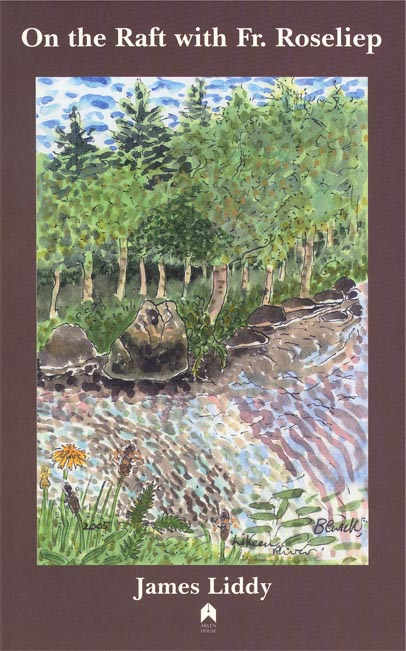 THIS CONTINUING PRESENCE is most evident in the new collection, also published by Arlen House, and, rather fittingly, featuring a painting by the early Dolmen artist Pauline Bewick. On the Raft with Fr Roseliep invokes the memory of Raymond Roseliep, another American-Irish writer transplanted to the Midwest – particularly Loras College in Dubuque, Iowa, which Liddy refers to brilliantly in his note as the “Little Rome of the Midwest”. As a frequent contributor to Threshold and The Dubliner as well as an extensive correspondent with Christy Brown, Fr Roseliep joins James Liddy’s sizable menagerie of poet-saints, for both his work and what he represents. As with many of Liddy’s recent collections in both prose and poetry, On the Raft is both a poetics and a lives of the poets at a time when, as Liddy writes in one poem, “The Writing Programs/ have won, to write is only to teach to get paid, Muses kick/ America in the ass”.
On the Raft opens with Let’s Invade Ourselves Not Iraq, a poem that starts off with the exchange: “Professor, are you thinking of retirement?/ I haven’t fully explored the drinking age yet”. Liddy is expert at inserting voices in his poems and at subtlety in general – and that oxymoronic structural statement lies at the centre of why his poetry is sometimes under-appreciated. In this poem for instance, Liddy combines the epigrammatic gesture and the combined art forms of conversation and gossip: “Autobiography whispers in Cleopatra’s ear noble unencumbered woman/ what would happen if we weren’t failures?” Throughout a tightly structured movement stanzas rotate twice through consideration of self to others to societal considerations until concluding: “I lay agenbite of inwit beside the glass. / Mars, have mercy, direct wars within”.
AS IN LIDDY’S other collections and memoirs, this work is filled with casual mention and allusion. A fragmentary list of those who appear would include Willie Redmond, Charles Bukowski, Patrick Kavanagh, Michael Hartnett, Kay Boyle, Robert Duncan, Bob Watt, Whitman, Pound, Eliot, Graham Mackintosh and Joe Dunn (both White Rabbit Press), Jack Spicer, John Ryan, George Stanley, Baudelaire, John Ashbery, Edward Carson, Oscar Wilde, John Kerry, and, of course, Pope Benedict XV. In one of his best breathless recitations, On Cooking & Jack Spicer, Liddy writes out a litany of the White Rabbit Press (San Francisco) that is an invocation and a catalogue, ending: “These are the lives of the poets. Transparencies. When we dead white rabbits arise we will cook up literature again”. Samuel Beckett wrote in Dublin Magazine in 1934 that “all poetry, as discriminated from the various paradigms of prosody, is prayer”. Going a step further, Liddy repeatedly presses prayer into the service of poetry – his secular invocations, litanies, loves, and devotions ride upon that beatific line.
On the Raft with Fr Roseliep opens with an epigraph from Jack White. In a collection filled with allusiveness – to Fr Roseliep himself, to the Beats who fly throughout his work like so many saints on a Byzantine frieze, to the fellow-poets of Liddy’s many cities on either side of the Atlantic – it makes sense that there’s another name at the start, as it begins:
‘This album is dedicated to, and is for and about the death of the sweetheart. In a social plane, impossible to exist, and in memories, past defeating present. We mourn the sweetheart’s loss . . . ’
The note of melancholy began for Liddy with his very first work, found its first brilliant articulation in one of his most important works, Baudelaire’s Bar Flowers (White Rabbit, 1975), and continues here. This persistent melancholy, though, is that of a true and puckish lover and is discovered only by – in good readerly Beat fashion – taking the poet at his word and entering into his world, searching out this Jack White, or (if you’re one of his many students, or the current generation of writers), you may already know that Jack White is not one of Liddy’s universe of writers but the lead guitarist and writer of the band The White Stripes, whose liner notes from the album Elephant (2003) continue:
We mourn the sweetheart’s loss in a disgusting world of opportunistic lottery-ticket holders caring about nothing that is long term, only the cheap thrill, the kick, the for-the-moment pleasure, the easy way out, the bragging rights and trophy holding.
A new generation should continue to know Liddy’s work so as to know that we have not lost the sweetheart – though the cry must continue from Arena through to Elephant and beyond.
David Gardiner is associate professor of English, and director and editor of Creighton University Press and An Sionnach, publishers of The Collected Poems of James Liddy.
Sunday, January 21, 2007
VICE, The Fiction Issue
 Vice magazine, first time I’ve seen an issue in a good six months or something, maybe more. Since I don’t currently live in New York, L.A., or London, I only get them when a friend gives or sends me one. (Guess I should check the website more often, since you can actually download them for free.) But one thing I immediately noticed was a letter in this issue’s Mail section – a gushing, over-serious ass-kiss (“This is not an ass-kiss,” it begins) from a 37-yr-old man who actually deems it necessary to stipulate, “I am not a part of Vice’s demographic.” The letter-writer is, “however, always drawn to your magazine because it shows a side to society that us comfortably numb old farts can peer into and then ponder the world around us.” It then goes on to laud Vice for its “bold and important” articles, “courage,” the “issues” it “highlights,” etc. The title the editors have given this short missive is “Averting Midlife Crisis.” Inexplicably (for anyone who has ever read the magazine around, say, the early 2000’s), they don’t make fun of this guy in the slightest and actually go so far as to answer, with no real trace of irony, “Thanks, old-timer.” Perhaps Vice has in a sense entered its own mid-life crisis. But then one could hardly expect it to maintain the same relentless style of attack after ten-plus years. But to see them openly accepting a comment about a “demographic” at all, much less tacitly admitting that a 37-yr-old guy might not be part of it, was a bit weird.
It was always well-known that advertising was a major part of the magazine, but it used to be that it was more just a vehicle which enabled them to do their own uncompromised and uncorrupted thing. Now we’ve got product placement in the “Tidbits” section. Believe it or not, underneath the item on the Clone-A-Pussy kit is a blatant promo for Canon’s Elph camera: “Call it brand loyalty but it seems like the Elph just keeps getting better and better...” Is it just me or does this stick out like a sore thumb? Well, at least they actually gave Jay-Z a bad review. On second thought, part of the reason seems to be because he’s too old! And meanwhile, Li’l Wayne gets the thumbs up (unbelievably termed “best rapper in the universe”) for lyrics like this: “Bitch I’m paid / that’s all I gotta say / can’t see you little niggas / the money in the way...” They actually quote this as a testament to his genius. Well, put me in the “old” category too then, because I’ll take almost any half-decent old-school rapper, or anyone who can come up with something at least slightly more original to say, over this. (I agree with them on the Clipse album though. As far as commercial rap goes, it’s not bad.)
But this is Vice’s Fiction Issue and a lot of the sorts of articles that normally would have been included aren’t here, in favor of short fiction pieces. So in some ways it’s hard to compare it to other issues, and it’s not got a lot to do with any supposed demographic. I was really surprised by the high quality of the writing they’ve published. Not because I’m down on Vice, because, let’s face it, despite my above criticisms it’s still the best magazine out there and the only one I would read on a regular basis with any real interest. Really it still is. And despite the occasional clunker, they always seem to come back with a great issue. Surprised just because frankly I don’t read a lot of contemporary fiction, being as preoccupied as I am with poetry and “non-contemporary” fiction. I have, however, read 57-yr-old Richard Hell before – his novel Go Now was pretty good I thought – and his piece here about early sex is too. Also included is a story by the almost 45-yr-old Chuck Palahniuk, author of Fight Club. Sam Brumbaugh (40) conjures a weirdly claustrophobic sense in “Baron in Vegas,” a story about a guy selling his dead semi-famous uncle’s guitar to something like a Hard Rock Cafe. Harmony Korine’s (only 34) fictional (?) conversation between Ol’ Dirty Bastard and Clint Eastwood, though, comes off as rambling and a bit dull, but then probably how it would have gone down in real life. Another filmmaker, Neil LaBute (44) (who, unfortunately, directed that awful remake of The Wicker Man) has a really good story here, about an office racist. He gets into some pretty twisted shit (no pun intended) (you have to read it to know what I mean). And I have to mention Eileen Myles (57), a really interesting figure, a punk poet who’s been doing a lot of great stuff since the 70’s – “Tapestry” is no exception, a brief chronicle of certain erotic adventures, which she likens to “a procession of beaver shots.” Speaking of poets, when is Vice going to do a poetry issue? Or have they already and I missed it?
Anyway, I could go on, because almost every story in here is really, really good. Sorry for those I left out, but after starting off criticizing, all of the sudden I notice all I’m doing now is saying how amazing this issue is. But alright, one last kudo – as always the photography is great too, not least the cover pic of the Strand Bookstore by Roe Ethridge (age 37). Enough.
Thursday, January 04, 2007
Maurice Scully, Tig
 Got Maurice Scully’s latest book, Tig (Shearsman Books, 2006, 102 pp., ISBN 978-0-907562-96-2), which is the conclusion to his massive meisterwerk entitled Things That Happen. Tig follows Five Freedoms of Movement (1987, 2001), Livelihood (2004), and Sonata (2006). At present I have not gotten my hands on the penultimate volume Sonata, so I’m looking at Tig as its own thing, and am not at the moment all that worried about how it ties in with the rest (although I have read the others, Livelihood being the bulkier volume).
But now that I see the gigantic scheme of all this, I am reminded of William Carlos Williams’ Paterson, which, like Things That Happen, is a large continuing poem written over the course of decades. And though I don’t want to stretch the comparison too far, Scully, at the very least, is obviously a poetic kindred spirit to Williams.
Tig opens with an image of a butterfly migration, an “immense blizzard of wings,” but Scully, as always, wants to get under the surface of the image. It is not only the beautiful forms and colours one sees, but also “...light exuding // over the visible / light intruding...” and there is a comment on the evolution of insect wings, and a rectangle representing a window, “rain on glass to the side of yr face...” Then comes what is more or less the book’s central (and recurring) image, a leaf falling from a tree (thus the cover photo), again seen from a windowpane, a windowpane that is the lense through which the poet sees, at a remove:
different (or) touching a windowpane where
drops gather ( ) difference ( ) &
or different
The window implies a house behind it, which is a central concern here too. A couple of sections have the title “A Place to Stay”: a space where one lives, or from where to engage with the wider world, as in a society, how one approaches society from one’s own space. In Munster Irish, the word tig means “house.” The themes are simple but the actual process may be complex. The section “Backyard” gives us a crisp picture, “on still pools oakleaf / folded in a muddy crevice” and wonders, “are we just / photographs talking...?” Life is “one elong- / ated crisis (with / modulations)....” Things that happen.
But it is the modulations that are of crucial importance here, otherwise why put pen to paper, fingers to keyboard. The falling leaves suggest age; there is an oblique reference or two to death. And modulations in writing. The best thing about Scully, for me, at the moment, is his style, which he’s really honed at this point. It’s got clarity and precision, even the way it looks on the page is made for particular effect, the use of certain marks, and the occasional use of the Irish language and Gaelic literary tradition totally makes it. It has got purpose, and he says so:
I’ve had quite enough
CreativityFree Expression, Genius & all that.
Quits.
Let’s communicate.
That’s the end of book one. Book two opens (nearly) with an observation, “essentially a poem is a flat surface covered in part by groupings of twenty-six quite well-known symbols.” Later an ironic joke:
All that these able writers have said on language has been
challenging, provocative, & generally very helpful.
Thank you.
And that’s where it starts to get really good, I mean really turned up a notch. All the images from the first half of the book are reconstituted, repeated, cut up in a sustained burst of energy, like watching a fireworks display, which keeps getting more and more spectacular till the end. For me, Scully is one of the very best Irish poets alive today. Tig reconfirms it; and this book is worth your while.
Saturday, December 30, 2006
Eric Basso, deux livres
 Eric Basso is a poet, novelist, playwright, and critic, born in Baltimore in 1947. His output is prodigious, though I had not read him until I received these two well-made books. Decompositions: Essays on Art & Literature, 1973-1989 (Leaping Dog Press / Asylum Arts Press, 2006, ISBN 1-878580-58-2) is exactly what its subtitle says it is, a collection of critical essays. Although “critical” is perhaps not the right word, because these are more along the lines of explorations of the subjects Basso chooses to discuss, his responses to them, rather than the sort of critical writing one would find in a review, for example. His prose is clean and readable, while exceedingly erudite.
Although he does not restrict himself, his main interests clearly lie with the French – Romantics, Symbolists, and moderns. Occasionally, I feared I would find myself lost. I am of course familiar with the likes of Baudelaire, Mallarmé, Paul Valéry, et al. But I must reluctantly admit that Villiers was merely a name to me, and de Nerval little more (de Nerval of the famous pet lobster). As for Jarry, I am again shamefully deficient: although I did once see a staging of an Irish-language version of Ubu Roi, I remember only a tiny bit of it. But not to worry, for Basso actually makes all this stuff accessible in the context of his essays. The pieces on de Nerval and the (English) Elizabethan playwright Cyril Tourneur I found particularly enlightening – the collection is certainly capable of broadening one’s scope. With the above, I would add that the piece on the painter Géricault (whose study of severed limbs graces Decompositions’ cover) is exceptional.
Basso occasionally verges into the philosophical, as in his discussion of Mallarmé’s courting of “Void”: “Thus we have the conscious mind, always at one remove from its core of being, able to conceive an idea of—but unable to know—itself, by such ignorance, reducing all notions of personal identity (which implies consistency) to a nebulous comedy of ever-changing masks.” But it is not always this...rarefied, and of course it was Mallarmé who became obsessed with nullity before his descendant Basso. And, while he sometimes appears to be in love with needless, antiquated diacritical marks (“rôle” for “role,” “reënter” for “reenter,” etc.) and a florid font style, he is able to convey the “abstract” concept relatively clearly and efficiently.
But for me personally, the best essays in Decompositions were the ones that took up writers I was more familiar with myself – Kafka, Céline – and I found Basso to be about as on the mark as anyone can be in his reading of Joyce’s Finnegans Wake, certainly an arduous task for even the most knowledgeable Joycean. He makes a couple of possibly overlooked points here. One being that (referencing Harry Levin) the Wake is relatively poor in visual imagery, with the emphasis instead on its bizarre wordplay. Therefore, rather than the massive dream that some have proposed FW to be, Basso suggests something along the lines of “hypnagogic trance”: “Certainly, true dreams seem more coherent, if only to suspend our disbelief, to keep us sleeping in ignorance of a veiled chaos.” The implication is that the Wake is the “veiled chaos” revealed. Later in the essay he writes, “The elucid language of Finnegans Wake is the architectonic transmutation of culture, myth and romance on the grand scale, like the sacred books of the past...”
 However, Basso is quite interested in dreams, and thus Revagations: A Book of Dreams, Volume I, 1966-1974 (Leaping Dog Press / Asylum Arts Press, 2006, 386 pp., ISBN 1-878580-57-4). It is hard to “review” a book of this nature. You are either interested in it, or you’re not. For some, the material of the subconscious will be worthy in and of itself; for others, the dreams of a stranger with whom one has no personal connection will seem boring. I myself am in the former camp, for the most part. Oddly, Basso’s dreams even reminded me of my own in places. His introduction draws heavily from the French – no surprise there, knowing his preoccupations now – with much discussion of Valéry’s, Victor Hugo’s, and de Nerval’s work, as well as that of the English Romantics like Shelley.
And here is a brief, interesting taste of Basso’s own nocturnal travels: “An old-neighborhood girl, whom I am to marry, is vacillating between me and two unknowns. She looks nothing like I remember her, much younger and far more attractive.... We walk down a cobblestone alley, near the back of St. Bernadine’s. The atmosphere gradually becomes more European. A pub, below street-level, at the end of the alley. I’m still wearing my baseball umpire’s cap and sunglasses. As we approach, Dan tells me to remove the sunglasses, that it is illegal to go incognito into a public gathering.... The pub is dark, crowded. Thick wooden tables heavily marked with graffiti, a cloud of smoke through which we see barmaids coming and going.... I hail one of the barmaids with a sweeping gesture: ‘Coke for everybody!’....”
I may have been there too one time.
Tuesday, December 19, 2006
Susanna Roxman, Imagining Seals
 Susanna Roxman, a Scottish-Swedish poet, recently sent her book Imagining Seals (Dionysia Press, ISBN 1-903171-19-9). I guess in a nutshell I would say that it’s written in a straightforward, lyric style, with a partiality to Classical mythology (some of the poems deal with themes like Eurydice and Orpheus, Circe, etc.). But Roxman has an interesting voice and brings a certain originality to her work on the whole. For example, in “A Roman Officer in Winter Quarters,” a poem with historical subject matter, she gets psychological, using expressions such as “It’s like lying awake in darkness between two dreams about rage” and “An overwhelming winter moon / floods me with sleep-inducing water.” But for me, the more interesting pieces were the ones that presumably come from the author’s real life experience, say snapshots of Edinburgh on a rainy evening, cigarette butts, and empty beer bottles slowly filling with water (“Rain in Edinburgh”). Or “The Haunted Hut,” rendered in rather stark terms:
It looks like a TV set,
the deserted Lappic hut,
screen facing west
but walls covered with torn turf...
The couple of dream poems (one identified as such, one not) also stood out to me, but I have been known to appreciate subconscious materials at times. I have also written about seals myself, now that I think about it, so I should say something about the title poem, “Imagining Seals” (which can be read at the link). It might be true that “something otherworldly and weird / clings like wetsuits to these creatures” (I liked the ironic “wetsuit” description), and it is certainly true that seals have very expressive faces, which quite obviously reveal some kind of thought or emotion, making you wonder at the whole idea of sea mammals – it’s astounding sometimes, really, when you see them sticking their heads up out of the water by the shore, looking at you. What I didn’t like about the poem was the cliché of “Seals live effortlessly by lunar logic, / are psychic, understand cycles...” and are “serene and healing” and all that. Maybe they are, maybe they do, but this New-Agey sort of thing is played, big-time. At least the poem sort of saves itself with the oblique ending, “Mostly, though, your mind is not on seals.”
This varied collection is certainly worth a look, in any case. Apparently the publisher does not have a website yet. £6.50, Dionysia Press, 127 Milton Road West, 7 Duddingston House Courtyard, Edinburgh EH15 1JG, Scotland.
Thursday, December 07, 2006
A United Ireland, Pt. 2
 Further to my previous post on the possibilities of a united Ireland, I recently read this Irish Times article about Ireland’s fast-growing census figures. If the predictions that the island will reach 8 million people in twenty years’ time (up from the present 5.5 million) is anywhere near correct, it makes planning for housing on an all-Ireland basis utterly necessary. There is apparently talk of creating a new metropolitan area out of Dundalk and Newry (which, for those who don’t know, are towns that are presently on opposite sides of the Border). Some kind of a united Ireland will really become a necessity as the population of the island of Ireland continues to grow. Economic and structural necessity means planning for housing (for one thing) on an all-Ireland basis.
The British government already recognizes the necessity of working closely with the Irish government on the North of Ireland. They have already stated outright that if the various political parties can’t agree to govern under the recent St Andrews Agreement (2006) for the implementation of the Belfast Agreement (a.k.a. Good Friday Agreement, 1998), that the two governments will forge ahead and implement the Agreement themselves. (This intent is specified in section 12 of St Andrews.) It is also quite possible that the two governments, without being hampered by wrangling with the parties, would be quite content to go even farther than the parties themselves can currently agree to amongst themselves. So in regard to the two governments’ position, a kernel of joint authority already exists, whether or not anyone wants to call it that. The principle of giving the Irish government a role in the governance of the North has long since been ceded by the British, and it certainly doesn’t appear to be going anywhere. Strand Two of the Agreement is all about North-South relationships. And whatever they call it in the short term, things will likely continue to move in the direction of closer North-South integration. A united Ireland might not come about in one dramatic fell swoop, as republicans had originally hoped, but in my opinion a united Ireland seems inevitable.
Deep down the British government might, one suspects, even prefer a united Ireland. Near the beginning of the Irish peace process they issued the Downing Street Declaration (15 December 1993), another joint statement with the Irish government. Section 4 of this Declaration reads, in part:
“The Prime Minister, on behalf of the British Government, reaffirms that they will uphold the democratic wish of the greater number of the people of Northern Ireland on the issue of whether they prefer to support the Union or a sovereign united Ireland. On this basis, he reiterates, on the behalf of the British Government, that they have no selfish strategic or economic interest in Northern Ireland. Their primary interest is to see peace, stability and reconciliation established by agreement among all the people who inhabit the island, and they will work together with the Irish Government to achieve such an agreement, which will embrace the totality of relationships. The role of the British Government will be to encourage, facilitate and enable the achievement of such agreement over a period through a process of dialogue and co-operation based on full respect for the rights and identities of both traditions in Ireland. They accept that such agreement may, as of right, take the form of agreed structures for the island as a whole, including a united Ireland achieved by peaceful means on the following basis. The British Government agree that it is for the people of the island of Ireland alone, by agreement between the two parts respectively, to exercise their right of self-determination on the basis of consent, freely and concurrently given, North and South, to bring about a united Ireland, if that is their wish. They reaffirm as a binding obligation that they will, for their part, introduce the necessary legislation to give effect to this, or equally to any measure of agreement on future relationships in Ireland which the people living in Ireland may themselves freely so determine without external impediment. They believe that the people of Britain would wish, in friendship to all sides, to enable the people of Ireland to reach agreement on how they may live together in harmony and in partnership, with respect for their diverse traditions, and with full recognition of the special links and the unique relationship which exist between the peoples of Britain and Ireland.”
Assuming we can take this at their word, it essentially means that the British position regarding the North of Ireland is now officially neutral, and that they will even help institute a united Ireland, as long as it is through consent. They specifically state that they have “no selfish strategic or economic interest” in holding on to the North, which pretty obviously shows that they see it in a different category to the rest of the U.K. They don’t, for example, go around making joint statements with the Irish about not having a “selfish strategic or economic interest” in England, Scotland, Wales, or Cornwall. And they also make a conspicuous distinction between “the people of Britain” and “the people of Ireland.” A British government source at the time interpreted the Downing Street Declaration as meaning, “We step back. We’re here for historical reasons but if the people of the island as a whole want to go in a different direction then we’ll accommodate that” (quoted in Brendan O’Brien, The Long War, Dublin: The O’Brien Press, 1995, pp. 299-300).
Current trends in the U.K. could soon impact the Irish situation as well. The Scottish independence movement is once again picking up pace, and a recent poll clearly suggests that the British themselves would prefer an independent Scotland, and for the U.K. to break up. If Scotland were to become independent, it is hard to see how a union between the North of Ireland and England, for example, could remain much of a viable prospect. The logic for the union would, in that case, be blown to smithereens much more effectively than any hypothetical IRA bomb. (Here is the Scottish Nationalist Party’s website, which includes links regarding its vision for Scottish independence.)
Perhaps I am going against the orthodox republican movement’s views on this, but I don’t think a unitary 32-county Irish state is immediately required. I think the way it will probably work is that, in the short term and for a while yet, the Six-County North will continue to exist as a regional entity, but that a growing all-Ireland economy, cooperation in the health, housing, and education systems, etc. will create closer integration by default. And reflecting this, the British and Irish governments will continue to work ever closer as regards the North, to the point where a united Ireland becomes virtually a de facto reality, with the Six Counties set off as a region of joint cooperation, where the euro and the pound eventually co-exist, and as do Irish and British nationalities, with bilateral connections to both the Republic of Ireland and the U.K. The embryonic structures are already there – the North-South Ministerial Council and the North-South Bodies set up under Strand Two of the Good Friday Agreement.
What I am suggesting might happen, though it’s hard to predict the future, is a moving closer of North and South as a result of material and economic realities (this aside from the political and identitarian issues of the peace process). The connection to Britain would most likely not immediately cease, or perhaps ever completely cease, just that in the short term the connection to the South would continue to increase. What’s wrong with retaining the Northern Assembly, for example, even as these ties to the South grow?
Irish unity could even coexist with “British unity” until such time as it would be necessary to, or there appears to be a critical mass in favor of, holding a Border poll (if the U.K. doesn’t break up on its own first). The section of the Belfast Agreement on “Constitutional Issues” expressly provides a mechanism for a referendum on a united Ireland “if at any time it appears likely to [the Secretary of State] that a majority of those voting would express a wish that Northern Ireland should cease to be part of the United Kingdom and form part of a united Ireland.” Such referenda can be repeated at seven-year intervals, per Schedule 1, Paragraphs 2-3.
Of course, such a referendum, if it were to happen, would not be called until the unionist community might come to the conclusion that the economic and material realities on the ground (which make closer North-South ties necessary) don’t in any way detract from their British nationality. Indeed, the benefits of these ties are an all-island economy which brings greater prosperity to everyone (or, at least as much as in any other capitalistic society). Economic or material reality ultimately overtakes political ideology. It is not a matter of coercing unionists into an arrangement that they are uncomfortable with, simply that both British and Irish nationality should be allowed to coexist in the North, if the two communities cannot agree on a shared national ethos. Nobody wants to deny unionists their aspiration to remain part of the U.K., but equally then the aspiration of nationalists and republicans in the North to be an official part of the country of Ireland must also be granted as of right. Why should one be valid but not the other? The answer is a coexistence of national arrangements, unless a common one can be agreed. Why should a double-standard be vaunted?
As for the political connections to Britain and the South of Ireland, there’s no real reason to say that, for example, at some point in the near future some MPs from Northern Ireland can’t go to Westminster if they want, while others go to the Dáil instead. Or even at times to both. Why should it be unworkable? The Irish Seanad already allocates a number of seats to representatives from the North. And Sinn Féin representatives presently abstain from sitting in Westminster, yet the U.K. parliament functions just fine without them. So all of this would simply be an officialization and expansion of practices that already exist. Allowing Northern representatives to sit in the Dáil is an issue that has indeed been raised. It hasn’t been enacted yet, but again I think it’s a matter of time. Given that the Good Friday Agreement already recognizes rights of those born in the North to Irish citizenship, there is an onus on the Irish government to give representation to all of its citizens in the legislature. I am not a member of Sinn Féin or any political party myself, but SF has put forward a compelling plan for Northern representation in the Oireachtas. (For that matter, SF’s complete practical plan for Irish unity is well worth a read – and other facets of their proposals for reuniting the country can be found here.)
Of course there are objections to any move toward a more united Ireland. There is the economic argument: the North is heavily subsidized by the British government and many of its jobs are in the public service sector. Well, while an immediate British withdrawal would be great from a strict republican point of view, what I am suggesting in the shorter period is not some sudden withdrawal, or full-scale annexation of the North by the South, which could lead to chaos. What is envisioned in the shorter term is the British government continuing to have its connections to the Six Counties in parallel to all-Ireland structures. The Northern economy would continue to be supported by the U.K., but would have extra input from the Republic of Ireland. The North is part of the island of Ireland, and the rest of the island is a natural market, at least as natural as Britain and probably more so. The South is more than capable of filling the gap over time, while the British market would exist as usual. The EU is a common market anyway. And the Irish economy has been relatively booming for the last decade and a half. For that matter there will probably even be U.S. investment involved.
Another objection is: unionists will react to any political moves towards a united Ireland, and violence will ensue. Well, first of all, if people condemn the IRA for its (now ceased) campaign of violence, then to threaten unionist violence is as equally wrong on a moral level. Hopefully over time unionists will understand that the connection with Britain need not be ended, and that an Irish national connection, for those who want it, need not be a threat to their British national connection and identity. Both can coexist. It should not be a question of coercion one way or the other. But there must be equality of national aspirations, or the conflict will probably go on endlessly. I am talking about freedom of choice – the freedom of nationality, to play a full part in the nation of one’s choice, be it Ireland or the U.K. or both, from within the Six Counties. Not simply a recognition or toleration of “cultural identity” under one country’s rule but not the other. For too long unionists have had the idea that their interests can only be served by dominating the other side. I am making the humble suggestion that it will be better for everyone if both communities’ national interests are fulfilled side by side, and no one dominates over anyone else. Until such a time as a common national ethos can be agreed, people in the North should have full rights to be part of either country, from within the North. Or again even both, depending on one’s choice. And then perhaps when everyone is on an equal footing in this respect there will even be some common commitment to the Six County/Northern Ireland entity.
But the immediate issue is the attempt to get the Assembly and Executive up and running again, which was the purpose of the St Andrews talks. That is, to get people to engage with each other through the mechanisms of the Belfast/Good Friday Agreement, and to fully implement this Agreement, which after all was voted for by large majorities in concurrent referendums on both sides of the Border. These referendums were the only significant time since the landmark 1918 all-Ireland election (which, incidentally was won in a landslide by Sinn Féin – they won 73 seats out of 105) that the people of Ireland have voted as a whole, and thus take on an importance that cannot be easily denied.
It appears that Ian Paisley and the DUP have now actually agreed in principle to share power with Sinn Féin. Time will tell if this comes to happen, but to even entertain such a notion would at one time have been considered ludicrous. So progress is indeed being made. One sticking point is policing, but my personal impression is that SF wants the Assembly and Executive to work, and so will attempt to deal with policing as best as possible. However, at the time of this writing, there is still a lot of work to be done to make the PSNI even somewhat acceptable to republicans. SF has set out an approach to the issue. But it is a difficult task, especially from the point of view of one who has in the past, say, been a target of RUC violence, or whose relative has been killed by a plastic bullet, or whose community has been on the receiving end of state oppression, etc. With this kind of history, even reaching the level where the PSNI are only hated as much as the regular police force in any regular country is difficult.
The police in the North have always been perceived – and with good reason! – as a sectarian enforcer of British/unionist policy. A lot of work remains to be done to set the PSNI on the right path, and as long as only the British government has sovereignty over the North, there will be some who refuse to recognize what they see as a British-only police force. Indeed, there is criticism of Sinn Féin’s approach to all of this from within the republican community (much of which can be read at The Blanket website). Time will tell what happens with this, and if SF is in a position to endorse policing, which is the real-politick condition for agreement on revivifying the Assembly and Executive. The time-frame seems to be January 2007, to decide whether there is sufficient agreement to continue with these. I have mostly been talking about “big picture” issues here, because the more immediate debates are fast-moving and hard to predict. Whatever the outcome of all this, I am convinced that the two parts of Ireland will continue to move closer together, making a united Ireland in one form or another an eventual reality.
Saturday, November 04, 2006
Black Mountain Review 14
 Just received what is likely the final issue of the Black Mountain Review (that is, the Irish one, not the famous American one of the 1950s and 60s). It’s a shame that it’s folding, because it was a steady, well-produced journal focusing firstly on the North of Ireland, but then also the whole of Ireland and the world as well. I myself have appeared in its pages many times. I guess, however, many a good literary magazine’s days are numbered (and sometimes that is even what ought to be). BMR had a seven-year run, and began roughly at the same time as The Burning Bush. The associated Black Mountain Press has also published some very important books of poetry and prose, not least of which was the forward-looking anthology Breaking the Skin: Twenty-First Century Irish Writing. It is to be hoped that the Press can still continue in some way.
BMR 14 includes a range of poetry and short fiction, with some criticism mixed in, much of it part of this issue’s special feature on “Oriental writing” (I thought “Oriental” was becoming a politically incorrect term?). The piece that most caught my attention was British poet Kevin Bailey’s article “The Problem with Haiku.” I was very interested to read that there is currently a new generation of British poets coming to the fore who have been consciously influenced by the haiku and other Asian forms, as were the Imagists of the early 20th century at the instigation of Ezra Pound, T.E. Hulme, and others. In fact, Bailey goes so far as to call contemporary poets such as Chris Powici, Daniel Healy, Harry Guest, Gary Bills, et al. neo-imagistic.
One thing I would take issue with, perhaps – Bailey claims that “the entropy of the British literary establishment quickly snuffed out the Imagist movement.” He immediately goes on to question his own assertion by citing a “filtered-down” imagism in the work of Wilfred Owen, Edward Thomas, and the later Hardy. Which is not off the mark, but is to ignore the fact that Imagism (along with Symbolism in France) essentially gave birth to the whole of Modernism, and thus poetry as we know it today. Free verse itself, the clear, crisp image, the move away from Romantic abstraction – all of this comes right out of the Imagist movement. Pound, William Carlos Williams, H.D., Wallace Stevens, etc. all started their careers as Imagists. Granted these were American, and Bailey here wants to concentrate on British poets; he wants to make that distinction. I don’t know if you can, at least not completely. Did Modernism too fail in Britain? What then of the likes of D.H. Lawrence, Herbert Read, and other British poets who directly took up Imagism and Modernism? In any case, Bailey’s article is quite elucidating, especially in regard to the more recently emergent writers he discusses.
Other things that struck me were the poems of Greagóir Ó Dúill (who has recently made the switch from writing in Irish to writing in English), Gary Allen (a very strong poet from Ballymena), Nigel McLoughlin’s translations of new Cathal Ó Searcaigh poems, “Ferro et Flammis” by Paul Maddern (on the clash between English and Native American cultures at Jamestown, Virginia, c. 1609), and Cosima Bruno’s article on contemporary Chinese poetry. BMR also included a reviews section, an important feature which some journals neglect. This magazine will truly be missed. But kudos must go out to its editors Niall McGrath and Sonja McGarr, who in their editorial at least hold out some small hope of a rebirth “in the next few years.”
Thursday, October 26, 2006
American Hardcore soundtrack
 I haven’t seen the film yet. It’s not playing where I’m at. I might have to wait till DVD. But I did pick up the soundtrack, officially titled American Hardcore: The History of American Punk Rock 1980-1986 (Rhino). A lot of this stuff I already had – most on the original vinyl (no, none of it’s for sale!). But it was good to get a few of the rarer tracks on CD. YDI comes to mind. Their included song, “Enemy for Life,” is from the 1983 Get Off Our Backs comp, rather than their A Place In The Sun 7”, though both are now difficult to find I’m sure. Who would have guessed that this band would turn out to be one of the standouts of the whole album? Cool that Philly gets some kind of representation, because it actually had one of the best hardcore scenes, even if bands like YDI, Ruin, F.O.D., McRad, Sadistic Exploits, etc. weren’t as well-known nationally. But if you ever went to shows in Philly in the early 80s, then you know how great a live band YDI was.
Yet New York City had a similar problem. Aside from Agnostic Front, the Beastie Boys, and later the Cro-Mags, N.Y. bands weren’t as celebrated as say D.C., L.A., or even Boston bands. The reasons for this are varied, and probably a lot of it has to do with touring and record distribution. But again, if you went to the hardcore matinees at CBGB’s in the early 80s, or shows at A7, Gildersleeve’s, or wherever, then you know that bands like Reagan Youth, Urban Waste, Major Conflict, etc. were great bands. Their records, unfortunately, were hampered by production issues and didn’t have the same primary impact as the Dischord records for example.
Of all the bands I’ve mentioned so far, the only ones appearing on the AHC soundtrack album are YDI and the Cro-Mags (interestingly, with a 1982 demo track). Given that there were so many great bands out there, and so many hundreds of records released in hardcore’s heyday of ’80-’86, it would be impossible for one 26-song CD to be truly representative. AHC gives it a decent try, though. Geographically it is wide-ranging, but understandably gives more weight to the cities that really originated the music. L.A. has four entries here: Black Flag, the Circle Jerks, the Adolescents, and the early band the Middle Class (“Out of Vogue” is a great track, but incongruously came out in 1978, before the collection’s stated time frame – so where are the Germs?). Washington D.C. has Minor Threat, the Bad Brains of course (though I guess the latter also counts as a N.Y. band), and Scream, Void, and the Untouchables – great bands for sure. The latter’s “Nic Fit” was always one of my favorite tracks on Flex Your Head, but would you really say that the Untouchables are more representative of the D.C. scene than Government Issue, who do not appear? (Or if we’re talking about older D.C. bands, what about S.O.A.?)
Boston gets four bands – SSD, Gang Green, Jerry’s Kids, and the Freeze. Not a bad selection. The awesome Negative Approach are on it, but if we’re talking Midwest bands, how could the Necros possibly be left out? Or Hüsker Dü? San Diego’s Battalion of Saints is in, but not L.A.’s Wasted Youth? Nice to see the Big Boys getting their due, but no Dead Kennedys? I’m not a huge DK fan nowadays, although I did really like them at the time, and a lot of their stuff still holds up. In any case, they were one of the most famous HC bands ever, yet they are not on this compilation. That is very odd. I hear they are not in the film either – either a gross oversight, or there was some disagreement over the specifics of getting them involved. And the biggest absence of all...the Misfits! I hear they were left out of the film also, and this strikes me as a major, major drawback. Given that the American Hardcore book devotes a whole chapter to the Misfits, I can only imagine that again there was some disagreement, or some legal issue, or something....
It’s easy to nitpick about what bands should have been in this collection. Given the limited amount of space, it would be hard to please everybody. A truly comprehensive retrospective would take at least three discs, probably more. But without the Misfits or DK’s, the “history” aspect (which is specified in the disc’s subtitle) is going to be a bit skewed. None of which is to say that any of the material on here is weak, because in fact it’s all really good as a whole. A couple of the tracks might fall a bit flat, but this is just down to subjective personal taste. For example, Articles of Faith never really did it for me – I don’t know why – even though I still bought their records. On the other hand, I was glad to be reminded how great Die Kreuzen really were.
Aside from quibbling over what bands should or shouldn’t have been included, one serious issue with this CD is the fact that the liner notes are shit. Actually, there really aren’t any liner notes per se, just a brief statement by the writer/producer of the film, Steven Blush, about the importance of hardcore as “short dissonant blasts, angry sociopolitical lyrics delivered as a primal scream – with little regard for the previous rock tradition...” This is fine as far as it goes, but there was scope for much, much more. There’s no band info aside from the bare minimum (writing credits and a date), no listing of band members, no information about the source of these tracks, and only a handful of photos. Before I opened it, I expected better in terms of printed information. Some kind of factual history, cooler photos (the ones here are mostly marred by an overlay of title lettering) – but unfortunately it was not to be. Blush’s book was great; maybe he didn’t want to repeat himself. Nonetheless, for the uninitiated listener who perhaps has only recently heard about hardcore, or seen the film but knows little else about it, well, s/he’s not going to find out much from this package. The music at least is still amazing. But the release of this CD makes me realize how necessary a true hardcore anthology is now. The American Hardcore soundtrack doesn’t claim to be definitive, but a definitive anthology is certainly needed.
Thursday, October 05, 2006
Burdock
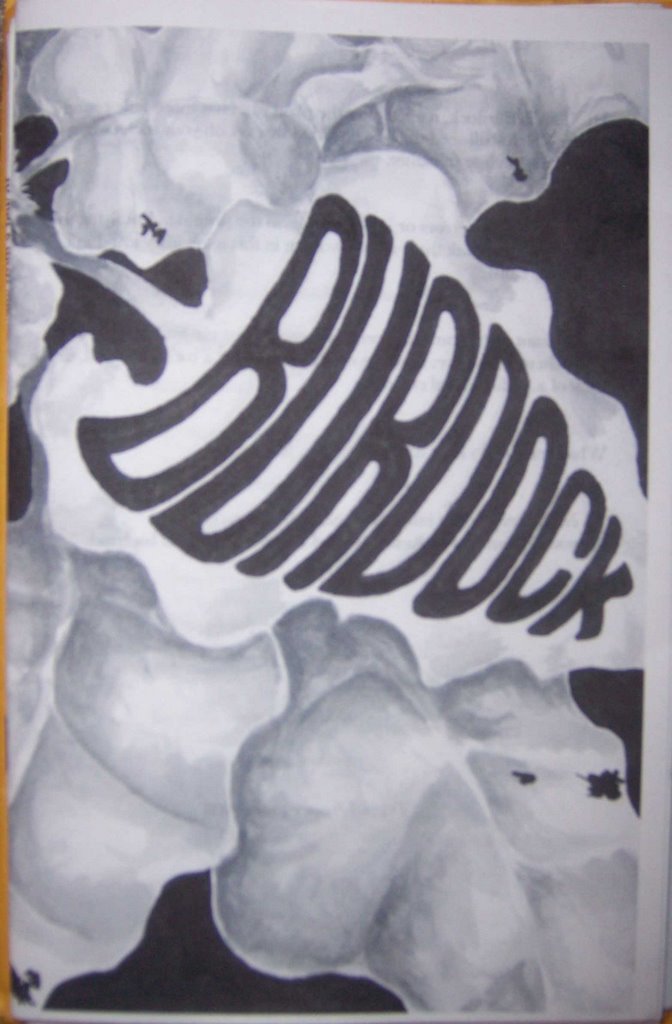 Coming straight out of Milwaukee is issue number one of Burdock, edited by Keith Gaustad. It features poets such as James Liddy, John Menesini, Zack Pieper, David Stone, Jim Chapson, and myself, among others. A great little collection, and highly recommended. One of the things that makes it particularly interesting is that some of the poems are printed on sticker paper, so you can get them up on buses, men’s room (or women’s room) mirrors, stop signs, etc. A burdock is apparently the plant which has those seed/pod things, or burs, which stick to the cuffs of your pants like velcro...
Copies are $2 (a bargain) from Keith Gaustad, 1515 E. Kane Pl. #39, Milwaukee, WI, 53202, USA. Submissions for issue two can be sent to the same address (with an SASE), or inquire at burdockmagazine@yahoo.com
Yes, Milwaukee is a hotbed of poetic activity (I’m not joking)...
Wednesday, September 20, 2006
Avant-Post
 Avant-Post: The Avant-Garde under “Post-” Conditions (ISBN 80-7308-123-7, pbk., 300 pp.) has recently been published by the Prague-based press, Litteraria Pragensia. This book, a collection of essays edited by Louis Armand, focuses on “the question of whether or not avant-garded practice remains viable under the prevailing conditions of a whole series of ‘post’- ideologies” (as the blurb sums it up)(i.e. postmodernism, post-structuralism, etc.). It includes a fantastic lineup of poets and critics such as Rachel Blau DuPlessis, Johanna Drucker, Pierre Joris, Lisa Jarnot, Robert Archambeau, Christian Bök, Mairéad Byrne, and many others, including – last but hopefully not least – myself. It seems like a great book (I haven’t read it yet, but my copy is supposed to be in the mail).
My article is “The Ancients Have Returned Among Us: Polaroids of 21st Century Irish Poetry.” As the title suggests, it is something of a recent history of Irish poetry, roughly of the non-“mainstream” variety, through the lens of The Burning Bush (which I edited from 1999 to 2004). It is therefore rather subjective, and deals with some writers, controversies, and recent developments which struck me as interesting and/or important. I will say no more for now, and hope that everyone buys the book.
Tuesday, September 12, 2006
Dán i gCrannóg
 Seo é dán de mo chuid a d’fhoilsigh an t-irisleabhar liteartha Gaillimheach, Crannóg, in eagrán 12, Samhradh 2006:
Lá Bealtaine, thar Sáile
B’fhearr na rainn a chumadh
agus tuirse ort, easpa suain
nó go dtiocfadh aislingí sa dhúiseacht,
nó, mar a déanadh roimh éag do Mhongán,
riamh i seomra dorcha
ag déanamh aithrise ar chodladh aríst,
nach dtagann
Cuardaíonn tú leabhar nótaí,
láithríonn buidéal beora,
teilifíseán ar ‘MUTE’,
cat i bhfuinneog trasna na sráide
ag breathnú ort
trí theas tiubh an tráthnóna —
tine tine
— Mícheál Ó Beigléinn

Saturday, September 02, 2006
Che Elias, Death Poems
 Che Elias is probably one of the most original writers today, and one of the most real. His latest publication, Death Poems (from Six Gallery Press, with whom I am incidentally also published), furthers the project he began in 2001 with a book called Rockets Construe Vala. Death Poems, by the way, seems largely to resemble the form of all of Elias’ books, somewhere between poetry and prose, sometimes dream-like narrative:
And then she pointed to a hole in the floor which she wanted OscarSome of the pieces in Death Poems have titles, but most don’t. This is from the section called “One Really Big Jar or Two Maybe”:
to crawl into and she put him there and through some of the culture which
Wheeling consists of down there with him,
And he was down there for a
while...
And he wore a fox maskIn all of literature I can think of no one who has quite written anything like Elias has, with the possible exception of Lautréamont, or William Burroughs. He is that extreme, that violent, writes as freely as his own savage and true visions. What I wish to say is that none of it is for mere effect. There are so few now who write for nothing but their own sakes, out of compulsion, the actual primal writer figure (I was going to put this last phrase in quotation marks, but find no, I cannot), who is unaware of and unconcerned with the notion of acceptance – as Lautréamont and Burroughs were also rare examples, and perhaps Bukowski. Che Elias is such, or at least as much as it is possible to be so. Where many seek to exploit their pain in order to appear on Oprah, Elias is writing this:
and he was just
that
one
person
who they called a real
piece of
shit
and
he remembered that when he gathered around them all as they
were dying when he laid them out none of them said he was sorry...
Those questions they all asked youThen, from the same section:
Did they touch you
here
And they point to your crotch
Or was it there
And then they point
to your anus...
What was it these men did to you
Exactly?
...They play images of themselves in Wheeling, the images of menIn the last year or so it has come out that the author J.T. LeRoy is apparently the creation of Laura Albert. While I personally cannot judge what really happened in that situation, it does seem that LeRoy is, strict definition at least, a “hoax.” I mention this because it makes me think of Elias, but only by contrast. LeRoy was supposed to have been from West Virginia, and supposed to have suffered sexual abuse and exploitation. Many people have said that it was the “authenticity” of the figure of LeRoy, beyond the actual writing, that made him/her such an attractive proposition. But Che Elias really is from West Virginia (Wheeling), and really has had to deal with abuse. Death Poems is about abuse, and how it is used to control people. But Elias does not court victimhood in such a manner as to become a bestseller in today’s book industry, nor does he write in a very easily accessible style:
against Magic and in hell, they always cast that whole part of life on the
screen, that whole misery and the exhuming, some of them lay down in
graves...
...That it is done that way in Wheeling, what filth you’ve
scorched, it was the neighbors, you could have your cock
splayed on the tip
in their basement
or in any other basement in Elm Grove,
I hear you’re
getting along real fine in West Virginia...
 Elias is an artist above anything else. That he is writing about similar subjects as J.T. LeRoy is simply incidental. Yes, if you have suffered sexual abuse, as many have, you might “relate” to Che Elias, and this might give you the illusion of some extra insight into what is frankly a difficult work, a highly experimental work as regards form (the narrative line is cracked, many times over). But ultimately Death Poems has to be approached as literature, not as memoir, even though in many ways it is autobiographical. Ultimately it is in the writing itself that Elias approaches any kind of “redemption”; its existence is its own end. This is really a work about a person writing against his own death, and obviously that is the origin of the title. If Che Elias had not discovered literature I wonder if he would still be alive. Thankfully for all of us, he did.
Saturday, August 26, 2006
Mercury, in ZYX
 Mercury, the Dime was recently reviewed in the literary magazine ZYX. The editor is Arnold Skemer, who (I assume) also wrote the review. I’m actually not sure of the issue number – I’m guessing 40, but if anyone can confirm or correct this, please post a comment. I’ve only seen a tear-sheet/photocopy of the page, not the whole mag.
I hope Mr. Skemer will not object to my reproducing the review here:
MERCURY, THE DIME, Michael S. Begnal, Six Gallery Press, P.O. Box 90145, Pittsburgh, PA 15224, 2005, perfect-bound, 46 pp. 0-9746033-7-6, $6.99. Were it not for having previously read MOBILE by Michel Butor, I don’t think I would have made a point of this, but MERCURY resembles it with its sense of placement in “these United States.” There is movement across the map of signal locations that suggest some abstruse, contemplative quality, the underside of cities and towns, the varieties of descriptive experience: “...the Boyd Hotel,/ empty,/ its outside finish of plaster/ worn off/ ...the paint of its big mural.../ chipped and faded,/ its rates unreadable.” The faded landscape of the perpetually changing nightfall, the undramatic country that is unchanging. These early poems reveal the young poet in development. This ur-Begnal is suggestive of an interesting future which some of us have already encountered.
ZYX, 58-09 205th Street, Bayside, NY, 11364.
ZYX does not have a website, apparently, but issue 10 is online. An opinion piece by Arnold Skemer is also online. Reviews of recent issues of the magazine can be found at New Hope International Review.
(As an aside, the above photo is of the real Hotel Boyd, San Francisco, which, I have just discovered, has recently been renovated! When I wrote about it, in 1993 I think, it was in a fairly run-down yet still bizarrely intriguing state, seen from windows of a passing bus...) (The photo is by Mark Ellinger, from his excellent site.)
Sunday, August 20, 2006
A United Ireland?
 For a variety of reasons I have recently been wondering about the prospects of a united Ireland, not the least being that 2006 is both the 90th anniversary of the Easter Rising and the 25th anniversary of the Hunger Strikes. It’s easy to be pessimistic about Irish unity, however, as there has been little tangible progress in the last couple years, and unionists (particularly the DUP) continue to avoid engaging with republicans on the issue of full implementation of the Good Friday Agreement (which was originally reached in 1998). Still, this is not to say that the Agreement itself is completely in mothballs, since the various bodies formed under its remit continue to exist, albeit with British direct rule ministers replacing those meant to be drawn from the various parties of the North.
It is to be hoped that the current impasse can be broken. The IRA has fully disarmed, and this has been verified by the Independent International Commission on Decommissioning. Therefore the “terrorism” excuse that unionists have hidden behind for so long, in order to avoid talking with Sinn Féin, is no longer tenable. But if the DUP continues drag its feet and an Executive cannot be set up, so be it. Other aspects of the Agreement will go on. So it seems to me like it would actually be in the DUP’s best interest to engage. The alternative is being left out in the cold while the two governments press ahead with a “greener” form of direct rule based on the Agreement anyway. Of course, I am not exactly au fait with DUP thinking.
 From a republican point of view, the Agreement can be frustrating. It seems to give unionism a veto over Irish unity. It is not what the IRA waged a 30-year resistance struggle for. Not what Bobby Sands and the others starved to death for. But the reality of the armed struggle must be recognized – it had reached a stalemate and was not going to achieve an immediate united Ireland. Some would say it had become a detriment to that cause. I personally see no point in going back to the armed struggle. Despite the unpalatable elements of the Agreement, it does include provisions for a united Ireland if a majority in the North votes for it in a referendum. Thus the paradox: how to get a “majority” vote?
 I put the word “majority” in quotes because the Northern state itself is an artificial entity created by a British border commission with political expediency in mind. The idea was to choose just the right amount of territory with a safe unionist majority. The province of Ulster actually has nine counties, yet only six were thought safe enough to become the unionist state of “Northern Ireland.” However, in the past 85 years since the border commission, the unionist majority in the North has been cut to the point where nationalists are just about drawing even. West of the Bann is majority nationalist. While many would criticize the notion of sectarian headcounts and the “outbreed ’em” theory, the Northern state itself was predicated on sectarianism, so possibly it could be a case of chickens coming home to roost? Mindful of Northern Ireland’s genesis, it is quite possible that political expediencies could shift, or are shifting. Being something like 15% of the population of the island of Ireland, it seems unjust that what is in actuality a unionist minority is allowed to perpetuate partition, which affects all of Ireland.
One thing that has been made obvious in the last decade-and-a-half of the peace process is that the British government no longer considers the North to be an integral part of the UK. From Peter Brooke’s statement in 1990 that partition was simply “an acknowledgment of reality, not an assertion of national self-interest” and that “the British government has no selfish strategic or economic interest in Northern Ireland,” to its reaffirmation by John Major in the Downing Street Declaration of 1993, to the Good Friday Agreement itself, Britain seems to have stated that it would not be opposed to a united Ireland. Though the Agreement says “the present wish of a majority of the people of Northern Ireland...is to maintain the Union” (yet note the use of the word “present”), it does also specifically state that the British and Irish governments “...recognise that it is for the people of the island of Ireland alone, by agreement between the two parts respectively, and without external impediment, to exercise their right to self-determination on the basis of consent, freely and concurrently given, North and South, to bring about a united Ireland, if that is their wish...” Clearly the British government does not view the North of Ireland in the same light as the rest of the current UK. (The Agreement was, of course, also accepted by the people in referendums both North and South, by large majorities.)
Personally, I find it hard to say whether a border poll would have any success in the near future. I think that there would have to be a lot of engagement between all sides in the North before any such agreement could be reached, and that a level of trust would have to be built up through the working of the political institutions of the Agreement. But who knows – if a referendum were really to be held it would inevitably focus minds once the tangible possibilities were brought forward. Of course it could also concentrate unionist minds against the proposition, and frankly it is unlikely that they are suddenly going to vote against the Union any time soon. Nor should we expect them to.
I also think that the main reason the DUP has been trying to obstruct the process is because deep down they fear reconciliation, and they know that change is in the offing, in some form or another. They would rather maintain sectarian division as a means of preserving the status quo. It’s ultimately got to be a useless tactic. Certainly there are some in the party that recognize this. In an interesting move, the DUP recently (19 Aug.) lauded Sinn Féin’s approval of a DUP motion calling on all paramilitary groups to stand down. Not only did this allow SF an opportunity to reiterate its peace strategy, but it prompted DUP MP Gregory Campbell to say, “We are pleased that the representatives of all the parties, particularly Sinn Féin, accepted the impact that such a move would have on community relations and that it should occur immediately.” A possible opening to negotiations with SF? In reality, the DUP has already sat in the Stormont parliament of which SF was also a part, and works with them on committees and in local councils.
But perhaps an Executive, or a referendum on Irish unity, isn’t really even that necessary in the short term. The North-South bodies which exist as part of the Agreement can be built upon. They could even be considered the embryonic structure for a united Ireland. They are already there. Certainly Sinn Féin’s strategy for achieving that goal is to build upon the all-Ireland structures of the Agreement. As I am not a SF member (or a member of any other party or political group for that matter) I won’t parrot their policies here, but they are well worth taking into consideration. I can’t say that I disagree with them in the current circumstances. The Agreement was always simply a transitional period, and the political situation is fluid. The Agreement stipulates that there will be “at least” six cross-border bodies, but does not rule out more. It could well be that given the tide of history and demographics, and the (hopefully) neutral position of the British government, along with the all-Ireland frameworks already in place, that we could see a united Ireland become the de facto situation even as the North maintains links to the UK.
Instead of a “winner takes all” situation, why not expand our thinking a little bit and allow both sides to have what they want? Call it a united Ireland, call it the UK, call it joint sovereignty (which certainly is already in effect to a degree) – in a postmodern world cannot all of these states co-exist? A North where to live in the Irish Republic (in the North) does not mean that the person next to you is not living in the UK, and vice-versa. Perhaps I am being naïve. But if that is naïve it is no more so than “Brits Out” or “Not an Inch,” and in any case the 1916 Proclamation of the Republic states that it “cherish[es] all of the children of the nation equally and [is] oblivious of the differences carefully fostered by an alien government, which have divided a minority from the majority in the past.”
Wednesday, August 02, 2006
Begnal interview by Menesini, from Encyclopedia Destructica

[The following is the text of the interview I gave John Thomas Menesini for the Pittsburgh mag Encyclopedia Destructica, issue 1 of the 2nd (“Bumba”) edition, published May 2006.]
Age of Quarrel: An Interview with Poet Michael S. Begnal
JTM: How did Mercury, the Dime come to be? Did you study Native American History in university?
MSB: Mercury, the Dime is still something of a youthful work, written in 1992-93, in my mid-twenties. What I’m doing now is much different in form. But Mercury came about unconsciously at first — simply writing about the things I saw when I was living in L.A., and then when I moved to San Francisco. It began to cohere as a single long work when I brought that historical underpinning to it, the Indian stuff, the Route 66 stuff, the Elvis stuff, the baseball stuff, etc. This gave me an historical platform over which individual experience could be elaborated, and manipulated. It is concerned with the nostalgia of American Mythology, simultaneously revels in it and subverts it. At least, that is the idea. Like, there’s this great nostalgia attached to American Indians among a lot of white people. At the same time, this country was founded on genocide. But no, I didn’t specifically study Native American History. Whatever wasn’t common knowledge came from books. At one point I had a job at [a well-known commercial book publisher] in San Francisco, and we would occasionally get awarded free books. I usually chose the ones about ancient cultures. They were more interesting than, say, the ones about gardening.
JTM: This is something we’ve talked about before, the role of the poet in the ancient sense — do you think that role is the same even if their place in society is not?
MSB: In certain societies throughout history, poets have had a much more central, even public, position, as in Gaelic culture in Ireland. But when material circumstances change and that almost institutional role is destroyed, there are still going to be people who are drawn to language as a medium, who feel compelled to put something forward through poetry which can’t simply be expressed through prose. It seems like in contemporary Western society the poet has become fairly marginalized, or interacts in small groups of other writers, or in universities. This has its downside for sure. But it might also allow for a larger degree of artistic freedom. You don’t necessarily have to play to the lowest common denominator.
JTM: We have a country that pumps democracy through the loudspeakers, yet the foundation is built on treachery and thievery. How do you think this and where we are at in the world right now weighs on the everymind? It’s naïve sure, but how do you get through the day knowing that awful things happen, and will continue to?
MSB: It is impossible to escape the realities of our age, the “War on Terror” etc., and for a writer this raises certain questions. Most specifically, how to deal with this in one’s poems without coming off as political-propagandist, without lapsing into what used to be called Socialist Realism. For me, I think the anxieties of our current political situation and so forth manifest themselves organically in my writing. And as my writing is inevitably bound up with my view of the world, it would be ridiculous to censor this aspect. On a personal level, you still have to do whatever you have to do to get through the day, not think about it sometimes, not allow it to obsess you.
JTM: There was an ongoing argument between you and another writer a few years back. The argument, if my memory serves correct, was over the content of poetry; he claiming if it did not serve a higher purpose (in this case political) it was “art for art’s sake” whereas your angle was regardless of the “righteous” intentions, a bad poem is still a bad poem. Could you elaborate on this, and where is the line drawn between social observation and all-out political tirade?
MSB: You’re referring to the Irish poet Kevin Higgins, who I worked with for a time on The Burning Bush literary magazine. I wouldn’t initially have labeled it as an argument, since I didn’t even have the slightest idea there was a rift between us when he left the magazine — he never verbalized this. But you could say that we did later find ourselves at odds over some of the issues you just raised. In reality, we were probably not quite as far apart politically as Higgins contended. But I did for a brief time feel that he was letting his obvious gifts go to waste in the service of propaganda (for lack of a better word), even though I might have agreed with what he was saying on a given issue. Still, it’s all a process of evolution, and I imagine Kevin had to go through that to become the writer he is today; and he is incidentally very good, one of the best contemporary Irish poets. To answer the other part of the question, politics is an obvious major part of life, but I don’t think it’s realistic to think ideologically all the time.
JTM: You grew up in the 80’s with Thatcher in England and Reagan in the White House; the same fears of those under the H-Bomb became those under the Nuclear Bomb. The reaction to this was hardcore, yes? Would you agree that though not overly political, bands such as Minor Threat and Black Flag attempted to make sense of the mess they saw around them? What was the feeling in the 80’s with the Cold War? Did you think the bomb could drop at anytime, that the USSR or we could snap and push that damn button, and did the music of the time do anxiety justice, did the uncertainty translate, did it unite?
MSB: Well, of course hardcore was trying to make sense of the world at the time, but on more of an immediate personal level. Despite the political lyrics of many of the bands, you’ll notice that most of the quintessential hardcore bands (like Minor Threat and Black Flag) were not really concerned with that. The politics was there, though, of course it was. But hardcore can’t really be reduced to a Cold War reaction. Mostly it was a bunch of kids who were alienated from mainstream society, who had noted the failures of the 60’s generation, and who somehow briefly managed to create a scene of their own, which existed underground, virtually unrecognized, and was completely and utterly separate from the commercial music scene. So yes, it did unite some people in a very real way, through a specific type of music, for a brief time in the early 80’s. But very few people knew about it at the time, relatively speaking. I was a teenager then, and was lucky to be in a position to get into the hardcore scene. I don’t remember ever really being afraid of a nuclear bomb dropping. Some people probably were, and there are more than a couple hardcore songs on the subject. What was a bigger concern for me, approaching draft age, was that Reagan would invade Nicaragua or El Salvador and we’d end up in another Vietnam. That never happened, although all the fears there were of war etc. under Reagan would now seem to have resurfaced under Bush.
Subscribe to:
Posts (Atom)


 Posts
Posts