I have a review of an English poet named Graham Clifford over at Todd Swift’s blog. Writing this review led me to think about the issue of reviewing friends or acquaintances, but not because Clifford is a friend nor an acquaintance. He’s neither. I’ve never met him and had never heard of him before Swift sent me the chapbook to review. Clifford is someone I probably never would have read otherwise. Lately, though, it sometimes (though certainly not always) has been someone I know or have some connection with who I end up reviewing or writing about (as in my McGrath review below). It is natural that your colleagues or friends will send you their books, and vice-versa. I think it’s also a good thing to have such poetry friends. There are seemingly so few readers of poetry to begin with, and so it’s understandable that you will want some kind of response from somewhere, and usually your literary associates are going to be good readers. We should be thankful to have any readers at all, really. But reviewing someone completely unknown to me again was interesting. Perhaps in retrospect this review is a bit didactic. But decide for yourself if you’ve got the time to click the link.
Sunday, August 28, 2011
Review of Graham Clifford
I have a review of an English poet named Graham Clifford over at Todd Swift’s blog. Writing this review led me to think about the issue of reviewing friends or acquaintances, but not because Clifford is a friend nor an acquaintance. He’s neither. I’ve never met him and had never heard of him before Swift sent me the chapbook to review. Clifford is someone I probably never would have read otherwise. Lately, though, it sometimes (though certainly not always) has been someone I know or have some connection with who I end up reviewing or writing about (as in my McGrath review below). It is natural that your colleagues or friends will send you their books, and vice-versa. I think it’s also a good thing to have such poetry friends. There are seemingly so few readers of poetry to begin with, and so it’s understandable that you will want some kind of response from somewhere, and usually your literary associates are going to be good readers. We should be thankful to have any readers at all, really. But reviewing someone completely unknown to me again was interesting. Perhaps in retrospect this review is a bit didactic. But decide for yourself if you’ve got the time to click the link.


Friday, August 05, 2011
Niall McGrath, Treasures of the Unconscious & Who I Am
 Interestingly, though unexpectedly, both of these collections by Niall McGrath reference me. Treasures of the Unconscious (Scotus Press, 2009) contains a poem titled “To Michael S. Begnal Founding the James Liddy Society of America,” which, though not stated here, I happen to know is written after a poem by Liddy himself titled “To Joan Navarre Founding the Oscar Wilde Society of America.” Thus, McGrath, who had published both Liddy and me in his journal The Black Mountain Review, humorously notes certain poetic connections. Who I Am (Lapwing, 2009) is a poetic treatment of McGrath’s family history, the concept of which, as the author explains in the notes that appear at the end of the volume, “originally…centred around the idea of ‘Ancestor Worship’, but as others (most notably Michael S. Begnal) have used that title, I searched for another.” One poem in the sequence nonetheless retains the “Ancestor Worship” moniker, and if I have in some small way inspired something here, then I am quite pleased for McGrath to run with it.
I have been aware of McGrath since we were both editors of separate Irish literary journals about ten years ago or so now. We appeared in each other’s magazines, and I was included in the anthology Breaking the Skin which McGrath’s Black Mountain Press published. I don’t know if all this means I can still be an “impartial” reviewer, but who cares; let’s just call this something else if need be, a response from a long-time reader and occasional associate. While we probably have certain philosophical differences, McGrath is an interesting poet to me, and I also see certain commonalities. But to these books.
In both of these volumes, McGrath is sure-handed and at home in the tradition of Northern Irish lyric poetry but is more than willing to extend it or to try other things. Much of his work is focused on the crisply observed details of his rural upbringing, as in the title poem of Treasures of the Unconscious, or in “A Farmhouse Kitchen in Country Antrim.” But then he occasionally presents something unexpectedly crazy, like the poem “2012,” a fantastical portrait of the North post-apocalypse. There are deft formal poems, such as “An Ulster Nativity,” alongside funny formal poems, such as “The Prince of Outer Baldonia and the Pepsi-Cola Kid,” alongside the surreal, television-inspired “Diabolical,” alongside elegiac poems of death. The humour and occasional weirdness leavens the often heavy tone of this collection, not that heavy is a bad thing in itself.
One aspect of McGrath’s work that does really interest me is his treatment of political and cultural identity in Ireland. In previous works of his, it appeared to me that identitarian politics was something he wanted to avoid, though the six-county focus could be seen as political in itself. McGrath, though, it often seemed , wished to rise above the fray of the North’s cultural divide. In Treasures of the Unconscious, the Troubles are briefly referenced as “a feud/ that made international headlines” (“Botanic”) (perhaps with an echo of Paddy Kavanagh’s poem “Epic”), while “Elder” justifiably affirms those Protestants who eschewed bigotry, even while their position in Northern society made them seem complicit in it to some. “Covenant,” which appears in both of the two books (in fact several poems occur twice in these overlapping collections) is about a grandmother who signed the Ulster Covenant, yet McGrath complicates the statement that signing the Covenant embodied: “she’d…learn/ other shades of green;/ and that pledges made in the heat/ of the moment don’t always ring true.”

Such muddying of the waters in regard to Irish identities and even family connections comes to the fore in Who I Am. On one level, this book is intended to solidify poetically the writer’s position in history and genealogy by exploring his family history and personal roots (which comprise both Protestant planters and native Gaelic Irish) — indeed the ancient Gaelic poets were practically obsessed with genealogy, and so this endeavour in itself helps situate McGrath in Irish tradition, if nothing else. However, despite the bold proclamation of the title, Who I Am ultimately seems to me to result in more of a sense of indeterminacy than certainty. One of the poems that perhaps best sums this up is “Name Calling,” wherein the writer, Niall McGrath, a Protestant with a Gaelic name, reflects on “growing up during the Troubles,/ one side suspicious because of the name,/ the other at first open, then clamming up/ on discovering you weren’t ‘one of them’.” But it isn’t even simply a North-South thing or a unionist-nationalist thing — the poem goes on to discuss a sister-in-law from the South whose parish priest refuses to call her by her given name (Deirdre) because it’s too Gaelic and thus pagan-seeming.
In the notes that appear at the back of Who I Am, McGrath states that “the experiences of forebears shape the individual as well as our own experiences.” This is true, I think. Yet, as in my own experience also, it would ultimately appear that assertions of identity can only be partial, contingent on many things beyond ancestors and family lore (as much as these things may touch us, and they do). McGrath himself is aware of this, of course, and this collection sees him opening up to the rest of Ireland, while rejecting the Catholic/Protestant divide that has plagued the country for hundreds of years now (McGrath posits a personal “Vaisnavist perspective”). The final few poems look boldly toward the future. I still couldn’t help but notice an interesting mistake in the text. The title heading on the verso pages of the book reads, “Who Am I,” instead of the intended “Who I Am.” From the author’s perspective this is probably an annoying error, understandably, but the question in a way is maybe just as interesting as the answer.
Wednesday, August 03, 2011

Thursday, July 28, 2011
Salmon Poetry raffle
 My publisher Salmon Poetry is holding a raffle. The prize is of all Salmon’s 2011 titles, signed by the authors. The draw will take place at Salmon’s 30th Anniversary Celebratory Event at the Unitarian Church, Dublin, on 1st November 2011. This is an opportunity to add considerably to your literary bookshelf with some great titles (it is a pretty good prize, I think — 31 books) and to support Salmon Poetry at the same time. 5 tickets for €5, 12 tickets for €10. For further info, including the list of books to be won, and to order tickets, please go here.
Thursday, July 21, 2011
Oblivion
 Oblivion is a band I was in in Philadelphia from 1984-86, playing drums. The other members of the original lineup were Steve Lukshides on guitar, Marc Fernich on bass, and Todd Cote on vocals. Lukshides had previously played in YDI, and Fernich had been in Kremlin Korps, while Cote was a fanzine editor and a well-known figure in the Philly hardcore scene. My claim to fame was having been in the band Wasted Talent. Oblivion quickly came to prominence in Philly, playing a lot of shows and beginning to record. These recording were never released at the time, but two songs are now available to download from Amazon here (for cheap, and the sound quality is very good).
Cote left the band in 1985 and was replaced by another well-known figure in the Philly scene, Dave Wynter, while a second guitarist, Fil Černý, was added to the lineup. Fil was originally primarily a metal guitarist, and, as a lot of post-hardcore bands at the time were doing, we had added something of a metal sound to the basic feel of punk rock. The recording sessions were finished with the new lineup, and there was some discussion with a well-known West Coast independent record label about doing an album, which all fell through due to an unfortunate set of circumstances.
By the term “post-hardcore” I do not mean that Oblivion had anything in common with the lame Warped Tour type of bands who are often described by that term today, but simply mean to say that we were coming out of the original hardcore punk scene while attempting to do something just a little bit different from it musically. The primary influence, though, was always punk, and I would say that we took some cues from bands like YDI, Ruin, Black Flag, the Stooges, and Motörhead. Oblivion finally ended in late 1986. (Incidentally, a few other bands have used the name Oblivion, either by itself or as part of their name, but I think that we, the Philly band from ’84 to ’86, were the first.)
Below is a video from Oblivion’s first show with our second lineup in October 1985, introduced by roadie and friend of the band Lou Perfidio, who used to announce us as being “from Kensington” (the Philly neighborhood where he and Fil lived and we practiced for a while). Oblivion is the first band in the segment:
Tuesday, June 28, 2011
David Stone, The Hogbutcher Poems
 Following on from David Stone’s previous chapbook The Bloodhound Works of last fall, Propaganda Press/Alternating Current has released his newest installment, The Hogbutcher Poems. Though Stone is based in Baltimore, both of these collections are set in Chicago where he has spent time, and the title of this latest must certainly be in part a reference to Chicago poet Carl Sandburg, who famously described the city as “Hog Butcher for the World.”
That said, the term “Hogbutcher” here can have other resonances. Where Stone’s previous chapbook dealt with our present economic upheaval, this new one seems to focus on the environment, the food industry, and our alienation from the processes by which we glean our own sustenance, all of it poisoned and redolent of death. In one poem, “The/ incandescent DEAD/ ...splash/ & crispen/ on the oily griddle.” In another, the water supply is full of sulphur, benzene, radioactive waste. In “In Hogbutcher City,” “Odors/ of death/ ...prepare carcasses/ with seasonings/for family picnics...” “Production Scheduling” is perhaps a comment on the factory farming system — baby piglets are slaughtered according to a production model, and, “Wait, one is alive/ and blinking/ OK, I can fix that/ with my tire iron.”
Stone’s vision is often violent and apocalyptic, but it is little details such as these that make us see the connection between the horror and our daily lives. These are not poems for the faint-hearted, but both subject and form (often clipped, prose-like, philosophical iterations of ideas and images) force us to reexamine contemporary society and the wider world in which we live. Highly recommended.
Addendum: Stone’s previous book The Bloodhound Works has been translated into Serbian by Ivan Glišić as Krvožeđe. Further information can be obtained from: ivangl [at] sbb.rs
Thursday, June 16, 2011
Review of Liam Mac Sheóinín, Mid-Eternity
 On this Bloomsday, I am pleased to be able to write a few words about Liam Mac Sheóinín’s novel George W. Bush Buys Coke in Mid-Eternity (Serving House Books, 2011). I know Mac Sheóinín (indeed a brief blurb from me appears on the back cover of the book), so I can’t say this is an impartial review, but my admiration for his work is genuine. As editor of The Burning Bush, I published a couple of excerpts from Mid-Eternity, yet reading it in full book form is quite an amazing experience. Very few people are writing like Mac Sheóinín now. With the ascent of creative non-fiction, memoir, crime fiction, and the like, literary fiction of this sort has largely been shunted to the sidelines. As the Western world’s collective cultural intelligence quotient continues to drop daily, and our universities are turned into degree-printing assembly lines for business majors, fewer and fewer people are being equipped to read a novel such as this. James Joyce himself wrote in Finnegans Wake, “Wipe your glosses with what you know,” but today many people seem to know less and less. All of which is to say that Mac Sheóinín’s Mid-Eternity will not be a bestseller, but nevertheless it is to my mind a welcome addition to the corpus of poetic-prose novels in the mode of Joyce, Pynchon, Nabokov, and Djuna Barnes.
The novel’s main character is an Irish-American Jersey Shore coke dealer named Brian Jordan. It is the late 1980s. Jordan is an anomaly as a coke dealer — he is interested in Joyce, philosophy, linguistics (oh, and anal sex), and intersperses much of his speech with obscure (to those around him) literary references. Jordan runs a bar and a strip club with his partner Dentelupo, is seeing the girlfriend (Rachel) of an acquaintance, and spends part of his time in the local library (à la Stephen Dedalus), where at one point he runs into the novelist Martin Amis — or is it Martin Amis the character in Money? Mid-Eternity is sub-titled “A Menippean Satire,” and Amis certainly is satirized — enough to, as was the power of the poets in ancient Ireland, bring boils to his face. Harold Bloom the literary critic also makes an appearance and comes off only slightly less scathed than Amis. The Bushes, both W. and H.W., tend to be described in simian (the former) and sinister (the latter) terms, and the scene from which the book derives its full appellation is hilarious.
Jordan is also given to visionary moments, which may or may not be encouraged by drugs and Jameson, and further he is seemingly abducted by aliens (Zeta Reticulans), who supply the coke he sells. In a parody of the detective novel — or is it in homage? — there is a murder. Such is the plot. The blurbs tend to portray Mid-Eternity as a rollicking, madcap good time, and they are not at all wrong in that. But I think there is something further going on here. Neither Menippean satire nor the modernist / postmodernist novel is really about plot. Mid-Eternity is about character and language, and puts forward ideas in something of a stochastic manner. “The true writer has nothing to say,” conjectures Jordan in one internal monologue, “It’s the fucking way he says it.” This may not be the first time it’s been suggested but it bears reiterating, and while it may sound coarse as presented, it suggests a deeper and possibly mystic sensibility. Clearly, this is a novel that is conscious of a tradition — not just of the 20th century, but going at least as far back as Scotus Eriugena.
Jordan, and Mac Sheónín himself, have actualized “A world where poetry is legal tender.” For Jordan, it may be in the form of his own wishful thinking, but Mac Sheónín really does create for the reader who understands his references a cosmology based on Joyce, poetry, and all of the above. Finnegans Wake, “the eternal book,” is Jordan’s “passport” to “sráid na réaltaí,” the Zeta Reticulans’ Irish-language term for the otherworld (meaning “street of stars”). The aliens have decided to intervene in human affairs because “your race has, largely, rejected Finnegans Wake.” These are wry strokes, but at the same time is this really so off in its sentiment? Mac Sheóinín is (if it is not obvious at this point in the review) an unapologetic Joycean, and Mid-Eternity takes Joyce as a given first premise. It is a work which builds on this premise; it is in dialogue with Joyce. Joyce is the greatest novelist of the 20th century. The literature of the 21st must of course continue to become itself, but I would be happy for it to spring from Joyce (in some way). And so Mac Sheóinín’s book is significant not only as an eminently worthy 252 pages of writing (and reading), but also because it is a marker of one possible direction for contemporary fiction.
Sunday, June 12, 2011
An Túaille Scanrúil
 Is mór an clú atá ar na Pittsburgh Steelers, an fhoireann péile Meiriceánaigh, ar fud an domhain. Comhartha naofa do thacaithe na Steelers is ea an “túaille scanrúil” (an “terrible towel” as Béarla). Feictear an túaille buí seo go flúirseach ag cluichí na foirne agus i ngach áit i mBaile Phitt. Go spéisiúil, tá leagan Gaeilge le feiceáil sa chathair sin anois. Ar an drochuair, tá botún mór déanta air — tá an chomhréir ainmfhocal-aidiacht as ord.
Tuesday, May 10, 2011
Kali’s Tongue (The Vinyl Press)
 I am included in a chapbook homage to the Rolling Stones album Sticky Fingers. The book is called Kali’s Tongue and is published by a new imprint, The Vinyl Press. Each poem responds to a song on the album. My piece, a mixture of poetry and poetic prose, is on “I Got the Blues.”
Editor Justin Kishbaugh has written this explanatory note:
Kali’s Tongue is the first in series of Vinylist texts that offer poetic interpretations of the songs on a particular artist or band’s album — in this case, the Rolling Stones’ Sticky Fingers. As a text, Kali’s Tongue attempts to build upon the general public’s willingness to apply meaning to music by using it as a bridge to poetry. Ultimately, Kali’s Tongue sutures the wound that exists between the art of poetry and mainstream consciousness, and seizes upon music’s fundamental imprint to create and present a poetic record of a song’s event and the fuller context, or album, within which it exists.Copies of this sharply-designed little volume can be purchased at the pop-up bookstore Fleeting Pages in Pittsburgh through the first week of June. It can also be ordered for $5.50 postage-paid. For ordering info, email: thevinylpress[at]gmail[dot]com
Wednesday, April 27, 2011
“Manifesto” in TINGE Magazine
 My poem “Manifesto” appears in the inaugural issue of TINGE Magazine, the new online literary journal produced by Temple University’s MFA program. TINGE is really well done. My poem is a recent piece. Check it out.
Sunday, April 24, 2011
Mairéad Byrne’s The Best of (What’s Left of) Heaven
 Mairéad Byrne sent me her latest book The Best of (What’s Left of) Heaven (Publishing Genius, 2010) a while back, and foolishly I let it sit for a long time in the pile of books that I have been letting build up for ages now. Somehow I assumed it would be tough to read, and it is 208 pages, and I’ve just been so busy, etc., etc. Bad choice, and how wrong I was, because I could have been talking about this one, recommending it, rereading it, for so much longer, because it’s that good that you’d want to. On the other hand, I get to right now experience that jolt of discovery, having read the whole thing in a day, and am still in the mode of enthused response.
The poems herein first appeared on Byrne’s blog Heaven (thus the title of the book), and so the question arises, why a book, can’t these poems just all be read online? Well, the reason why a book, or one reason anyway, is because this book is a great little object, an excellently-designed artifact in itself, with a sharp cover (by Stephanie Barber) and layout. On top of that, it has one of the best back cover blurbs ever, supplied by Luke Kennard, who ends by saying, “…it’s a beautiful, angry, generous collection and if you don’t like it you’re a fucking idiot.” Yes indeed.
Personally, I like books better than the internet. I like the feel and smell of them, and am interested in their construction and structures. The Best of (What’s Left of) Heaven is divided into sections, rough thematic chapters — “Calendar,” “Everyday Lunacy,” “Found,” “Interviews,” “Numbers,” “War,” etc. Byrne is an experimentalist of sorts, though I realize a term such as this may be restrictive. Her work is actually very wide-ranging, from short imagistic poems like “Fall” (“Now when I come home at night/ I take my pate off/ & watch the gold & auburn trees/ surge & blow”) to imagined interviews with a figure like the poet Charles Reznikoff, to found poems, to political poems (there are a number of anti-war pieces here with titles such as “Rubble,” “Baghdad,” “Headlines”), to the surreal poems of the section “Everything Is Unlikely.”
I suspect that Reznikoff is important for Byrne, because the found poem is to the fore in this collection (as has been the case in other of her books). In this regard, I also see an affinity to the work of Caroline Bergvall, not only in the manipulation of found texts (be it through erasure, addition, collage, cut-up), but in Byrne’s similar interest in the interplay of languages and cultures. “An Educated Heart” is a play on the poem’s title phrase in several different languages (I can see Spanish, Irish, German, French, and Chinese, but I think there are others), sometimes rendered phonetically. “Mount Pleasant” celebrates the neighborhood of the same name in Providence, Rhode Island, which seems to be the location of a number of Latino businesses (e.g. Tiende y Panaderia Guatemalteca) existing alongside places like Family Dollar and Print-It Plus. Byrne herself is Irish, having immigrated to the United States “for poetry,” as her bio note at the end of the book proclaims.
As I stated above, I was initially under the mistaken assumption that this would somehow be a difficult book. And in fact I do happen to like difficult poetry, so that would have been just grand too. As it happens, this collection is quite substantial and by no means trivial, but there’s a whimsicality to it, a conversational feel, which allows the reader to enter into Byrne’s poetry with ease. Her work includes much in the way of personal detail, yet it is not “confessional.” It is humorous but never trite. It is experimental but not hermetic. It is of the world, of life. Byrne’s poem “Donald Hall Would Hate Me” is a sort of manifesto, an ars poetica, and articulates her own approach to poetry better than I can at the moment:
Donald Hall Would Hate Me
if he knew me
I don’t want to be great
it takes me 10 minutes
to write a poem
sometimes
& then
I want to whisper or
shout it about
town
My poems are usually brief
they resemble each other
they are anecdotal
they do not extend themselves
they make no great claims
they connect small things to other small things
I LIKE SHORT!
I just want to kick the leaves
& have done
Part of me in a way feels like I should be doing a more in-depth, disciplined “criticism” of this collection — I don’t want to give this short shrift — but right now I really just want to say how much I liked it. And you probably will too.
Sunday, April 10, 2011
Alan Jude Moore review in JSTOR
 Here is another of my book reviews in Poetry Ireland Review, through the JSTOR database. This one is on Alan Jude Moore’s first collection, Black State Cars (Salmon Poetry, 2004). The review appeared in PIR No. 82 (2005). PIR was then edited by Peter Sirr.
If you have a JSTOR log-in, you can read the whole thing at the first link, above.

Sunday, March 27, 2011
Begnal in Pittsburgh Magazine
 The April 2011 edition of Pittsburgh Magazine features an article about a recent New Yinzer poetry reading I was part of at ModernFormations Gallery in that city, along with Alan Jude Moore and others.
While I’m not mentioned in the online version, the print version features a photo of me reading on the night. For those with good eyesight, though, I am also in the audience in the photo that accompanies the online article (photo by Jim Judkis, reproduced above) (Kevin Finn is the reader here). In any case, if you’re in the Pittsburgh area, do go out and pick up a hard copy. The article, by Kris Collins, is an interesting overview of the present state of Pittsburgh’s literary scene.
Wednesday, March 16, 2011
Reading at Duquesne University, Fri. 3/18
 I will be wowing audiences — or at least an audience should hopefully be present — this Friday night, reading poetry as part of the Duquesne University English Department’s graduate Echoes Conference. Also on the bill are John Fried (fiction), Craig Bernier (fiction) and Christina Rawls (poetry). The proceedings begin at 7:00pm at the Duquesne Union Africa Room.
Interestingly, I just found out that Duquesne’s campus includes a building (Mellon Hall, pictured) designed by the great architect Mies van der Rohe. It’s right across from the Union, where the reading takes place.
Monday, March 07, 2011
Begnal i bhFoinse an tseachtain seo
 Chuir an nuachtán Foinse agallamh orm mar chuid d’alt a fhoilseofar Dé Céadaoin faoi Ghaeilgeoirí atá thar lear. Tá cóipeanna ar fáil saor in aisce i bpáirtíocht leis an Irish Independent gach Céadaoin. Mar sin, pioc suas é!
The Irish-language newspaper Foinse will publish an article about Irish-speakers across the world in this Wednesday’s edition. I will be part of this, having been interviewed for the piece a few days ago. Copies are distributed free with each Wednesday’s Irish Independent, so if you’re in Ireland pick one up!
Thursday, March 03, 2011
Review of Somhairle MacGill-Eain et al. in JSTOR
 Another old(ish) review of mine in Poetry Ireland Review, this one being from No. 75 (Winter, 2002/2003) — and it’s online through JSTOR. This one is of three books: Dàin do Eimhir by modernist Scots Gaelic poet Somhairle MacGill-Eain (a.k.a. Sorley MacLean), ed. Christopher Whyte, Furnace of Love: A Selection from the Religious Poetry of Tadhg Gaelach Ó Súilleabháin (the somewhat earlier Irish Gaelic poet), trans. Pádraig J. Daly, and the collection Mis by contemporary Irish-language poet Biddy Jenkinson.
Monday, February 21, 2011
Review of Catherine Walsh, Optic Verve
 I have written a review of Irish experimental poet Catherine Walsh’s most recent book, Optic Verve (Shearsman 2009), now online at Todd Swift’s blog site Eyewear. The review suggests that, rather than engaging in wordplay for wordplay’s sake, Walsh actively critiques the way in which language may be employed in the service of dominant hierarchies, and that the pressures that cause language loss and even media censorship are, as Walsh notes, “a crucial determining factor in how people choose to interact socially, what they aspire to attain.” Perhaps, though, Walsh also explores (enacts?) possible ways around such language oppression. But there’s much more to this, so swing over to the review itself (linked above) and check it out.
Tuesday, February 15, 2011
Mac Lochlainn review in JSTOR
 Tá mo léirmheas de Sruth Teangacha/Stream of Tongues le Gearóid Mac Lochlainn (in Éigse Éireann Uimh. 73, Samhradh 2002) ar fáil tríd an bunachar sonraí JSTOR anois.
My review of Sruth Teangacha/Stream of Tongues by Gearóid Mac Lochlainn, in Poetry Ireland Review No. 73 (Summer 2002), is now available through the JSTOR database. The full review is available to anyone with a JSTOR log-in.

Monday, January 24, 2011
Salmon’s Off-Site Reading at AWP 2011
 I will be taking part in Salmon Poetry’s off-site AWP reading in Washington, D.C., to celebrate the 30th anniversary of this great press. It takes place on Friday, Feb. 4th, at 8pm, at Pigment Art Studio, 1848 Columbia Rd. NW, Washington, D.C.
This is a blockbuster reading, also including the launch of 10 new poetry collections by Andrea Cohen, Christoher Locke, Allan Peterson, Philip Fried, Drew Blanchard, Drucilla Wall, Simmons Buntin, John Fitzgerald, Alan Jude Moore, and Patrick Chapman.
As well as the above, readers include Kevin Higgins, Susan Millar DuMars, Stephen Powers, Patrick Hicks, Eamonn Wall, Helene Cardona, Devon McNamara, William Pitt Root, J.D. Smith, Pam Uschuk, Adam Tavel, Irene McKinney, Jeanne Wagner, and, as I mentioned, myself.
The event is supported by Culture Ireland. Hope to see you there....
Oh, and Salmon will also have a table at the AWP Bookfair. Its location is Table E26, Marriott Wardman Park Hotel, Exhibition Level. My book Ancestor Worship will be on sale, as well as Salmon’s other books, so please stop by. The Bookfair runs every day during the conference.
Monday, January 17, 2011
New Yinzer reading, Feb. 2nd
 Mark your calendar, call the newspaper, there’s an upcoming poetry event! I will be giving a reading in Pittsburgh on Wednesday, February 2nd, as part of “The New Yinzer Presents” series. It takes place at ModernFormations Gallery, 4919 Penn Avenue, Pittsburgh, 8 p.m. Admission is $5 or, if you can cook, free with contribution to potluck.
Reading with me is Alan Jude Moore, a fellow Salmon poet, who is coming all the way from Dublin, Ireland. Moore is one of the best of the new generation of Irish poets, and this is a great opportunity to hear someone one might not always get to hear. Also reading are Pittsburgh-based poets Ellen McGrath Smith and Kevin Finn. It looks like it’s going to be a good time.
Click here for more details, to check out the author photos, bios, etc.
Thursday, January 13, 2011
Review of Best Irish Poetry
 My review of the Best of Irish Poetry 2010 (Southword Editions) now appears at Todd Swift’s blog Eyewear. Books of this type are handy snapshots of the contemporary poetry of a time and place (country, region, etc.), but can’t really pretend to be objective, can they? I mean, so much of it comes down to who’s editing the thing. So, what of the contemporary Irish poetry as seen here through the lens of editor Matthew Sweeney? You are just one click of a link away from finding out....
Wednesday, December 22, 2010
James Liddy, Fest City
 Photographed above is James Liddy’s latest poetry collection, Fest City. It has just been published by Arlen House (launched last month in Dublin) and features cover artwork by Kyle Fitzpatrick (click on the photo to zoom in). It is also worth noting that it’s Liddy’s first posthumous collection. Because I wrote the Afterword for this book I’m not in a position to review it, exactly, but I will say that for me personally I think it is some of James’s best work.
My Afterword, titled “In James Liddy’s Country,” begins like this:
It’s been two years since James Liddy’s death. But with Fest City I return to Liddy’s country, as I often do through reading his work. Liddy’s country is a wondrously singular place. It is not Ireland, as much as it often resembles it, and it’s not America either, as much as it resembles the latter as well. But that’s one of the reasons why I like Liddy’s country so much – because it reminds me of these familiar places, and yet it’s something distinctly else. Liddy’s country is poetry. A poet has to make his own country. His country is self-created, or recreated, through the medium of poetry. To put it another way, the poet creates himself through poetry. I’m sure that something like this has been said before, but if ever there was a poet who exemplified this dynamic, it was Liddy. In fact, in many ways, his life and his poetry were virtually indistinguishable. Both his everyday speech and his written work, at least by the time I got to know him, seemed to me to occur on a similar plane; it all seemed to come from the same place, from his own country of poetry. His letters too were like poems, with gossip and tidbits of news included. And his poems sometimes read like letters (often they are addressed to particular people), delivered via the Muse from his mind to the page stamped with international postage....
To read the rest, but especially to read these great poems, do please order the book. It is available from Kenny’s Bookshop in Ireland, and distributed in the U.S. by Syracuse University Press.
Thursday, December 09, 2010
Wasted Talent
 From 1981-early 1984 I was in a hardcore punk band called Wasted Talent. Without going into the whole history here, we released a tape, a sort of cassette album, called Self Rule, in 1982. In 1983, three of the songs from that recording were included on the compilation album The Master Tape Vol. 2, released by Affirmation Records, a Midwestern label, in 1983.
Wasted Talent is mentioned a couple times in the American Hardcore book by Steven Blush, our symbol/logo (which I designed in my bedroom as a 16-year-old kid) is included in the flyleaf of the book, a flier drawn by my brother for a WT show is reproduced there, and the band is also represented in the American Hardcore film.
Writer of both American Hardcore projects, Steven Blush, has also put up a web page called 24 Hours of Hardcore, which includes streaming MP3s of a ton of hardcore bands (911 songs!), including Wasted Talent. Titles are listed alphabetically (though one can sort by title, band name, year, or album title). Scroll down to the song “Off to War,” and click the link to play. Tracks can also be downloaded.
A blog site called Noise Addiction has a brief history of the band and links to rare Wasted Talent recordings.
[Incidentally, American Hardcore incorrectly lists the band as being from Harrisburg, PA. In fact, WT was from State College, PA.]
Tuesday, November 23, 2010
The Irish Collapse: Sicíní Coming Home to Roost?
 So the curtain has finally come down on Ireland’s “Celtic Tiger” era. I lived in Ireland for a period that roughly corresponded with the worst excesses of its economic boom and witnessed the symptoms — property speculation, rising rents for smaller spaces, an obsession with mobile phones and the newest technological devices, and ridicule of anything that reminded one of Irish nationalism (conflated generally with the bad old days of Ireland before, say, the 1990s). I remember one Easter in the early 2000s, walking down the streets of Galway and overhearing two youths who had picked up a leaflet some group or other had had printed of the text of the Easter Proclamation. The two were reading it out loud to each other, but exaggeratedly and ironically: “...of the dead generations from which she receives her old tradition of nationhood, Ireland, through us, summons her children to her flag and strikes for her freedom....” Laughter ensued. I can’t say that I blamed these kids, who couldn’t have been more than 17 or 18 at the time and who clearly had come of age in a society quite alienated from the ideals of the 1916 Easter Rising, a society concerned more about car payments and holiday homes than history and independence struggles. But it did serve to provide a stark example in my mind of where Ireland was at at that point in time.
Interesting then to note that, as Ireland’s present-day ruling class and its bankers have driven the country’s economy into the ground and have in essence sold its sovereignty off to the IMF and the European Central Bank, The Irish Times would suddenly gesture toward the language of patriotism, 1916, and of Irish republicanism in a recent editorial titled “Was It For This?” (Nov. 18):
IT MAY seem strange to some that The Irish Times would ask whether this is what the men of 1916 died for: a bailout from the German chancellor with a few shillings of sympathy from the British chancellor on the side. There is the shame of it all. Having obtained our political independence from Britain to be the masters of our own affairs, we have now surrendered our sovereignty to the European Commission, the European Central Bank, and the International Monetary Fund. Their representatives ride into Merrion Street today.
[...] A nation’s independence is defined by the choices it can make for itself.
Irish history makes the loss of that sense of choice all the more shameful. The desire to be a sovereign people runs like a seam through all the struggles of the last 200 years. “Self-determination” is a phrase that echoes from the United Irishmen to the Belfast Agreement. It continues to have a genuine resonance for most Irish people today.
The true ignominy of our current situation is not that our sovereignty has been taken away from us, it is that we ourselves have squandered it. Let us not seek to assuage our sense of shame in the comforting illusion that powerful nations in Europe are conspiring to become our masters. We are, after all, no great prize for any would-be overlord now. No rational European would willingly take on the task of cleaning up the mess we have made. It is the incompetence of the governments we ourselves elected that has so deeply compromised our capacity to make our own decisions....
 There are a few things I would observe about this. For one, yes it does seem a bit strange. The Irish Times, similarly to most newspapers, of course has its own agenda and republicanism is not usually part of it. Though I have always considered The Irish Times the Irish newspaper of record, something like the New York Times, it has always seemed to me fairly anti-republican, in fact, and very D4 upper middle class. Nonetheless, this editorial pretty much hits the nail on the head, I have to say, even though it’s about 15 years too late. Ireland has indeed been sold out, but I don’t recall the IT being quite so vocal in its patriotism when, for example, the government twice re-ran referendums on European Union integration treaties when it didn’t like the initial “No” results.
Irish Times columnist John Waters responded to his employers’ apparent hypocrisy with a piece called “No Use Whining or Talking about the GPO Now” (Nov. 19):
Emerging from the mists of the 1950s, and finding ourselves with an undeveloped economy and no clue how to make it function, we decided to sell off our natural resources and bits of our sovereignty in return for folding stuff. Then we hit on the idea of offering Ireland to the multinational industrial sector as a cheap location in which to operate, no questions asked, which meant that our people could be provided with jobs without any expenditure of indigenous effort. Then we joined the euro and thought it no more than our due when Ireland was flooded with German money looking to turn a trick.Good point. And as someone who has myself spoken out over the years in my own humble way against the course Ireland has taken, I reserve the right to do so again, even if it entails reviving some degree of contrast with earlier history. Not that anyone would really have had reason to listen to me, an unknown poet, but back in 1998, I wrote a letter to the same Irish Times, which attacked “this age of encroaching European blandness.” I noted that Ireland was in some ways still dealing with the effects of British colonization and rhetorically asked whether the country was now “really going to jump out of the frying pan and into the fire of EU hegemony” in a vain attempt to demonstrate what I felt to be a mixed-up notion of “self-confidence.” I say it was a rhetorical question because clearly the answer was already yes. My letter then went on to bemoan Ireland’s plan to join the euro: “Isn’t anyone bothered that we’ll be giving up that particular Irish sensibility that sees fit to put animals like the horse, the salmon, and the bull on the country’s coins in exchange for utterly characterless maps of Europe?”
Surrendering all levers and mechanisms by which we might have continued to exercise control over our own collective destiny, we lay back and subjected ourselves to the whim of world capitalism.
Now the casino has collapsed on top of us, why should we be surprised, still less embarrassed? When you place your fortunes in the hands of transnational gamblers, you should expect to see stars every once in a while.
The point is this: we are not the masters of our own destiny and have not been for many years. That’s how we wanted it. It is a bit rich, if I may use that term in this rather inapposite context, for those who led the charge to have us give away everything true and useful about ourselves to now be whining about the loss of sovereignty.
When you have conditioned people for years to turn their backs on the past and think and speak only about “Ireland Inc”, it might be wiser and more edifying to say nothing about the GPO.
Though my concerns in this most likely glanced-at-then-quickly-forgotten letter were partly articulated in the realm of aesthetics, and infused with an obvious cultural-nationalist perspective, I sensed that what Waters speaks about in his more recent column would probably come to pass. Nationalism has no intrinsic value for its own sake I now realize, but arises in response to political, cultural, and/or economic oppression by outside forces. It can be a quite powerful bulwark against said forces. (This is not to say that I no longer see inherent value in Irish culture, language, and so forth, because obviously I do.) Only now have those forces become apparent to The Irish Times, it seems, in this new context of sudden economic collapse, as the IMF’s and the ECB’s “representatives ride into Merrion Street.” But I would suggest that in Ireland such forces had never truly disappeared, and as the IT correctly observes, inhabit the minds of Ireland’s own native ruling class and probably certain sections of its people. They are not only outside, but in.
I have long thought that Ireland is still going through a series of phases in response to its former colonization. During the period of 1916-1922, after hundreds of years of exploitation and cultural disembowelment, it asserted and gained its political independence. The nationalism that was theretofore valid and inspiring began to ring hollow when Ireland quickly became an economic backwater and was essentially raising its children for emigration. Suddenly by the 90s, through some rather dubious strategies (as Waters succinctly describes above), Ireland became the “Celtic Tiger” and the country was transformed into a bastion of nouveau riche who shallowly imagined that a few years of success could erase everything. It was always inevitable, I thought, that there would be a shocking return to hard times, and that perhaps this would force people to reassess, and maybe then would Ireland finally be itself having weathered this new turn. Something like thesis-antithesis-synthesis.
 Well, whatever about such grander theories. The immediate problem now is that Ireland is pretty much screwed for a while. It has been pimped out to German banks and to the EU. Instead of punishing the property speculators, the bankers, or the people who secretly made the decisions which got the country into this situation to begin with, it is the average person who will now have to suffer in the government’s soon-to-be-imposed austerity measures, which seem likely to include deep cuts in health care, social welfare, the minimum wage, etc. That is, if the government lasts that long. It looks like it will be brought down sooner than expected. But then what? Fianna Fáil obviously deserves to be voted out, if not run out, of office, but its inevitable replacement of a Fine Gael-Labour coalition won’t be any better. Fine Gael is simply Fianna Fáil Lite, and they have had their own corrupt politicians over the years, their own cronyism. Labour long ago ceased being the party of Connolly and Larkin and have in recent decades been nothing more than a prop to one or the other of the two big Civil War parties.
It can only be hoped that the anger and resentment the Irish people currently feel will somehow evolve into a new politics, perhaps elevating one of the smaller parties — Sinn Féin, perhaps — into contention. Or perhaps some completely new party or movement can yet spring up. If Sinn Féin is in the mix, though, they cannot continue to rehearse their previous platforms which have worked in the North (as sympathetic as I have been to them) if they want to make a difference in the Republic. The old opponents have morphed. They are no longer an easily, politically identifiable British Empire, but instead, as they are the world over, the shadowy forces of uncontrolled corporate greed which operate both extra-nationally and indigenously. The recent protests were good to see, however, in an Ireland which has been asleep for far too long.
 When you cede control of your monetary policy to the EU, you become prey to the more powerful forces that control it, and this is exactly what we’re witnessing now. Not that Ireland should cut its EU ties, and it’s probably true that a small country like Ireland cannot go it completely alone, but it's worth observing that the country became economically successful while the punt was still in existence. The euro is not necessary. The present economic model of the EU has shown to be wanting, and it was a lie that countries would have to give up sovereignty in exchange for economic certainty. Ireland did all of that, and this disaster has happened anyway. In light of this, the economist Paul Krugman has briefly laid out a possible scenario for exit from the euro:
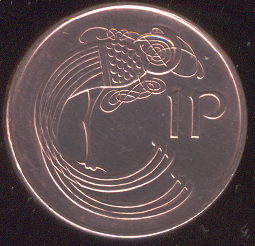
I used to be a full believer in the Eichengreen theory of euro irreversibility, which said that no nation could even discuss leaving the euro, because it would lead to the mother of all bank runs. But as I wrote in April,Krugman goes on to write that we’re not at “crisis-level yet. But the ghost of a possible ejection from the euro is starting to become visible.” This is apparently not an isolated opinion, as Germany’s finance minister Wolfgang Schaeuble has today noted, “It’s our common currency that’s at stake.” Only time will tell if such a thing might happen, but for Ireland, things are pretty bad. I guess, though, it would ring hollow for me to invoke the spirit of 1916 since The Irish Times has already beaten me to it, or even as a poet to say that Yeats would be rolling over in his grave or something — because this is a new situation, a unique point in history and time. But it sure appears that the chickens and the stylized Celtic birds which used to grace the old 1-pingin coins may finally be coming home to roost.
But now I’m reconsidering, for a simple reason: the Eichengreen argument is a reason not to plan on leaving the euro — but what if the bank runs and financial crisis happen anyway? In that case the marginal cost of leaving falls dramatically, and in fact the decision may effectively be taken out of policymakers’ hands.

Friday, November 19, 2010
Pharoah Sanders live!
 Caught the Pharoah Sanders show at the August Wilson Center last week (Nov. 13), and how really great it was. I was surprised firstly by how bop-focused it was. While my sense of Sanders is overwhelmingly tied to his late 60s and early 70s free-jazz work on Impulse! (and also from his intense free stuff with Coltrane in the mid-60s), his bop sensibility on the night was impeccable. I know this is not news to anyone who has followed his post-Impulse! career. That’s not my favorite period of his career, but this performance maybe made me rethink Sanders a little bit. Pharoah’s band, consisting of his touring pianist William Henderson along with the Pittsburgh rhythm section of Dwayne Dolphin (bass), Roger Humphries (drums) and George Jones (congas), held it down solid, and I suspect their own bop sensibilities at least fed into (if not drove) the vibe. I say this partly because, in the advance article in the City Paper, Pharoah suggested that he would go with the flow of his band: “We’ll just get together and start playing....I might just call a key: F-sharp minor, and that’s it. Everybody just blows. It’ll always be right.” So I initially expected the set to be freer, more spontaneous. Instead it was very directed and very much in the bop mode, and it only makes sense that Sanders would play to the band’s strengths.
I was surprised secondly also by how Coltrane-centric this set was (again, I probably shouldn’t have been, since Sanders has recorded late-period tributes to Coltrane). The band opened with a marathon version of “My Favorite Things” (at one point, I thought, incorporating the theme of Coltrane’s “Afro Blue,” which resembles it in a way) and finally closed, as an encore, with “Giant Steps.” Henderson’s piano-playing was often reminiscent of McCoy Tyner, utilizing his signature block chords throughout most of the evening. That said, there were also some quite original progressions on his part, Monk-like in their mathematicality, but in what I guess I should call even a Henderson-like mode. Broadly speaking, though, this was very Coltrane Quartet of the early 60s — bop structures but with free, exploratory solos.
 Pharoah himself was not quite as guttural or shrieking as in his earlier days. But the tone of his tenor is so uniquely his own, and that in itself was what was revelatory about the show, to hear it live, in front of you, rather than the ultra-intense bursts of energy contained on albums such as Tauhid, Jewels of Thought, Izipho Zam, Black Unity, or Village of the Pharoahs. Those bursts were still there in this set, however, from time to time. Pharoah would occasionally toss them out, or alternatively work up to a certain level, where, it seemed to me because he is so immensely talented and skilled, he can just let go and let the spirit move him (so to speak) to heights of beauty. Equally beautiful were those rare moments of squawk or overblown notes. Pharoah has always been so good at playing overblown notes that he can even play them melodically. At a couple of points in the set, also, he stopped blowing into his horn but continued to work the keys, allowing the air that was inside to be moved around by them, finally producing a quiet but unmistakable feedback-like sound. It was an inspired stroke, almost as if he was saying that he himself was but a vehicle for something else, the music, which is in the breath of life, existing on another level, actually outside of the person, occasionally allowing itself to be directed, though, and brought out into our world.
At age 70, Pharoah seemed to tire at times and would wander off-stage to take a break while the band did their thing(s). Well, who can fault him? But it was always a great moment of anticipation fulfilled when he’d walk back out, tenor at the ready, to renewed applause from the audience, and begin playing again. While the backing band was great, it was Pharoah we had all come to see. In the second half of the set, he once or twice stopped playing to dance around and dig his musicians, and the crowd would urge him on, some yelling, “Go Pharoah, go Pharoah!” And then he’d move back to his spot and blow some more. This was what it was like to hear and to see the greatest living tenor player. Perhaps Archie Shepp is a close second, but that accolade has to go to Pharoah Sanders now, and this show was proof.

Thursday, October 28, 2010
Begnal Poem at Dark Sky
 I have a poem titled “Dear _____,” online at the site of Dark Sky Magazine and Books. I really like this journal/publisher/blog and so am very pleased to appear there. Many thanks to them. And do go check it out, maybe leave a comment, etc.
Monday, October 25, 2010
David Stone, The Bloodhound Works
 I’ve written a lot about David Stone’s work already (see here, here, and here), but I just received his newest chapbook in the mail, and it is another great installment in the corpus of one of our most original poets. The Bloodhound Works (published by Propaganda Press/Alternating Current) is subtitled “Selected Poems 2009,” and marks Stone’s response the present economic upheaval the world seems to be undergoing. While his bio at the end of this 4¼ x 5½” pamphlet states that Stone “lives on some scraps from the financial crisis,” many of the poems themselves evoke it: “Bus passengers/ crashed in orbit./ Marauders and pirates/ scanned the premises of hell./ The bloodhound/ found the trail/ of body parts/ and blood/ in lit streets/ and open fields/ and demanded food/ on the diner/ parking lot” (“The Bloodhound’s Work”).
Thursday, October 07, 2010
“Dithyramb”
 A poem of mine titled “Dithyramb” now appears at Todd Swift’s online journal/blog site Eyewear. Read it here.
Thursday, September 23, 2010
Coltrane
 Today is John Coltrane’s birthday —
we mythologize and love our heroes
and propagate their images,
quantum leaps of evolution —
and propagate their images,
quantum leaps of evolution —
The best musicians, writers, artists for me are the ones who, either steadily over time but perhaps in radical bursts, change their style or approach, each work in part an attempt to surpass the previous. If you’re just going to be content to repeat the same old thing over and over, what’s the point.
For me, Coltrane exemplifies the artist who strives to surpass himself. It was no accident that one of his albums was titled Giant Steps. Call it arrogance, or call it the truth. In actuality, Coltrane from what I can tell was greatly humbled before the gift of his own talent, and felt it was his duty to explore it to the furthest extent possible. Sometimes that meant disappointing or exasperating fans, but for those who were willing or able to go along with him....
Coltrane, in this regard, has an analogue in Joyce — each of his works was a radical advance on what came before — each great in its own right, but compare the style of Dubliners to Finnegans Wake. Compare Blue Train to A Love Supreme to Live in Seattle — each great, but representative of the time and of the artist at a particular stage in his development. The only constant is change, and in that regard the art reflects life.
There are some who see staying the same as some kind of virtue, wanting to remain the same as long as possible, who therefore look to the past and wish to live in the past as a refuge. While I think there must always be some kind of core sense of who one is which is carried forward (and yes there are also great artists who do one thing all the time and do it really well, such as the Ramones or Charles Bukowski), the inability to evolve to me means a kind of death.
Death means things are fixed finally in time and that there are no more possibilities, no hope of the future. Coltrane is dead, but what he and his art represent — life and its concomitant change, the possibility of striking away what is stale and stultifying and taking up new and further explorations, the progression of the same artist only in a different form —
For me, Coltrane exemplifies the artist who strives to surpass himself. It was no accident that one of his albums was titled Giant Steps. Call it arrogance, or call it the truth. In actuality, Coltrane from what I can tell was greatly humbled before the gift of his own talent, and felt it was his duty to explore it to the furthest extent possible. Sometimes that meant disappointing or exasperating fans, but for those who were willing or able to go along with him....
Coltrane, in this regard, has an analogue in Joyce — each of his works was a radical advance on what came before — each great in its own right, but compare the style of Dubliners to Finnegans Wake. Compare Blue Train to A Love Supreme to Live in Seattle — each great, but representative of the time and of the artist at a particular stage in his development. The only constant is change, and in that regard the art reflects life.
There are some who see staying the same as some kind of virtue, wanting to remain the same as long as possible, who therefore look to the past and wish to live in the past as a refuge. While I think there must always be some kind of core sense of who one is which is carried forward (and yes there are also great artists who do one thing all the time and do it really well, such as the Ramones or Charles Bukowski), the inability to evolve to me means a kind of death.
Death means things are fixed finally in time and that there are no more possibilities, no hope of the future. Coltrane is dead, but what he and his art represent — life and its concomitant change, the possibility of striking away what is stale and stultifying and taking up new and further explorations, the progression of the same artist only in a different form —
Wednesday, September 01, 2010
2 Poems in Poets for Living Waters
 Poets for Living Waters, edited by Amy King and Heidi Lynn Staples, is “a poetry action in response to the BP oil disaster in the Gulf of Mexico begun on April 20, 2010, one of the most profound human-made ecological catastrophes in history.” Its site states that, beyond its current Web existence, a print anthology is also planned.
I am pleased to have two poems now online as part of this very worthwhile project. The poems are titled “Yellow Wave” and “The Black Gulf.” I was also asked to contribute a “Statement,” which came out as a third poem of sorts, a short, manifesto-like prose-poem perhaps.
It’s satisfying to note the high quality of the other work appearing on the site as well, most of which is cutting-edge, progressive, and veers away from the maudlin or hysterical hand-wringing that one might perhaps expect from lesser editors. Not that people shouldn’t be angry about the spill itself (they should), but what I mean is that there’s some really good, and often experimental, poetry here.
Subscribe to:
Posts (Atom)


 Posts
Posts