The tribute/festschrift for James Liddy, which I edited, was just reviewed by David Gardiner in The Irish Times (Saturday, 3 February 2007). Here is the piece:
A poet permeated by the Beat
David Gardiner
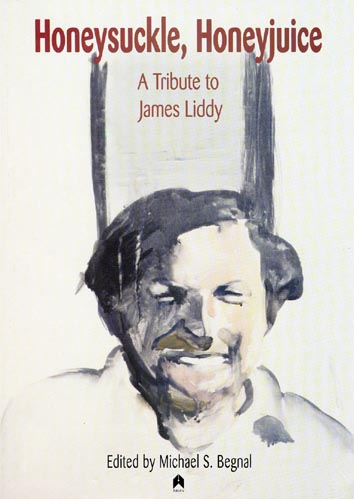
Michael S Begnal, Ed., Honeysuckle, Honeyjuice: A Tribute to James Liddy (Arlen House, 2006)
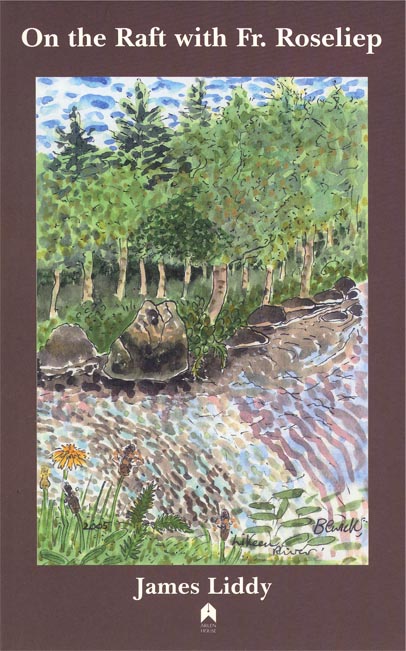
James Liddy, On the Raft with Fr Roseliep (Arlen House, 2006)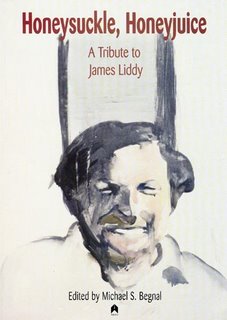
Being Irish-American has never really been particularly “cool”. Bob Dylan admits to learning a few things from Liam Clancy about protest songs, and there’s nothing particularly uncool about catching a Flogging Molly or Dropkick Murphys show. But between Bill O’Reilly and Pat Buchanan, the rebirth of cool does not seem to be around the corner.
And yet, being an exile to the US and a dissident voice there is both a truly complex and American stance. Extending back to the Jeremiads of the Transcendentalist writers through to the Beat generation, America can be a place to be (in the adapted words of an Irish poet who spent some time in Berkeley and Boston) lost,
happy, and at home.
Two recent works highlight the continuing achievement of James Liddy, an inheritor of generations of American writers who were watching their homeplaces and loved ones transformed and who remains an important continuing influence on a contemporary generation of writers.
Like his tireless efforts on behalf of his peers and younger writers, James Liddy’s work doesn’t pay much attention to what’s cool. He has paid attention to what’s important to poetry – to the life of the word. More than anything, this shows that his studies of, and travels with, the American Beat writers since his arrival in the US in the 1960s have permeated his very being.
James Liddy has remained one of the most prolific and active Irish writers since appearing on the scene with his 1962 publication,
Esau, My Kingdom For A Drink (Dolmen Press) and with the important, short-lived journal
Arena (1963-65), which he published with Michael Hartnett and Liam O’Connor. Since then, he has published more than 50 chapbooks, collections, and prose works, including his
Collected Poems (Creighton University Press, 1994) and the first volume of his autobiography,
The Doctor’s House (Salmon Publishing, 2004).
Parallels in the sheer volume of writing might be made between Liddy and George Moore, and they could continue – the exile and the autobiographer; the myth-maker of the houses inhabited, from the Doctor’s House to the Snake Pit to the Slovak Bowling Alley; both presenting themselves as one of the first of the “new Irish”; both documenting, as Liddy writes in
The Doctor’s House, a life “rotten with literature and art”. Recently, Liddy has stated that Moore gave to Ireland something that was hugely important to modern Irish writing: an imagination that was Catholic, European, and French. To Irish writing, as testified to in
Honeysuckle, Honeyjuice, James Liddy contributes an imagination – especially through his collaboration with the late Michael Hartnett – that is Catholic, libertine, and Beat.
The staying power of that imagination is one of the truly powerful literary achievements. When so many of the current generation lapse into a parody of self-promotion prior to their second MFA classroom award, Liddy has persevered in his writing, editing, and teaching career on his own terms across 60 hugely productive years. From the “hegemonic critical bent”, as a conferee might like to say, Liddy would seem to have it all – out in an Ireland that was repressively Catholic; flirtatiously Blueshirt in Dev’s Ireland; an outsider’s outsider from one side and a highbrow’s highbrow from another. Yet, there’s that “other side”. The side that actually likes that big, loud, dumb bully across the water; that writes sympathetically about, of all things, Slovak Bowling Alleys.
One of the chief strengths of the collection of tributes Michael S Begnal has gathered within
Honeysuckle, Honeyjuice is that the large collection of contributors does convey something of this Whitmanesque multitude. Among the most notable inclusions are Thomas Kinsella, Liam O’Connor, the late Michael Hartnett, Knute Skinner, Philip Casey, Terence Winch, Una O’Higgins O’Malley, Thomas McGonigle, Dermot Bolger, Cathal Ó Searcaigh, Eamonn Wall, Jim Chapson, Zack Pieper, Pearse Hutchinson, Micheál Ó Conghaile, Brian Arkins, and Dennis O’Driscoll. The sculptor John Behan concludes his appreciation, signed “Charles de Gaul airport . . . 3 May 2004”, by quoting Liddy’s poem Patrick Kavanagh’s Dublin, which could easily be claimed as an ars poetica:
We travel through Dublin’s wide streets bearing
white flowers to throw in bunches to our young friends
and sunrise halos from forgiveness to our unknowing lovers
where roof-high breezes out of a green still
on the fields pour along our hands which clumsily confess
the faithfulness too deep for anything but walking.
To remind us that the Dublin in which Liddy began writing was not entirely the bohemian paradise Liddy creates in his work, Begnal includes Flann O’Brien’s review of
Esau, My Kingdom for a Drink, which that great figure concluded “is all . . . illiterate schoolboy hysteria, brashness and, where any meaning can be discerned, a total ignorance by Mr Liddy of Joyce’s work and intent . . . Mr Liddy’s eructation can provoke nothing but derision and perhaps the hope that he is young enough to get a touch of the strap from the Brothers”.
Though giving no evidence of what Liddy got the touch of, Eamonn Wall provides a wide and generous context for the “New Irish” writing in the US in his contribution “From the El to Axel’s: Irish Poets Stateside”, in which he places Liddy’s work alongside Muldoon, Montague, Boland, Delanty, and Grennan. Wall comments eruditely that Liddy “is the poet of polkas, bowling alleys, bedrooms and bars who remains always the singer singing the song of the self. The urban America of his poetry . . . is as complex as Kavanagh’s Dublin and Pope’s London. Often, he is out of tune with Irish America and very much in tune with Serbian, Bohemian, Czech, and Polish America”. A previously unpublished letter from Charles Bukowski concludes: “we’re not going to cause any literary revolution, but we hope to say a few things that haven’t, for some reason, been said and to print the good clear strong poem – the poem that drinks beer and smokes cigars and laughs – sometimes. all right. but we have to reject almost everything and people get discouraged. we do too.”
Throughout the collection, Begnal generously selects unpublished works of James Liddy’s, including Her Disposition, which is simply one of his most remarkable poems, in which he imagines his mother, pregnant with him and near WB Yeats at a cocktail party (and which concludes in box, below left). Only John Montague, perhaps well aware of too-early epitaphs, uses the word “encomia” properly in
Honeysuckle, Honeyjuice, for it really is a tribute to a career in continuing stride rather than finishing sprint.
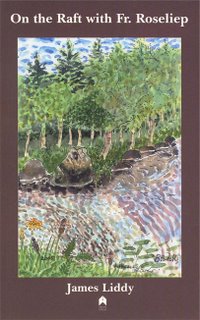
THIS CONTINUING PRESENCE is most evident in the new collection, also published by Arlen House, and, rather fittingly, featuring a painting by the early Dolmen artist Pauline Bewick.
On the Raft with Fr Roseliep invokes the memory of Raymond Roseliep, another American-Irish writer transplanted to the Midwest – particularly Loras College in Dubuque, Iowa, which Liddy refers to brilliantly in his note as the “Little Rome of the Midwest”. As a frequent contributor to
Threshold and
The Dubliner as well as an extensive correspondent with Christy Brown, Fr Roseliep joins James Liddy’s sizable menagerie of poet-saints, for both his work and what he represents. As with many of Liddy’s recent collections in both prose and poetry,
On the Raft is both a poetics and a lives of the poets at a time when, as Liddy writes in one poem, “The Writing Programs/ have won, to write is only to teach to get paid, Muses kick/ America in the ass”.
On the Raft opens with Let’s Invade Ourselves Not Iraq, a poem that starts off with the exchange: “Professor, are you thinking of retirement?/ I haven’t fully explored the drinking age yet”. Liddy is expert at inserting voices in his poems and at subtlety in general – and that oxymoronic structural statement lies at the centre of why his poetry is sometimes under-appreciated. In this poem for instance, Liddy combines the epigrammatic gesture and the combined art forms of conversation and gossip: “Autobiography whispers in Cleopatra’s ear noble unencumbered woman/ what would happen if we weren’t failures?” Throughout a tightly structured movement stanzas rotate twice through consideration of self to others to societal considerations until concluding: “I lay agenbite of inwit beside the glass. / Mars, have mercy, direct wars within”.
AS IN LIDDY’S other collections and memoirs, this work is filled with casual mention and allusion. A fragmentary list of those who appear would include Willie Redmond, Charles Bukowski, Patrick Kavanagh, Michael Hartnett, Kay Boyle, Robert Duncan, Bob Watt, Whitman, Pound, Eliot, Graham Mackintosh and Joe Dunn (both White Rabbit Press), Jack Spicer, John Ryan, George Stanley, Baudelaire, John Ashbery, Edward Carson, Oscar Wilde, John Kerry, and, of course, Pope Benedict XV. In one of his best breathless recitations, On Cooking & Jack Spicer, Liddy writes out a litany of the White Rabbit Press (San Francisco) that is an invocation and a catalogue, ending: “These are the lives of the poets. Transparencies. When we dead white rabbits arise we will cook up literature again”. Samuel Beckett wrote in
Dublin Magazine in 1934 that “all poetry, as discriminated from the various paradigms of prosody, is prayer”. Going a step further, Liddy repeatedly presses prayer into the service of poetry – his secular invocations, litanies, loves, and devotions ride upon that beatific line.
On the Raft with Fr Roseliep opens with an epigraph from Jack White. In a collection filled with allusiveness – to Fr Roseliep himself, to the Beats who fly throughout his work like so many saints on a Byzantine frieze, to the fellow-poets of Liddy’s many cities on either side of the Atlantic – it makes sense that there’s another name at the start, as it begins:
‘This album is dedicated to, and is for and about the death of the sweetheart. In a social plane, impossible to exist, and in memories, past defeating present. We mourn the sweetheart’s loss . . . ’
The note of melancholy began for Liddy with his very first work, found its first brilliant articulation in one of his most important works, Baudelaire’s Bar Flowers (White Rabbit, 1975), and continues here. This persistent melancholy, though, is that of a true and puckish lover and is discovered only by – in good readerly Beat fashion – taking the poet at his word and entering into his world, searching out this Jack White, or (if you’re one of his many students, or the current generation of writers), you may already know that Jack White is not one of Liddy’s universe of writers but the lead guitarist and writer of the band The White Stripes, whose liner notes from the album Elephant (2003) continue:
We mourn the sweetheart’s loss in a disgusting world of opportunistic lottery-ticket holders caring about nothing that is long term, only the cheap thrill, the kick, the for-the-moment pleasure, the easy way out, the bragging rights and trophy holding.
A new generation should continue to know Liddy’s work so as to know that we have not lost the sweetheart – though the cry must continue from
Arena through to
Elephant and beyond.
David Gardiner is associate professor of English, and director and editor of Creighton University Press and An Sionnach, publishers of The Collected Poems of James Liddy.








 Posts